Most great cathedrals dominate their surroundings. They were built to do exactly that — to rise above the city, to terminate vistas, to make the surrounding architecture feel provisional by comparison. The Almudena Cathedral in Madrid does something almost unprecedented for a building of its ambition: it defers.
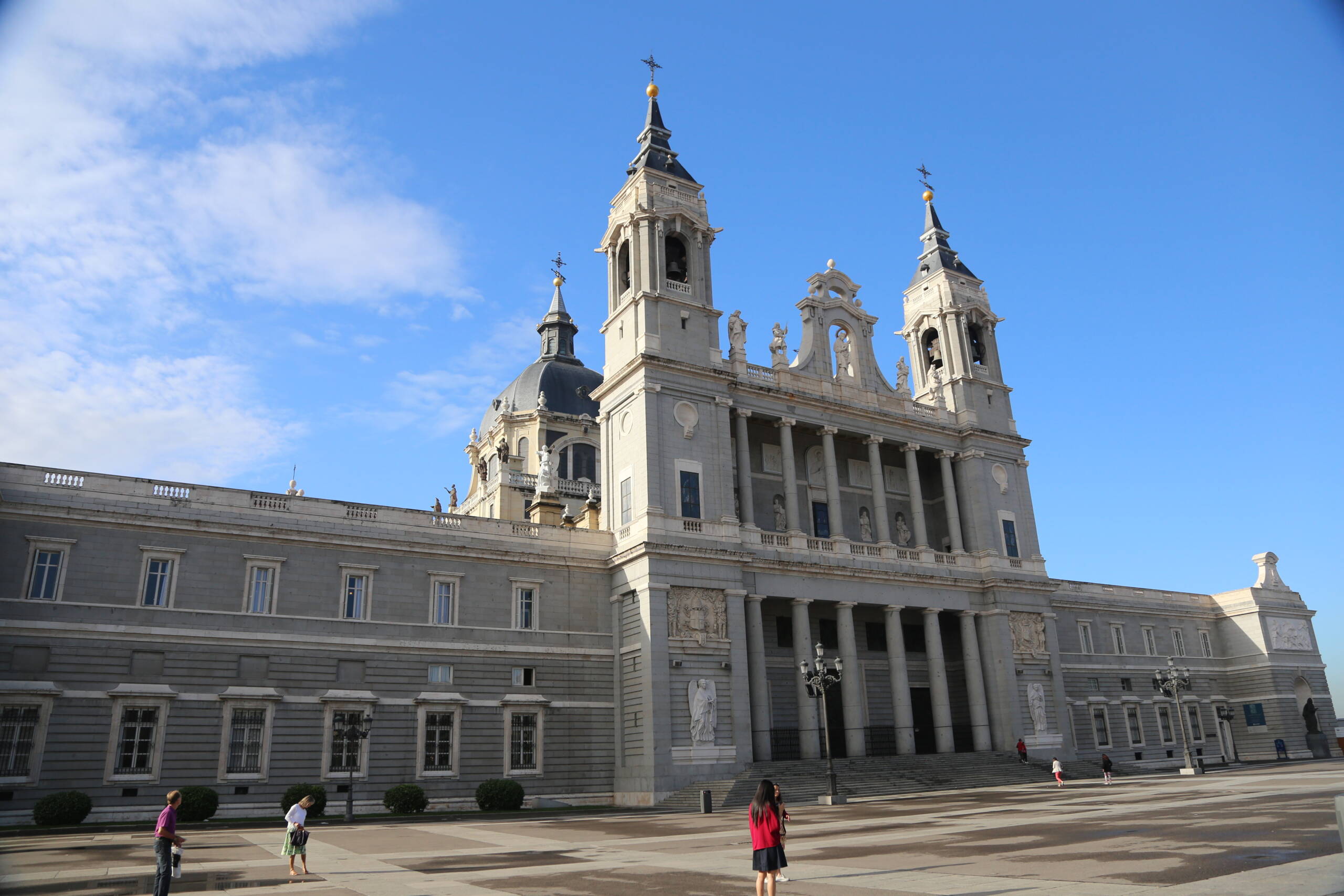
Stand in the Plaza de la Armería and the dynamic is immediately legible. To your right, the Royal Palace — long, horizontal, Baroque, built to project the authority of the Spanish crown across an entire continent. Directly ahead, the cathedral’s neoclassical facade. The two buildings face each other across the open plaza, and the cathedral, despite its twin towers and carved stone frontispiece, clearly blinks first. The scale is restrained. The stone is lighter. The silhouette is tidier. The whole composition reads as the supporting act.
This was not an accident. It was the brief.
A Cathedral Designed to Lose
When construction on the Almudena resumed in earnest in the mid-twentieth century, the architects were working with a problem that no medieval cathedral builder had ever faced: how to design a major church directly adjacent to an already-completed secular masterpiece that could not be moved, modified, or outshone. The Royal Palace of Madrid had stood since the 1760s. It occupied its site with complete authority. Any cathedral rising next to it would be judged, immediately and permanently, against that facade.
The solution chosen by architect Fernando Chueca Goitia, who oversaw the exterior’s completion, was to match rather than compete. The Almudena’s facade adopts the same neoclassical vocabulary as the palace — columns, pilasters, restrained ornament, horizontal emphasis — and stays within a comparable height envelope. The effect is coordination, not confrontation. From a distance, the two buildings read as a single composition bracketing the open plaza, which itself functions as a kind of urban stage.
What this means in practice is that the Almudena’s exterior is genuinely unusual among European cathedrals. It does not announce itself. The twin towers are modest by the standards of the form — nothing like the soaring Gothic spires of Cologne or Burgos, nothing like the assertive Baroque campaniles of Rome. The central facade, with its columned portico and sculpted tympanum, is handsome and precisely detailed, but calibrated to read as civic rather than celestial.
The contrast with the Almudena’s interior is the point. Outside, deference. Inside — as the polychrome vaulted ceilings and Gothic arches make immediately clear — the building finally permits itself a voice. The restraint of the facade turns out to be preparation rather than character. Visitors who approach the Almudena expecting a cathedral that announces its greatness from the street leave either disappointed or surprised, depending entirely on whether they went in.
The plaza between the two buildings amplifies this. It is one of the more underused grand urban spaces in central Madrid — vast, open, wind-swept on cold days, quiet except for scattered tourists doing the obligatory photograph between palace and cathedral. That emptiness is not a failure of planning. It is the space that makes the relationship between the two buildings legible. Without it, you would lose the dialogue. With it, you can stand at the centre of the plaza, look left at the palace and right at the cathedral, and understand exactly what the architects were trying to say: these two institutions, state and church, are equals — or at least are being asked to perform equality, even if the palace got there first and set the terms.