You come in off the piazza, where the light bounces off pale stone and water and hits you from every angle, and for the first thirty seconds inside St Mark’s you can barely see anything at all. The basilica is dark. Then your pupils widen and the ceiling arrives — not all at once, but in patches, a gilded arch here, a haloed figure there, until the whole upper half of the building resolves into gold.
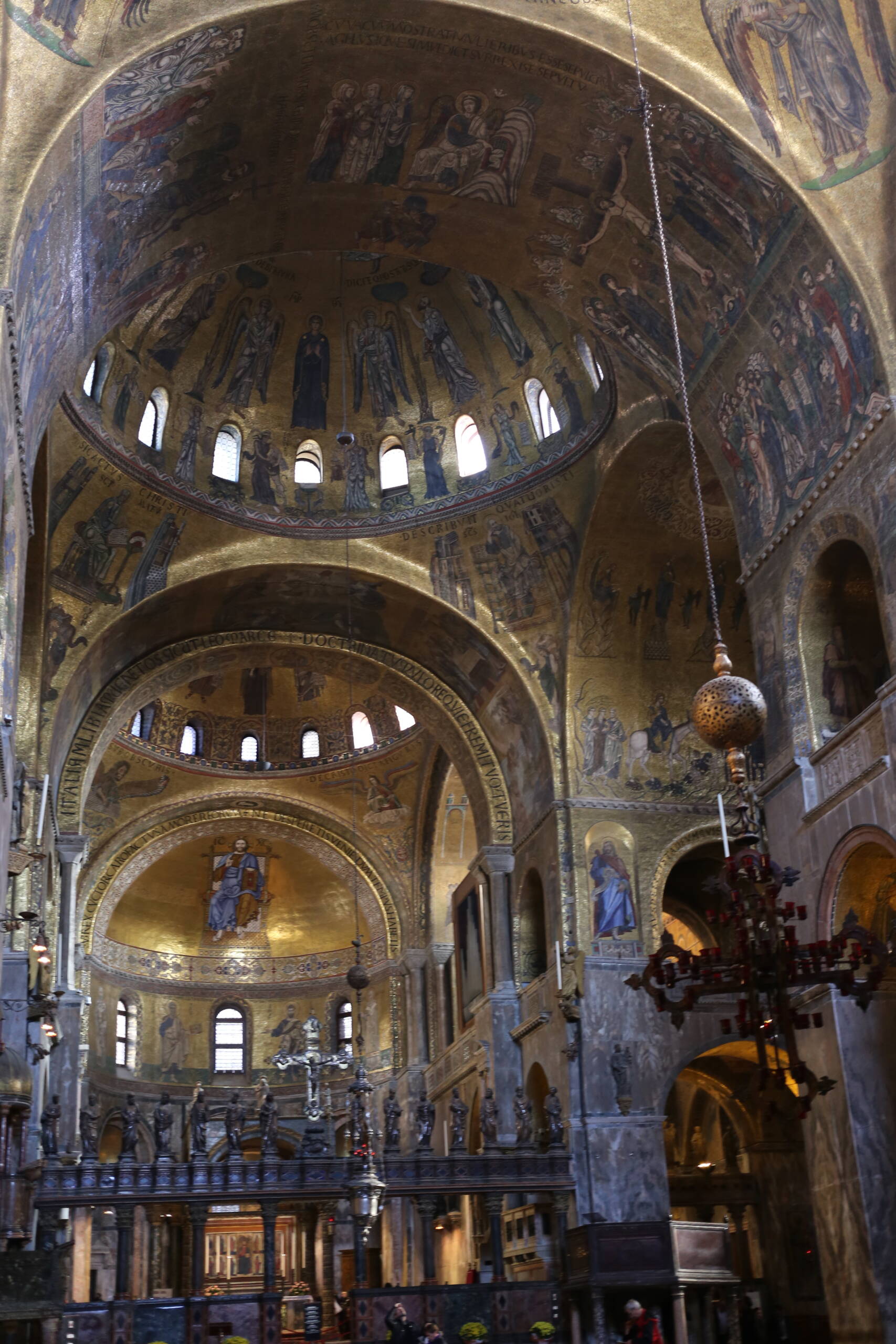
That delay is the single most important thing to know about visiting. Photographs of the interior are almost always made under floodlights or with long exposures, and they promise a blaze that the building does not deliver on an ordinary Tuesday afternoon. What it delivers instead is something better, if you give it time: a slow, uneven glow that shifts as you walk.
Why the gold behaves the way it does
The mosaic surface covers more than eight thousand square metres of dome, vault and upper wall, and almost none of it is flat. The tesserae are set at slightly varied angles, so each cube of glass throws light back in a marginally different direction. Move two paces and a saint’s robe changes colour. Stand still and the figures seem to breathe as clouds pass over the windows in the drums of the domes. This is the reason the building earned the nickname Chiesa d’Oro, and it is also the reason the interior can look flat and brownish in a bad light.
The structure underneath is a Greek cross with five domes, modelled on the Church of the Holy Apostles in Constantinople and consecrated in 1094. That eastern lineage is not decorative borrowing. Venice looked east because Venice traded east, and for most of its history this building was not the city’s cathedral at all — it was the doge’s private chapel, attached to the palace next door. The cathedral was San Pietro di Castello, out on the eastern edge of the city. St Mark’s only took the title in 1807, after the republic was already gone.
Knowing that changes how the interior reads. This is not a bishop’s church. It is a state treasury with an altar in it, and much of what glitters was brought here by force. The relics of the evangelist arrived from Alexandria in the ninth century, smuggled, the story goes, under a layer of pork to deter Muslim inspectors. The porphyry, the columns, the marble revetment and the four bronze horses on the loggia came out of Constantinople after the Fourth Crusade sacked it in 1204. The building is a manifest of what Venice took.
The light is the whole visit
On weekdays the floodlights are switched on for roughly an hour around midday — usually 11:30 to 12:30 — and the difference is not subtle. The vaults go from smouldering to molten. The problem is that everybody knows this, and the illumination window collides almost exactly with the arrival of the tour groups and the day-trip crowds, so the best hour for the mosaics is the worst hour for actually standing under them.
There are two honest ways out. Book the earliest slot, around 9:30, accept the dimmer building, and have the nave nearly to yourself for the first half hour — the pavement and the lower marbles reward this far more than the domes do. Or book one of the evening lit visits, which run in short slots after regular closing and include the crypt. Under the evening lights, in a group of a dozen rather than three hundred, the basilica is a different building entirely.
What to look at once your eyes adjust
Most visitors track the domes and miss the middle distance. Look at the marble rood screen across the front of the chancel, carved in 1394 by Jacobello and Pier Paolo Dalle Masegne: a row of dark stone figures — the Virgin, St Mark, the twelve apostles — standing shoulder to shoulder along the architrave beneath a tall cross, silhouetted against the gold behind them. It is the one place in the building where sculpture and mosaic fight for the same sightline, and the sculpture wins.
Then look down. The twelfth-century floor is more than two thousand square metres of marble and coloured stone laid in geometric panels and animal figures, and centuries of subsidence have given it a gentle roll underfoot, like a deck. Behind the high altar, the Pala d’Oro — a Byzantine gold altarpiece studded with close to two thousand gems and set with enamels accumulated over four centuries — needs a separate supplement, and it is the one add-on genuinely worth the money.
Practical notes
- Tickets must be booked online in advance. The on-site ticket office closed in July 2025, and basic basilica entry runs around €10, with supplements for the Pala d’Oro and for the Museum and Horses Loggia.
- Opening is roughly 9:30 to 17:15 Monday to Saturday, with last entry about half an hour before close. On Sundays and feast days tourist visits do not begin until 14:00; before that, only the Museum and Loggia are open.
- Entry for worship at mass is free, through the side door on the Piazzetta dei Leoncini, but that is a service rather than a sightseeing slot and should be treated as one.
- Shoulders and knees covered. Large bags are refused at the door and have to be left at the deposit round the corner on Calle San Basso, which costs time you may not have budgeted.
- In autumn and winter, acqua alta regularly floods the narthex. Raised walkways go in, the queue moves anyway, and the reflections in the entrance are worth the wet feet.
Allow an hour, not the twenty minutes the controlled one-way route encourages. The building is not difficult to see. It is difficult to look at.