The queue is not for the house. Nobody comes for the house. They come for a courtyard about the size of a generous parking space, a stone balcony bolted to one wall, and a bronze girl standing under a fig tree with one breast polished to a mirror shine.
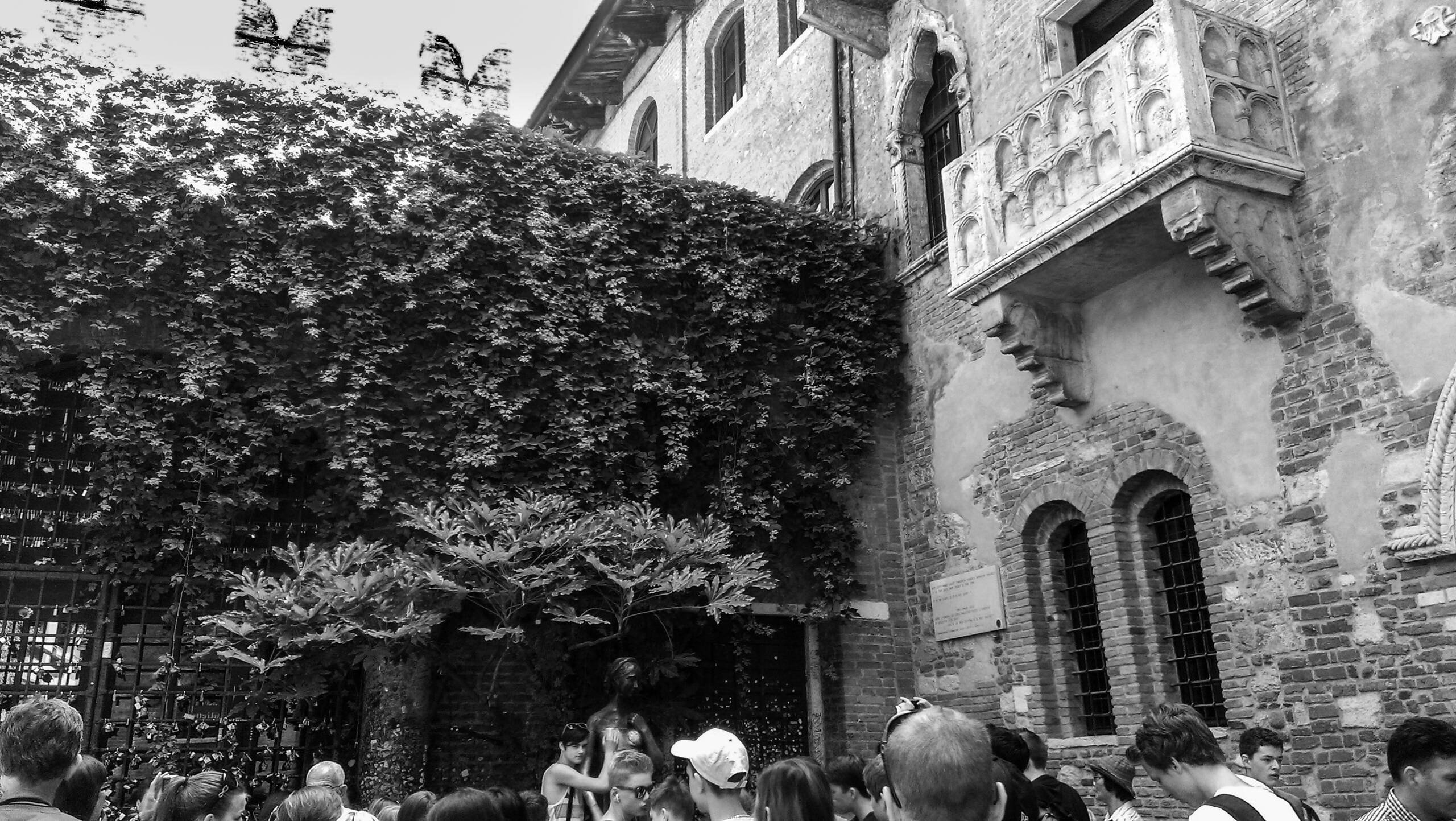
I went in July, late morning, which was a mistake and also the only honest way to see the place. Verona at that hour is a flat white glare. The courtyard was shoulder to shoulder. Above everyone’s heads a guide was explaining, in three languages, a love story that never happened, in a building where it definitely never happened, from a balcony that was not there when it did not happen.
The balcony is about as old as sliced bread
Here is the sequence. The city bought the old house on Via Cappello in the early 1900s. It was a run-down property with a courtyard, and it had belonged centuries earlier to a family called dal Cappello. Cappello, Cappelletti, Capulet. That is the entire evidentiary chain. Somebody noticed the names rhymed and Verona ran with it.
Then, in the 1930s, the man in charge of the civic museums decided the story needed a stage. A balcony was assembled out of a piece of old carved marble and fixed to the wall at exactly the height a photograph wants it. It has been there ever since, looking convincingly medieval, weathering nicely, absorbing several million upward glances a year.
Shakespeare, for his part, never went to Italy. Not that anyone can show. He set two plays in Verona and got the geography wrong in one of them.
The statue you are touching is not the statue
The bronze Juliet went up in the late 1960s. Tradition, invented on the spot and then enforced by every guidebook since, says you rub her right breast for luck in love. Enough people did it that the metal wore thin and the original developed a crack. The city quietly moved her indoors about a decade ago and put a copy in the courtyard. So the thing in the photographs, the thing under everyone’s hand, is a replica of a fake tradition attached to a fictional character who never lived in the house she is standing in.
Everyone knows this. Nobody stops queueing. Watch a group figure it out in real time, shrug, and get in line anyway. That reaction is the most interesting thing in the courtyard.
The gum wall and the letters
The short passage from the street used to be one of Europe’s more disgusting monuments. Layers of chewing gum, thousands of sticky notes, initials in marker, initials scratched into the plaster underneath. The city eventually got tired of scraping and brought in fines and cleaning crews. Now there are boards to stick your note on, which is tidier and much less fun. The padlocks migrated to the gate.
The letters are the part I would actually defend. People send mail to Juliet, addressed to Verona, no street needed, and a volunteer club answers them. Real replies, written by hand, in a stack of languages, thousands a year. Grief, crushes, divorces, teenagers. Somebody reads all of it. There is a whole soppy film about this and the film undersells it.
How to do it without hating it
The courtyard is free. You walk in off Via Cappello and there you are. The house itself is a ticketed museum, mostly period furniture and Romeo and Juliet ephemera, and the ticket is what lets you stand on the balcony and wave down at strangers, which is either the whole point or beneath you, depending on your mood that day.
Go at opening or in the last hour. The difference is enormous. In the quiet the courtyard turns back into what it actually is, a nice old Gothic house with good brickwork and a wall of ivy, and you can look at the arched windows and the carved stone brackets without a hundred phones in the frame.
Then walk two minutes to the Arena, which is genuinely two thousand years old and somehow has a shorter line.
Verona built a shrine to a girl who never existed and it works. Go anyway.