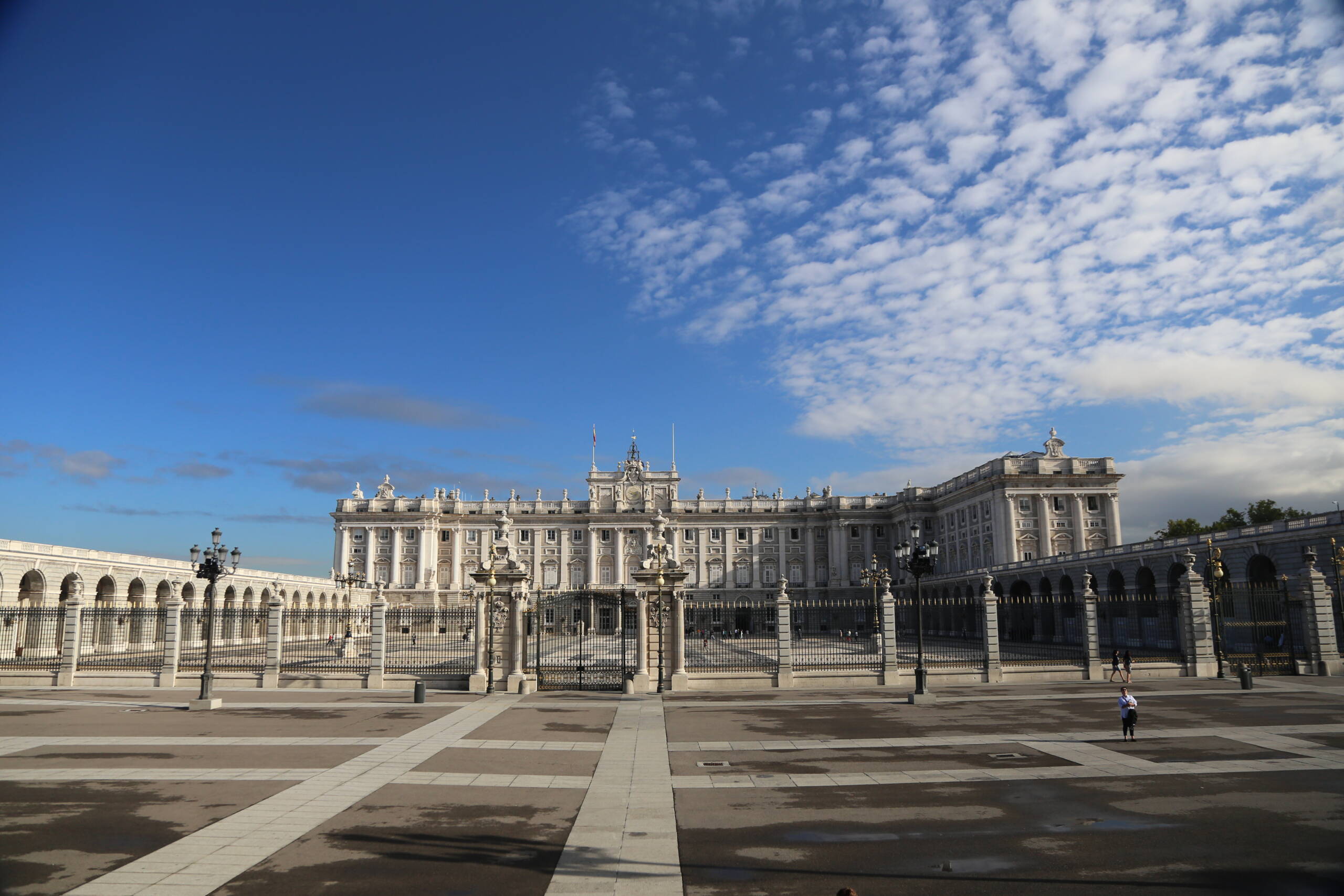
The Plaza de la Armería gives you the full measure of the Palacio Real before you’ve even reached the gates. The forecourt is enormous — deliberately so — and the palace fills the far end of it in a long, unbroken horizontal of white limestone and grey granite. No Gothic spires, no theatrical domes. Just mass, proportion, and relentless symmetry. On a clear morning with the Madrid sky doing what it does best, the whole ensemble reads almost too perfectly, like a rendering of a palace rather than the thing itself.
The ironwork gates along the perimeter are ornate in the way Bourbon architecture tends to be: controlled excess, decorative but never chaotic. Beyond them, the facade stretches across more than 135 metres, its windows marching in strict rhythm across three storeys, interrupted at the centre by sculptural groupings and a clock tower that signals the main entrance without shouting about it. The arcaded wings curving forward on either side complete the courtyard, drawing visitors into a space that manages to feel both exposed and enclosed.
Few visitors linger long in the plaza. They photograph, tick the box, and move inside. Worth resisting that impulse. The exterior, seen from a distance and then up close, tells a different story at each scale.
The Royal Palace of Madrid and the Fire That Built It
The Palacio Real stands on ground that has held a royal residence since the ninth century, when Muhammad I of Córdoba ordered a small fortress built to defend Toledo from attack from the north. That structure — a modest watchtower by later standards — was the seed from which everything else eventually grew.
The Moors held it until 1083, when Alfonso VI of Castile took Madrid during the broader southward push of the Reconquista. The site passed to the Castilian crown, and over the following centuries the fortress was gradually expanded and adapted. By the sixteenth century, when Philip II made Madrid the permanent capital of the Spanish empire in 1561, the old Alcázar of Madrid had become a substantial royal residence — irregular, medieval in character, layered with additions from successive reigns.
It burned to the ground on Christmas Eve, 1734.
The fire started in the royal apartments and burned for four days. A significant portion of the royal art collection was lost, though many works — including paintings by Velázquez, Rubens, and Titian — were saved by being thrown from windows into the snow below. Philip V, the first Bourbon king of Spain and a man deeply shaped by his upbringing at Versailles, saw in the disaster not a tragedy but an opportunity. He ordered a new palace built in stone — entirely in stone, specifically so that it could never burn again — and on a scale that would leave no doubt about the ambitions of the Spanish crown.
The commission went first to the Italian architect Filippo Juvara, who died before construction began. His pupil Giovanni Battista Sacchetti took over and revised the plans, moderating Juvara’s more extravagant original scheme while retaining its Baroque grandeur. Work began in 1738. Philip V did not live to see it finished; the palace was completed under Charles III, who moved in in 1764.
The result is the largest royal palace in Western Europe by floor area — over 135,000 square metres, with 3,418 rooms. It was built to impress, and the numbers bear that out. The state rooms inside are accordingly lavish: ceiling frescoes by Giaquinto, Tiepolo, and Mengs; the Gasparini Room with its silk walls and intricate floor; the Royal Armoury, one of the finest collections of its kind in the world.
Spain’s royal family has not lived here since the early twentieth century. Alfonso XIII was the last monarch to use it as a primary residence before going into exile in 1931. The palace is now used for official state ceremonies — Felipe VI maintains his working residence at the smaller Palacio de la Zarzuela on the outskirts of the city — but it remains crown property and is open to the public outside of official functions.
The guided tour covers a selection of the state rooms and is worthwhile, though the palace is large enough that the unticketed walk around the exterior and through the adjacent Sabatini Gardens and Campo del Moro park can fill a morning on its own. Come early. By mid-morning the plaza is crowded, and the light on the stone facade is better before the sun is fully overhead.