Few museum buildings commit to a metaphor as literally as La Cité du Vin. Perched on the banks of the Garonne River in Bordeaux, the structure twists and swells like wine swirling in a glass, its facade of glass panels and gold-toned aluminum ribbons catching light in a way that shifts with every angle and every hour of the day.
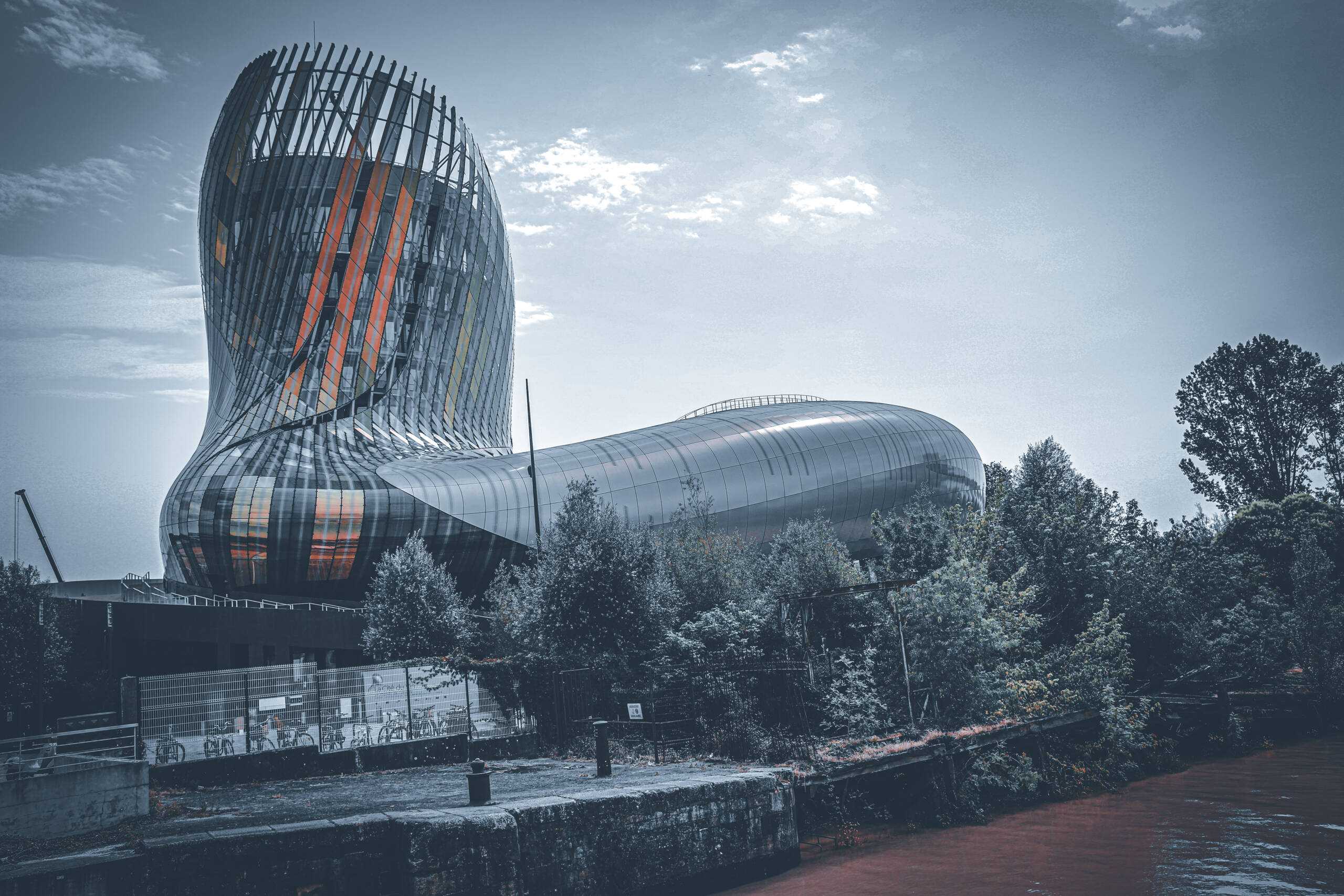
Designed by the Bordeaux-based architecture firm XTU, in collaboration with Casson Mann for the interior scenography, the building opened in 2016 as a €81 million cultural centerpiece for a city whose identity is inseparable from wine. The design team drew on the fluid, organic forms of the river itself and the swirl of liquid in a glass, rejecting anything resembling a traditional museum box.
Structurally, the building relies on over 2,500 curved glass and lacquered panels, no two exactly alike, wrapped around a steel skeleton that gives the exterior its rippling, almost fabric-like movement. The golden vertical fins climbing the tower section evoke the twisted stem of a wine glass, while the wider, silvery body below suggests the bowl.
Inside, the museum takes a sensory and cultural approach rather than a purely technical one, walking visitors through the history, geography, and mythology of wine across civilizations, before delivering them to a panoramic tasting room at the top, Le 7, with a glass of wine included in the ticket and sweeping views over the Bordeaux rooftops and the river below.
La Cité du Vin has become one of the defining images of contemporary Bordeaux, a city otherwise known for its 18th-century limestone facades, proof that a wine capital can build a landmark as bold and unconventional as the beverage it celebrates.