Madrid does not lack for grandeur, but the Almudena Cathedral earns a second look that most visitors don’t give it. From the Plaza de la Armería it reads as sober neoclassical — fine, formal, slightly cold. Step inside and the calculus changes entirely.
The nave stretches toward a great pipe organ at the far end, its silver ranks rising like a cliff face above the choir screen. Gothic Revival arches vault overhead in white stone, clean and precise, colonnades doubling on either side in a rhythm that pulls the eye forward. So far, so expected. What stops you is the ceiling.
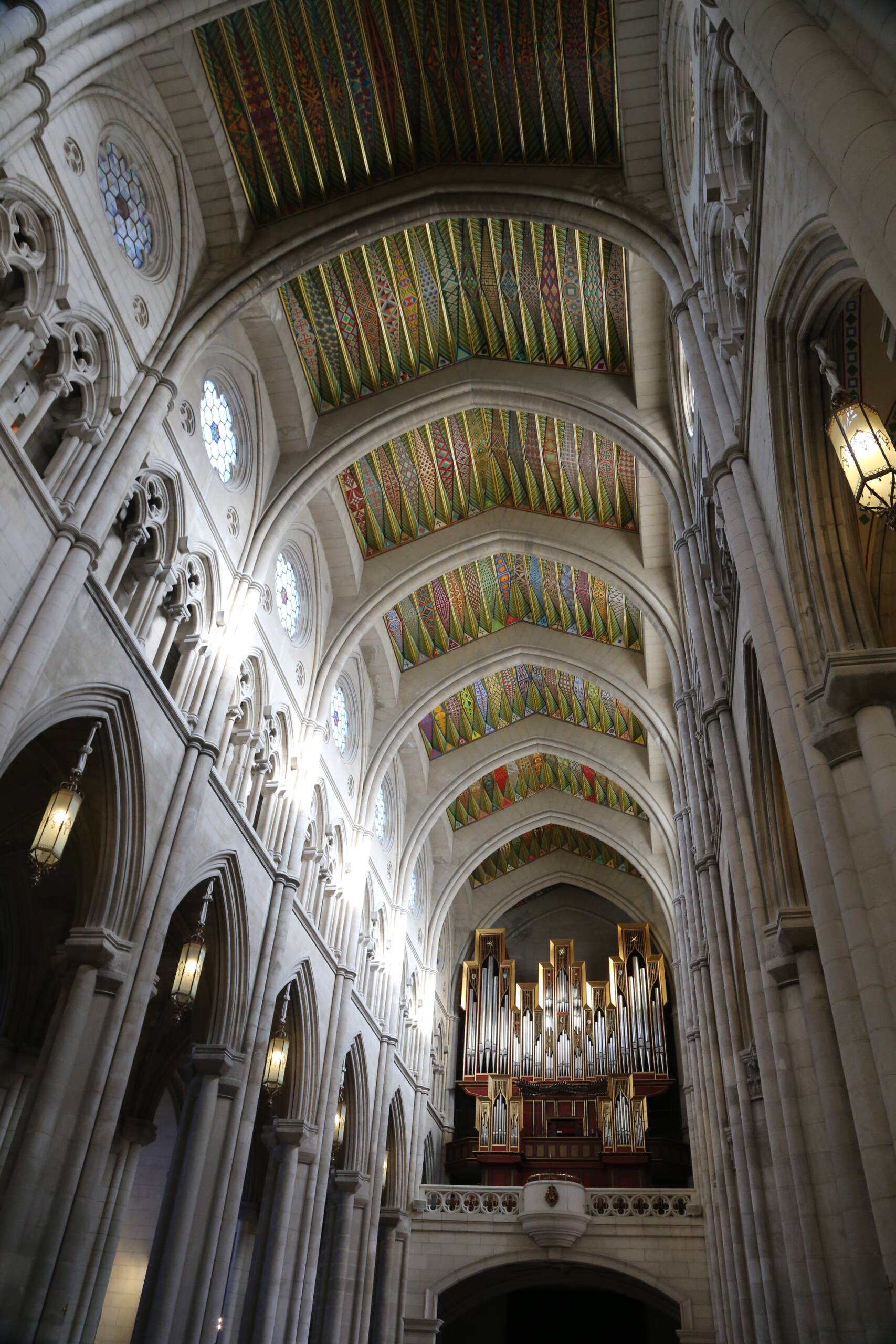
Between the ribs of each vault, the panels are painted — not with the standard heavenly blues and gold of Spanish ecclesiastical tradition, but with a dense, almost textile geometry: diamond patterns, interlocking lozenges, botanical motifs in greens, reds, golds, and ochres. The effect reads more Central Asian than Iberian. The result is a space that feels simultaneously ancient and invented, as if a medieval builder had dreamed of something that didn’t yet exist.
The Almudena was consecrated only in 1993, after more than a century of stop-start construction. That long gestation explains the eclecticism: neoclassical shell, neo-Gothic interior, and ceiling decoration conceived in the late twentieth century with a chromatic confidence that older cathedrals rarely permit themselves. Whether this is coherent or merely eclectic is a reasonable debate. In person, it works.
Rose windows punctuate the upper gallery, backlit on bright days to a pale luminescence. The hanging lanterns along the aisles cast a warmer counterpoint below. The scale is immense but the atmosphere stays legible — you are never lost in it the way you can feel lost in a true Gothic pile where the stone has had centuries to accumulate shadows.
Come mid-morning on a weekday, before tour groups arrive in force. Walk the full length of the nave twice: once looking forward at the organ, once looking up. The ceiling repays the crick in your neck.
Almudena Cathedral is located on Calle de Bailén, adjacent to the Royal Palace. Entry to the nave is free. A small museum occupying the crypt level charges a modest admission and is worth the extra twenty minutes.
Almudena: Madrid’s Cathedral and the Long Road to Its Completion
The Almudena Cathedral sits in an almost theatrical position across from the Royal Palace of Madrid, and that placement alone hints at its unusual story. Unlike most great European cathedrals that rose in the Middle Ages, Almudena is a relatively recent creation—finished only in the late 20th century—yet its roots stretch much deeper, into layers of conquest, devotion, and long-delayed ambition.
The name “Almudena” itself reaches back to the era of Muslim rule in Spain. Derived from the Arabic word al-mudayna, meaning “citadel” or “fortified place,” it refers to a legend tied to the Christian reconquest of Madrid in the 11th century. According to tradition, when King Alfonso VI reclaimed the city in 1083, a hidden statue of the Virgin Mary was discovered inside the city walls—preserved there for centuries. This figure became known as the Virgin of Almudena and eventually the patron saint of Madrid. That story, half history and half myth, gave the future cathedral its identity long before any stones were laid.
Despite Madrid becoming the capital of Spain in the 16th century under Philip II of Spain, the city lacked a cathedral for centuries. It’s a bit surprising, honestly—most major European capitals had grand ecclesiastical centers much earlier. The reason was partly political and partly ecclesiastical: Madrid fell under the powerful Archdiocese of Toledo, and there wasn’t an immediate push to establish a separate cathedral.
The idea finally gained traction in the 19th century. In 1868, Queen Maria de las Mercedes of Orleans expressed a desire to build a cathedral dedicated to the Virgin of Almudena, though her early death delayed momentum. Construction officially began in 1883, initiated by King Alfonso XII, who wanted the cathedral to serve as a memorial to his late wife. The project started in a neo-Gothic style, reflecting the architectural tastes of the time and the desire to evoke continuity with Europe’s medieval cathedrals.
But progress was anything but smooth. Financial constraints, political instability, and shifting architectural visions slowed construction repeatedly. Over decades, the design evolved dramatically. By the mid-20th century, architects reconsidered the cathedral’s appearance so that it would harmonize with the adjacent Royal Palace. The result is a striking exterior in a neoclassical style—clean, restrained, and aligned with the palace’s grandeur—while the interior retains a more modern, almost unexpectedly vibrant interpretation of Gothic forms.
The interruptions were not minor pauses but long stretches where the project simply stalled. The Spanish Civil War (1936–1939) halted construction entirely, leaving the structure incomplete and vulnerable. When work resumed afterward, Spain itself had changed, and so did the cathedral’s direction, reflecting a different era’s aesthetics and priorities.
It wasn’t until 1993 that the cathedral was finally completed and consecrated—over a century after construction began. Its consecration by Pope John Paul II marked a historic moment, as it was the first time a pope had consecrated a cathedral in Spain. That detail, a bit overlooked sometimes, underscores how unusual Almudena’s timeline really is.
Today, Almudena Cathedral stands as a blend of eras rather than a pure expression of one. Its crypt, one of the oldest completed parts, features a Romanesque revival style, while the upper church combines Gothic inspiration with modern artistic elements. The dome, visible across Madrid, ties the composition together, bridging the visual language of past and present.
There’s something slightly paradoxical about it—an ancient devotion housed in a modern structure, a cathedral that feels historic but is, in many ways, contemporary. Maybe that’s exactly what makes Almudena compelling. It doesn’t just represent Madrid’s past; it reflects the city’s long, uneven journey into becoming the capital it is today.