Madrid is one of Europe’s great literary cities, and nowhere is that identity more literally cast in bronze than at Plaza de España, where Miguel de Cervantes gazes down from his stone pedestal at the two characters who made him immortal — Don Quixote, lance in hand astride his horse Rocinante, and the rotund, steadfast Sancho Panza at his side.
The monument, completed in 1960, is the spiritual heart of Madrid’s literary geography. But for the book-minded traveler, it’s less a destination than a starting point.
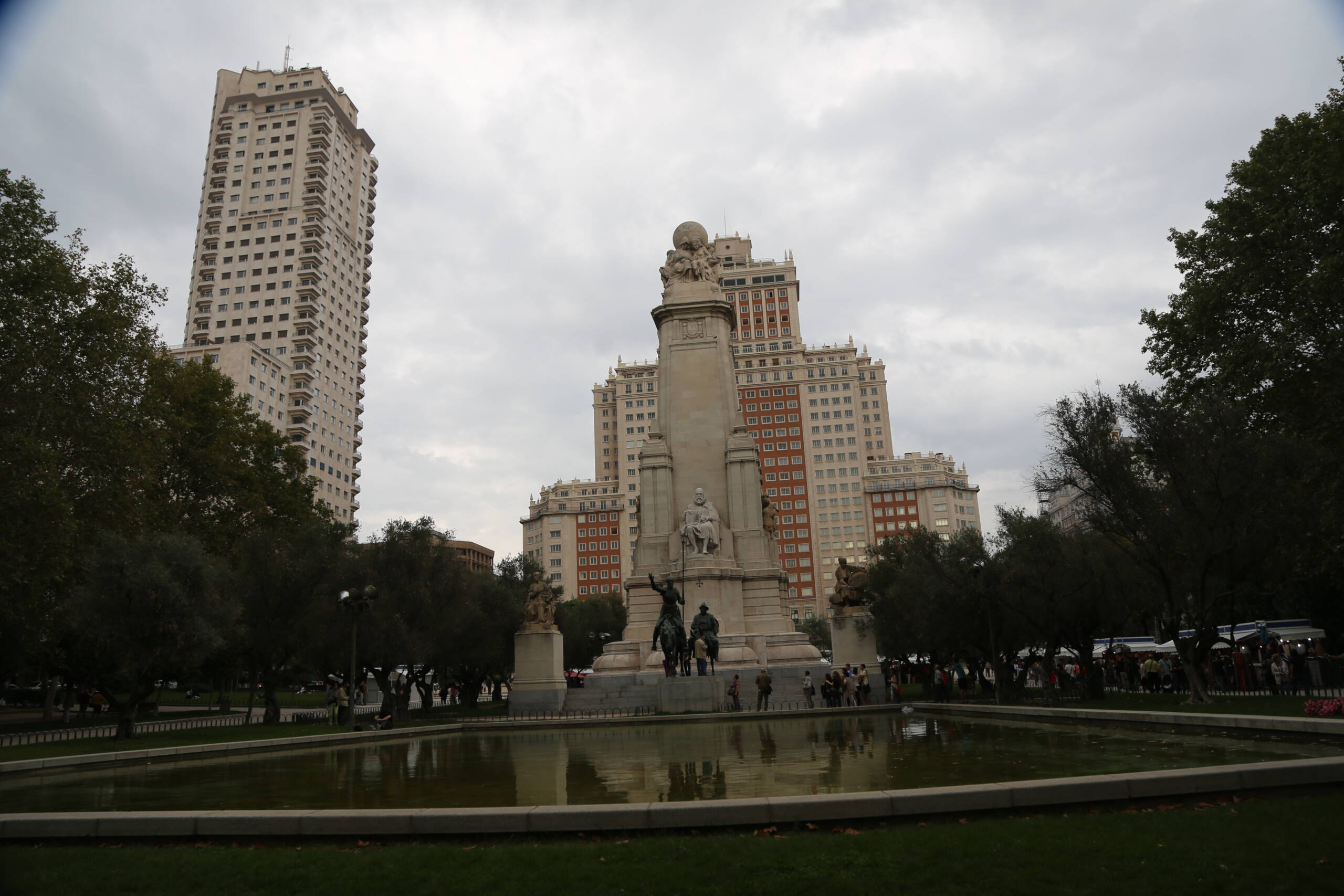
The Monument Itself
Most visitors photograph the bronze duo and move on. Slow down instead. The full composition rewards attention: Cervantes sits above the knights errant in scholarly repose, while allegorical figures representing poetry and history flank the column’s base. The reflecting pool in front frames the whole scene against the backdrop of the Edificio España — a mid-century tower that now houses a Riu hotel — creating one of Madrid’s most photographed vistas. Come on an overcast day and the mood turns genuinely Quixotic: melancholy, grand, slightly out of time.
The Literary Barrio: Las Letras
From Plaza de España, the serious literary tourist heads east toward the Barrio de las Letras — the Letters Quarter — centered on Calle de las Huertas. This was Madrid’s Golden Age literary neighborhood, where Cervantes, Lope de Vega, Quevedo, and Góngora all lived within blocks of each other, and occasionally feuded with magnificent bitterness. Quotations from their works are inlaid in the cobblestones underfoot.
The Casa de Lope de Vega on Calle de Cervantes (yes, the irony is intentional — Cervantes actually lived on what is now Calle de Lope de Vega) is a beautifully preserved 17th-century house-museum where the prolific playwright lived for the last 25 years of his life. It’s one of Madrid’s most underrated museums and almost never crowded.
The Cervantes Trail
Cervantes died in Madrid in 1616 — the same year as Shakespeare, a coincidence that has fueled centuries of literary romanticism — and was buried at the Convento de las Trinitarias on Calle de Lope de Vega. His remains, lost for centuries, were rediscovered there in 2015. The convent still functions as an active monastery and is not open to the public, but a commemorative plaque marks the exterior, and the quiet street itself feels like a pilgrimage site.
The Biblioteca Nacional de España, near the Paseo de Recoletos, holds one of the world’s great collections of early printed books, including rare editions of Don Quixote. Its attached museum runs rotating exhibitions and is free to enter.
Practical Notes for the Literary Traveler
- The Cervantes monument at Plaza de España is always accessible and best photographed in soft morning or overcast light — harsh midday sun flattens the bronze figures.
- Casa de Lope de Vega is closed Mondays; guided tours run in Spanish and English.
- The Barrio de las Letras is walkable from both the Antón Martín and Sol metro stops.
- Late April brings the Madrid Book Fair’s warm-up season, and April 23 — Cervantes Day — is celebrated citywide with readings, events, and free museum entry at select venues.
Madrid rewards the traveler who arrives with a book in hand. And if that book happens to be Don Quixote — even just the first few chapters — the city will feel like it was built to illustrate it.