The trade press has already reduced tiny tourism to a number of nights. Average trip length is falling, one-night hotel stays are up, and the easy conclusion is that people are just taking shorter holidays because money is tight. That is a real pattern and it is a different pattern. Tiny tourism is about the size of the place and the size of the ambition, not the size of the calendar entry.
The idea is simple enough to state in a sentence. Go somewhere that is not primarily in the business of being visited, and spend your time doing what the people who live there do on an ordinary Tuesday.
That means no famous view to queue for. No pre-booked timed entry. No street where every ground floor is a souvenir shop. You buy bread where the bread is, you sit in a bar where nobody switches to English, and you leave without a photograph that proves anything to anyone.
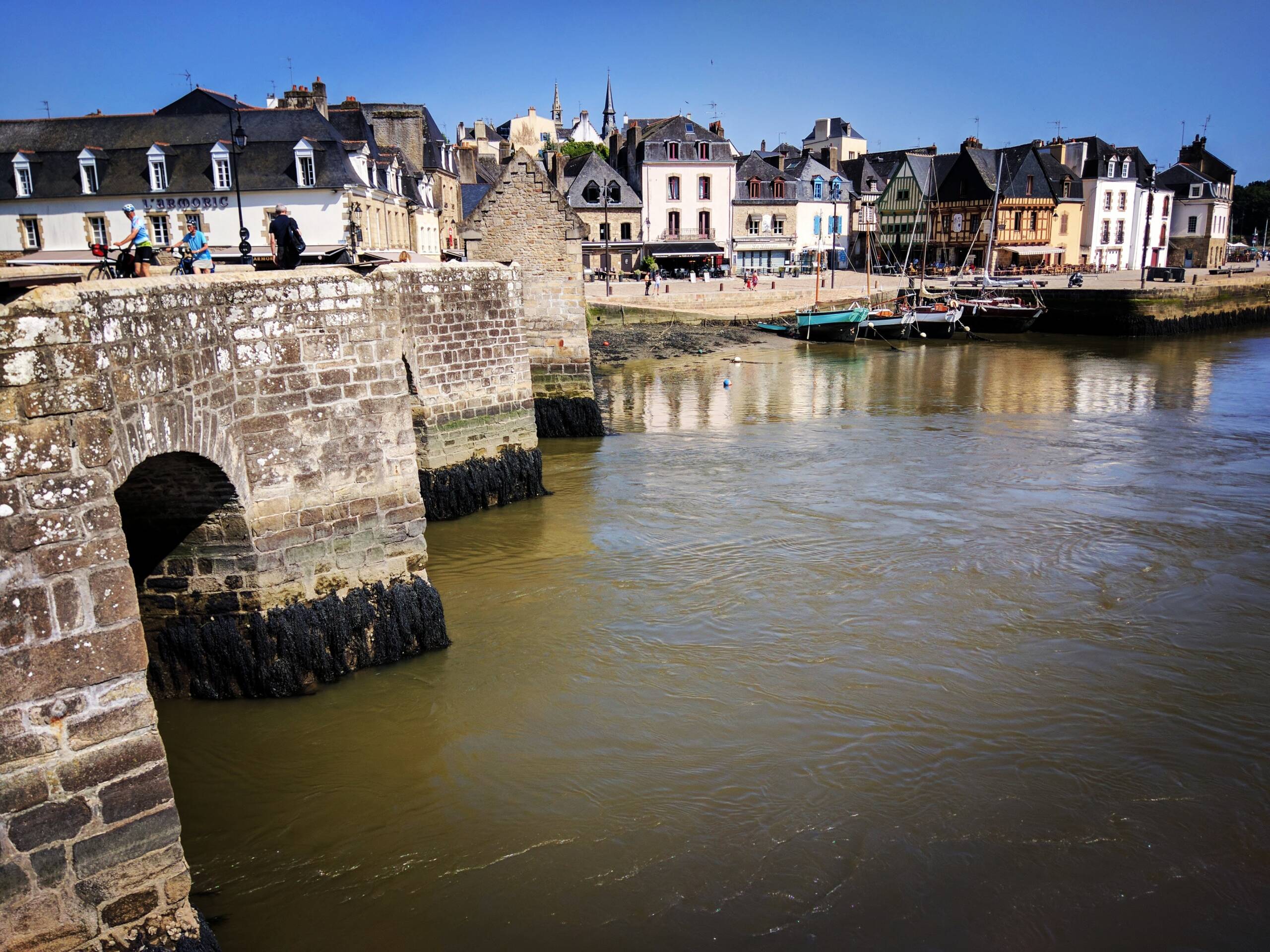
Saint-Goustan: The Old Port Quarter Hiding Under Auray’s Stone Bridge
Why this is arriving now
Partly because the famous places have stopped being pleasant, and increasingly they say so out loud. Towns that went viral on TikTok have capped coach numbers and physically screened off the view that caused the problem. Otaru in Japan put security guards on the street to manage tourists taking photographs. Barcelona, Venice, Amsterdam and Kyoto have all spent the last few years building policy around keeping people out rather than pulling them in. When a destination’s own marketing has turned defensive, the experience on the ground is already gone.
Partly because the alternative got easier to reach. The short-haul network that grew across Europe over the last two years mostly connects second and third cities to each other, not capitals to capitals. Regional rail did the rest. The obscure town is now a two-hour problem instead of a full-day problem.
And partly because the peak has moved anyway. Occupancy in Barcelona, Istanbul, London, Paris and Rome now tops out in shoulder season rather than August. People are already voting with their dates. Voting with the destination is the same instinct carried one step further.
Priceline caught an early version of this in the American market and called it townsizing, which it framed as travellers seeking simplicity in small towns. The framing was slightly off. What people are chasing is not simplicity. It is a place where the visitor economy is not the main economy, so the thing you are looking at is somebody’s actual life rather than a performance of it.
What living local actually requires
It requires giving up the itinerary, which is harder than it sounds.
The habits that make a small place worth visiting are boring to describe and quite specific. Rent a flat in a residential street rather than a hotel in whatever passes for the centre. Go to the market on the day the market happens, which is a Wednesday more often than a Sunday. Use the same café twice, because the second visit is where anything interesting occurs. Find out what the town does with its evenings, which in most of provincial Europe means a football pitch, a church hall or a promenade at seven o’clock, and go along.
The corollary is that you cannot do this in three towns in a week. This is where tiny tourism runs directly into the other trend in the data: two thirds of travellers now say they want to hit multiple destinations inside a single trip. Those two impulses cannot both be satisfied. Multi-stop travel is the old collecting behaviour wearing new clothes, and it produces exactly the shallow pass through a place that tiny tourism exists to avoid. Pick one.
Language is the other honest obstacle. Living local in a town with no tourist infrastructure means transacting in the local language or accepting that you will be slightly lost for a week. Plenty of people find that fine. Plenty of people find out on day two that they wanted the performance after all.
Places that fit
The test is whether tourism is a rounding error in the local economy. Not undiscovered, which is a fantasy, but unbothered.
In Italy, Mantua and Ferrara both hold Renaissance city centres with a fraction of the foot traffic of Florence, and both function as normal working towns on a weekday morning. Genoa is a large city that Italy’s own tourist economy has mostly skipped, which shows in the prices. Trieste reads as Vienna washed up on the Adriatic and belongs to its residents.
In France, Nancy has one of the finest squares in Europe and almost no international visitors standing in it. Metz and Besançon are similar propositions.
In Spain, León and Zamora are Castilian cities with cathedrals, tapas culture and a domestic-only visitor base. In Portugal, look inland to Viseu or Guarda rather than anywhere on the coast.
In central Europe, Olomouc in Czechia is the standard answer and still the right one. Kaunas, Timisoara and Szczecin all sit in the same category, cities of a few hundred thousand people with universities, tram networks and no reason to care that you came.
The American version is less about towns and more about mid-size cities that the coasts have written off. Duluth, Tulsa, Youngstown and Bethlehem all have a downtown, a food scene that exists for locals, and hotel rates set by business travel rather than by leisure demand.
What operators should take from it
Very little of this is sellable in the usual way, which is the interesting part.
A destination that markets itself as authentic stops being it, and the towns on any list of authentic places have roughly a five-year clock running from the moment the list is published. The operators who benefit are the ones already there and not built for tourism: the apartment let by the family that owns the building, the restaurant with one menu and no translation, the regional rail operator that suddenly has weekend load on a line built for commuters.
For DMOs in small places, the useful move is unglamorous. Make it possible to book a bed and find out what is on. Do not build an attraction.
The town that stays worth visiting is the one that never quite works out why people came.