Taormina does not ease you in. The town announces itself from a distance — a stone shelf jutting from the eastern flank of the Peloritani mountains, suspended between sky and sea at roughly 200 meters above the Ionian coast. Before you have walked a single street, before you have tasted anything or heard the dialect, you already understand why the Greeks built here in the fourth century BC and why the Grand Tour aristocrats of the nineteenth century never quite left. The place operates on visual authority alone.
Sicily’s most celebrated hill town is neither the largest nor the most historically layered of the island’s settlements. What it has — and has in a quantity that resists rational accounting — is position. The bay below it curves in a near-perfect arc toward Giardini Naxos, the Calabrian coastline shimmers across the strait on clear mornings, and Etna presides over the inland horizon with the casual menace of something that has been erupting since before human memory. Taormina sits at the junction of all of this and charges accordingly.
The View Before the Town
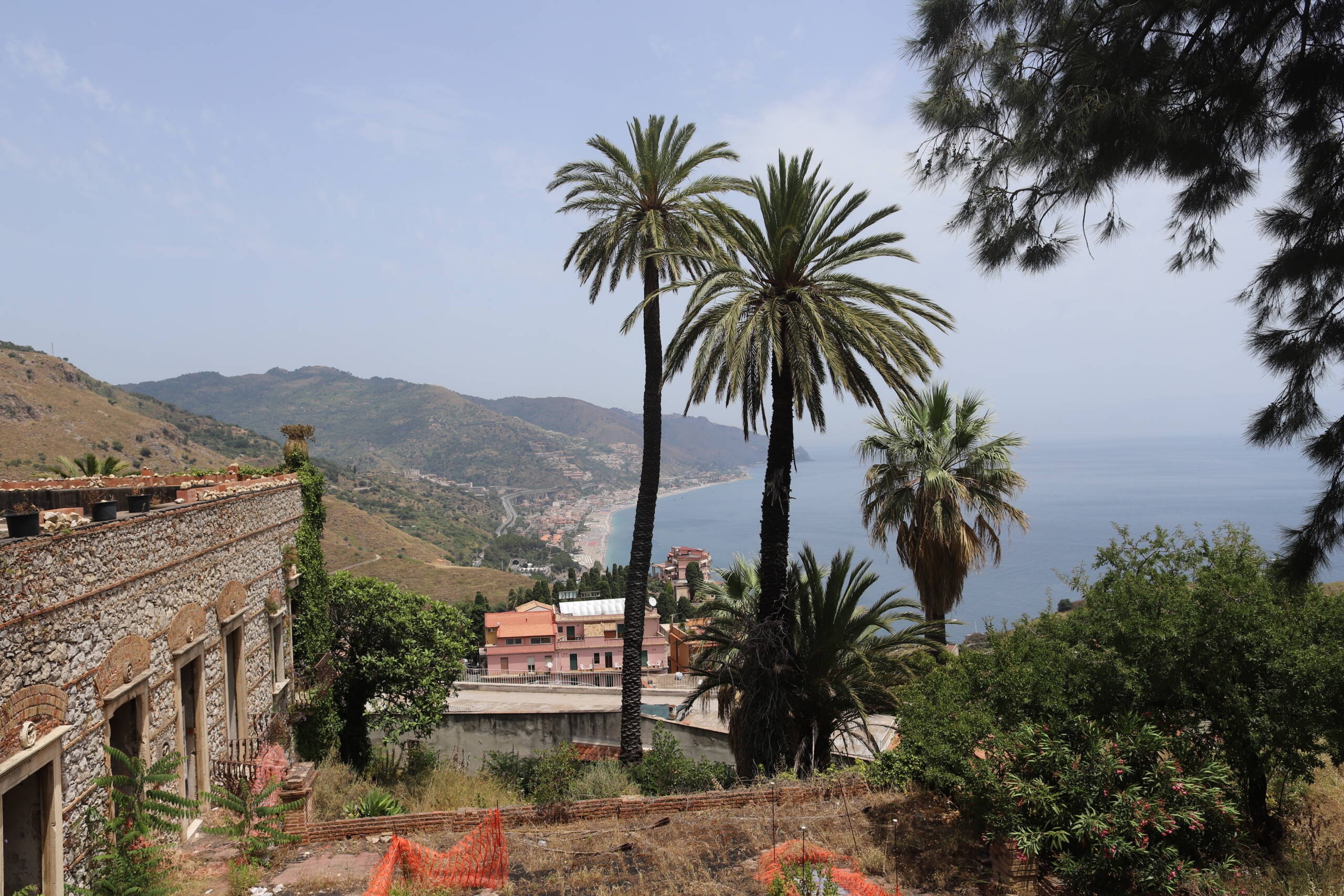
The first thing a visitor encounters, often before reaching the Porta Messina or descending into the Corso, is a view that does not belong to the town proper but to the terrain around it. From the higher approach roads and from vantage points near the ruins that fringe the upper districts, the Ionian unfolds in a shade of blue that photographs cannot reproduce faithfully — a slightly mineral, slightly hazy blue, thickened by summer heat and distance.
In the foreground of that view: overgrown rubble, orange construction netting, the skeletal remains of what was once a decorated stone building with arched window frames now open to the air. A pair of tall date palms rise from the terraced gardens like survivors. The Mediterranean hillside vegetation — prickly pear, bougainvillea, oleander — fills the spaces that formal planting abandoned years ago. It is not a postcard composition. It is something more instructive: evidence that Taormina, for all its glamour, contains neglected edges and unresolved histories pressed up against the beauty. The view past the decay is still magnificent. The juxtaposition is part of what makes it honest.
Here’s the section, ready to drop in before or after “What Taormina Actually Is”:
The White Lotus Effect
In late 2022, HBO’s second season of The White Lotus arrived and handed Taormina a problem it was not entirely unprepared for: the problem of becoming, in the global imagination, a set. The season was filmed primarily at the San Domenico Palace, a fourteenth-century Dominican convent converted into a Four Seasons property that occupies the northeastern edge of the historic center with the quiet confidence of a building that has survived multiple regimes and does not find television particularly threatening. The production used Taormina’s streets, its coastline, its terraces, and its Teatro Greco as backdrops, and the audience of several million who watched the season absorbed those images in the specific way that prestige television trains its audiences to absorb locations — as destinations, as aspirations, as places where something happened to people they found compelling.
The results were measurable. Searches for Taormina as a travel destination spiked in the months following the season’s release. The San Domenico Palace, already among the most recognized hotels in Sicily, acquired a new layer of cultural currency that its marketing team did not need to manufacture. Tour operators began offering White Lotus itineraries. The phrase appeared in property listings, restaurant descriptions, and travel magazine headlines with the reliable frequency of a tag that still converts. Taormina, which had been famous since the nineteenth century and did not require HBO’s assistance to fill its hotels in July, accepted the attention with the composure of a place that has been discovered many times and expects to be discovered again.
What the series captured — whether intentionally as location scouting or incidentally as the logic of visual production — was accurate. The San Domenico’s cliff-edge pool, the layered stone of the hillside streets, the quality of Mediterranean light at golden hour over the bay: all of it reads on screen the way it reads in person, which is to say, slightly unreal, slightly too composed, slightly too beautiful for the kind of human behavior that was being dramatized within it. That tension — between the setting’s perfection and the corruption it contains — is what the show was about, and Taormina furnished it without irony.
The more durable consequence is not the tourism spike, which will moderate, but the town’s entry into a specific cultural shorthand. To say White Lotus now is to invoke a particular register of wealth, aesthetics, dysfunction, and Mediterranean backdrop that Taormina has come to represent for an audience that may never visit but holds the image firmly. Whether this is an asset or a reduction depends on what Taormina was to you before the show aired. For the town itself, it is simply the latest iteration of a very old pattern: someone arrives, finds the place irresistible, records it, and sends the recording out into the world. The place remains.
Corso Umberto I
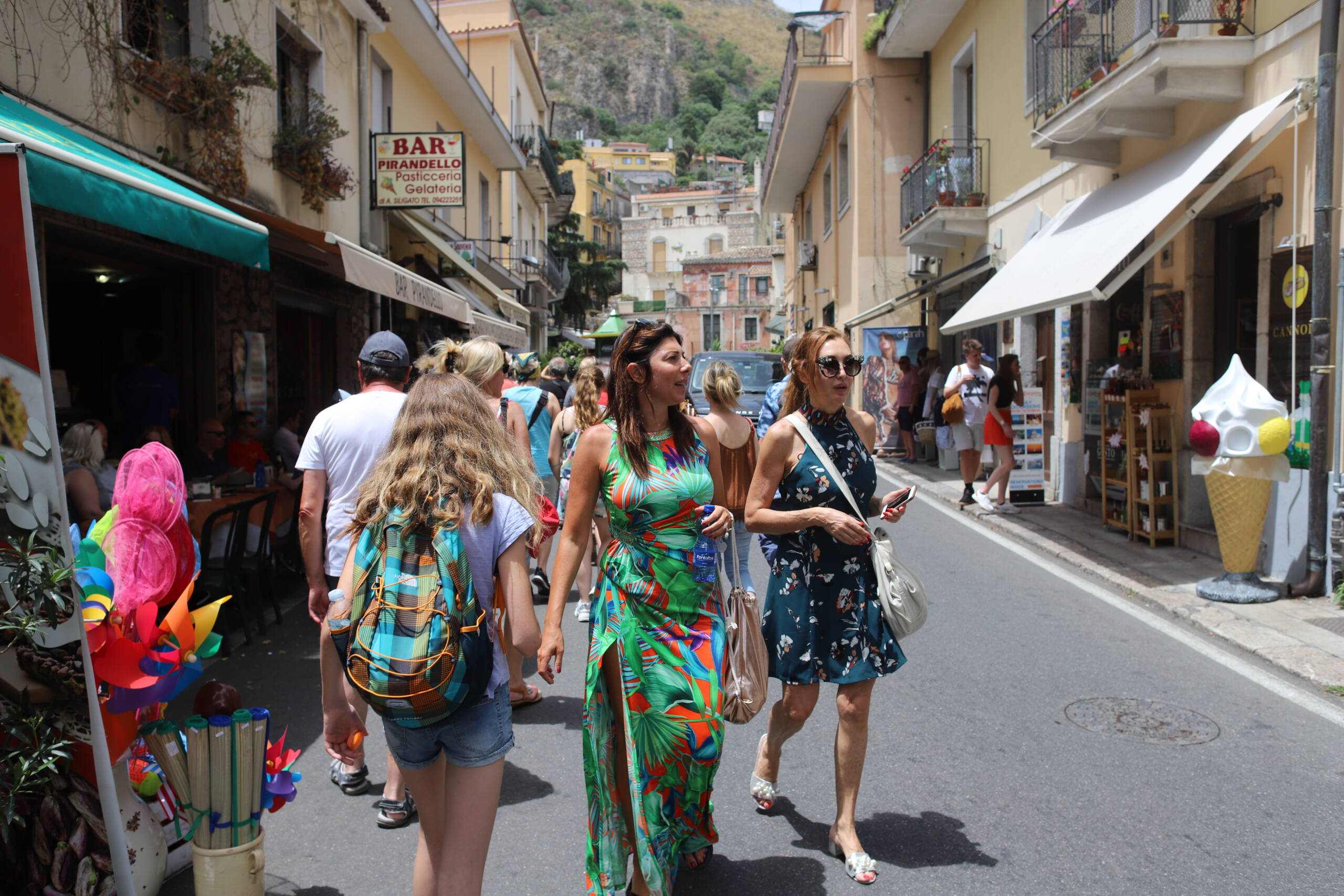
The town’s central artery runs roughly northeast to southwest through the historic center, a pedestrian corridor of approximately 400 meters lined with cafés, pasticcerias, gelaterias, boutiques, and the occasional church facade. In summer, which is the only season most visitors know, the Corso operates at a density that makes efficient movement impossible and unnecessary. Nobody is in a hurry. Nobody can be.
Bar Pirandello — named, with the Sicilian habit of local pride, after the Nobel-winning playwright born in Agrigento — is one of several establishments that anchor the social rhythm of the street. The sign is modest. The foot traffic is not. By late morning, the Corso has reached the kind of saturation that belongs to a place accustomed to tourism as its primary industry: summer dresses, backpacks, cameras, gelato cones, the sound of Italian competing with German, English, and various Scandinavian languages. A woman in a floor-length tropical print dress moves with the confidence of someone who has dressed for exactly this street. A white oversized ice cream cone sculpture stands outside a shop, doing what it is supposed to do.
The Corso is often described as charming, which is accurate but incomplete. It is also competitive, commercially sharp, and aware of its own attractiveness in a way that slightly cool hill towns tend to be. The charm is real. So is the calculation behind the presentation. Neither diminishes the experience of being there.
The Infiorata
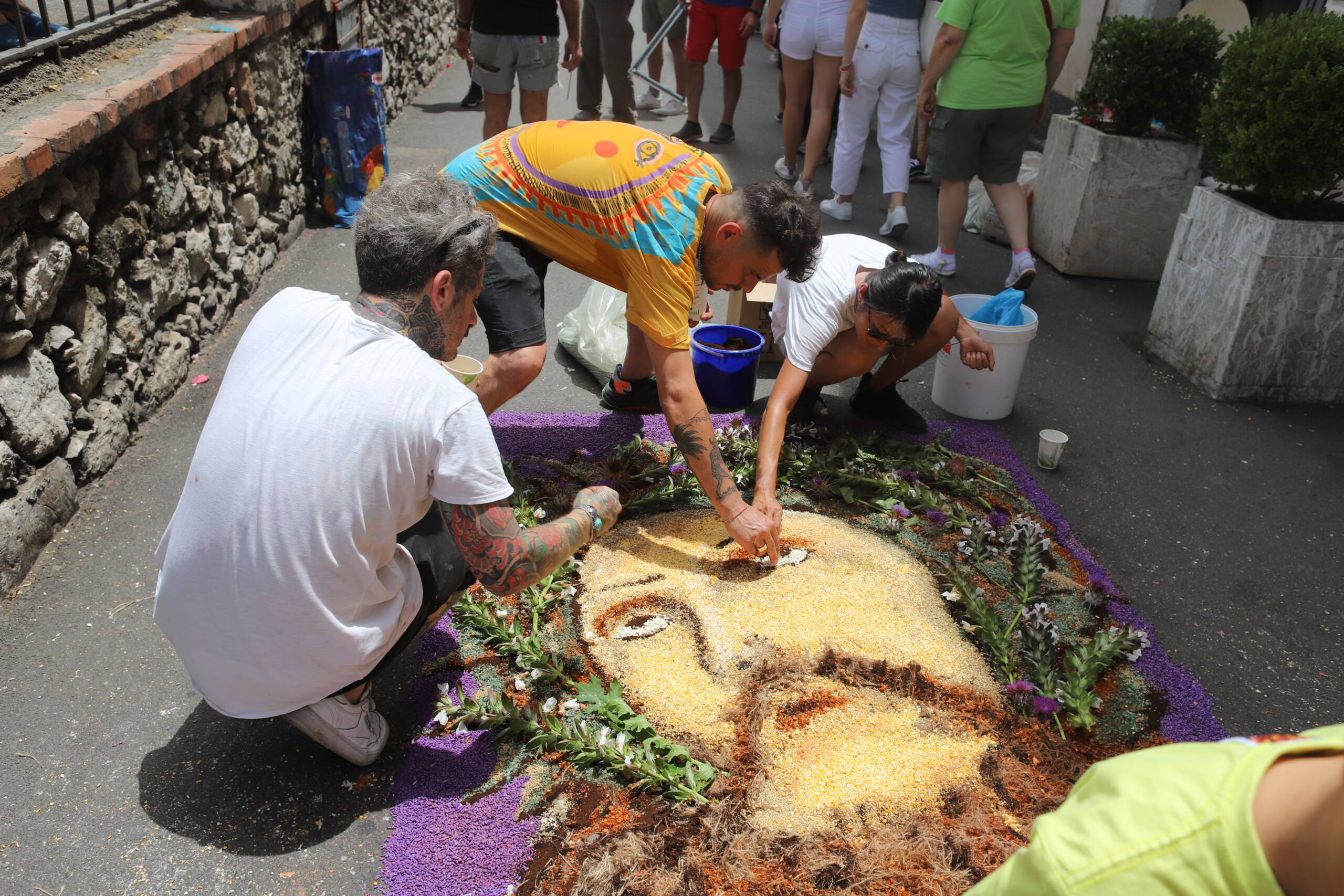
On certain festival days — typically tied to Corpus Christi but observed with local variation throughout the warmer months — the streets of Taormina host an infiorata: the Sicilian tradition of creating large-scale figurative compositions on the ground using flowers, colored sand, herbs, seeds, and plant matter arranged with meticulous care directly on the paving stones.
To come across one being assembled mid-process is to witness something that sits at the intersection of devotion and craft. Three men kneel on the asphalt in the heat, working inward toward the center of a face rendered in yellow grain, dark earth tones, purple sand, white flower petals, and green leaves — an image emerging from the street itself, built grain by grain. The man on the left has tattoos covering his neck and forearms; his hands work with the delicacy of someone accustomed to materials that do not forgive mistakes. A bucket of blue pigmented sand sits nearby. Onlookers crowd the edges, not helping, not interfering, simply watching the face take shape.
The infiorata tradition is older than mass tourism and indifferent to it. The work will be completed, the procession will pass over or around it, and by evening it will be gone — swept or rained into nothing. The impermanence is not incidental. It is the entire point. What the photographs taken by dozens of spectators cannot capture is the smell: herbs, earth, and flower pollen rising in the summer heat from a face that no museum will ever acquire.
The Camera in the Street
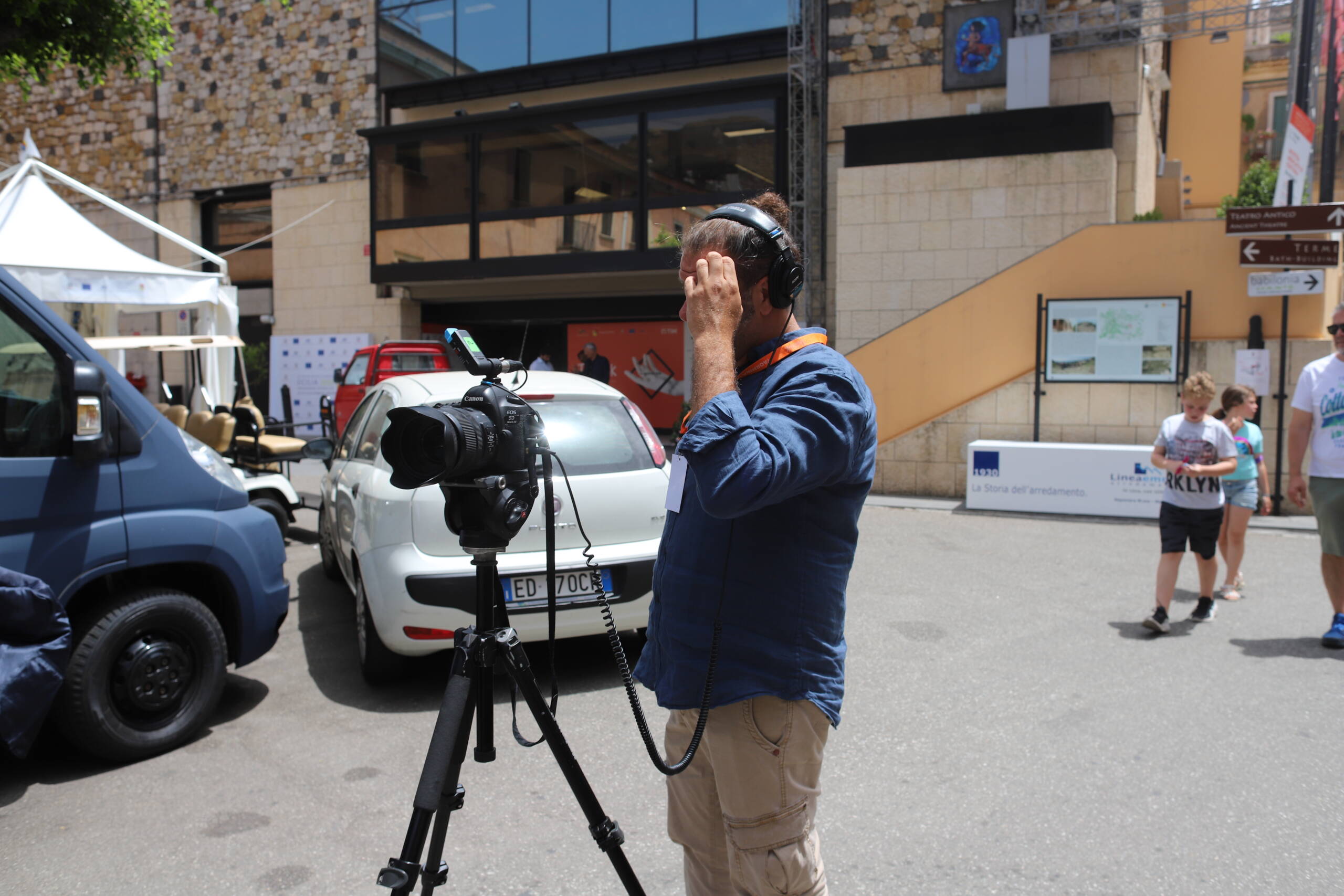
Taormina in summer is also, reliably, a production location. The town’s physical legibility — every corner self-composing into something photogenic — makes it attractive to documentary crews, broadcast journalists, and social media operations of all scales. A cameraman stands in the piazza near the Teatro Antico sign, Canon EOS on a tripod, headphones clamped over his ears, one hand raised to shade his eyes against the midday glare. The sign behind him points toward the ancient theater. The EU-flagged marquee of some institutional event occupies the background.
What he is filming is unclear. The town produces enough events, announcements, festivals, and performances in any given July week to keep several crews occupied. He squints into the brightness with the slightly distracted concentration of someone monitoring audio while thinking about the next shot. It is an entirely ordinary scene in a place that attracts cameras the way the bay below it attracts light — constantly, without having to try.
The Teatro Greco
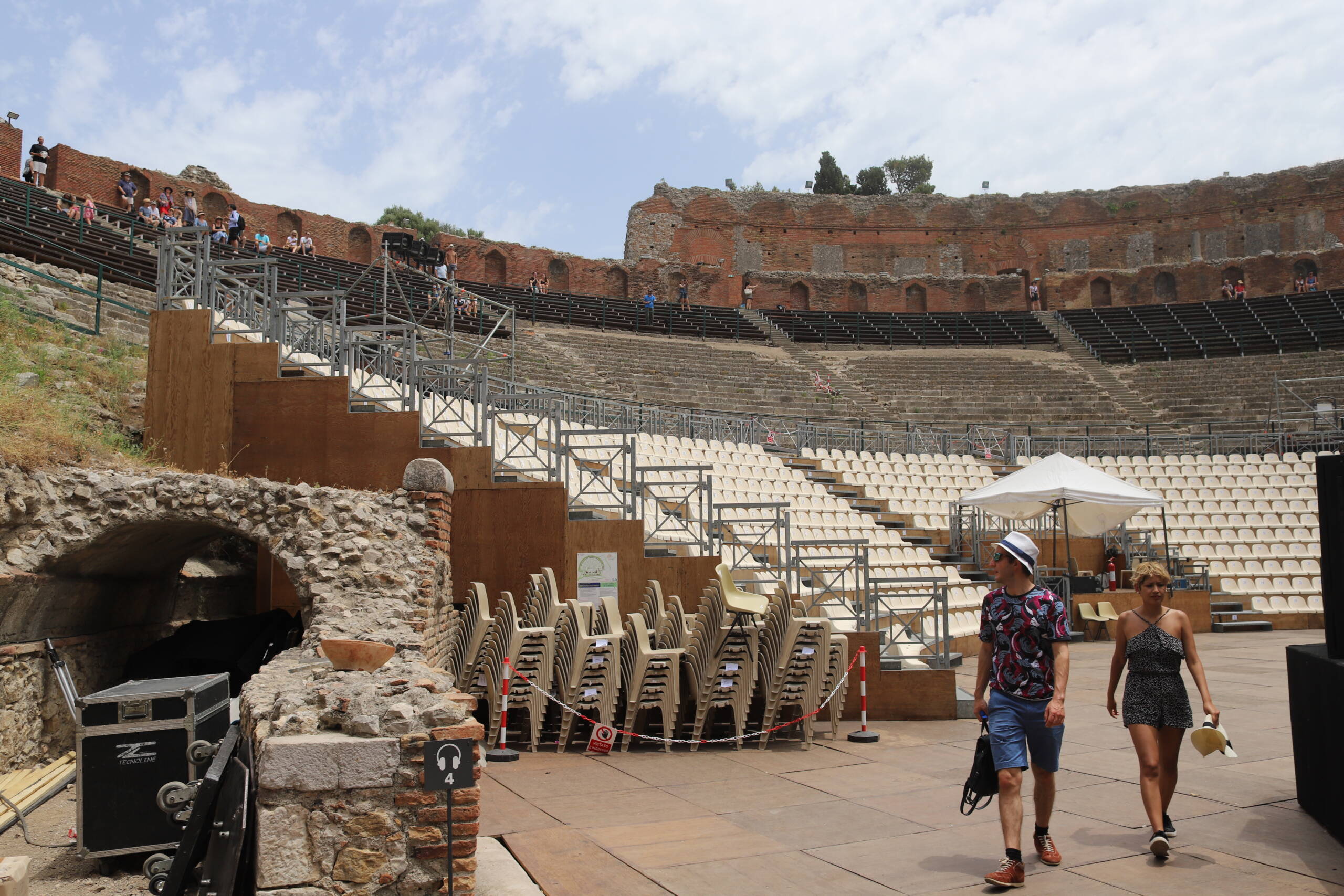
No visit to Taormina resolves without the Teatro Greco, and none should. Built originally by the Greeks in the third century BC and substantially modified by the Romans who inherited it, the theater occupies a site on the hillside that remains, after more than two millennia of use and reuse, one of the best-chosen positions in the ancient world. The cavea faces southwest, which means that audiences seated in the upper tiers look not only at the stage below but at Etna framed in the distance behind it — a backdrop so theatrically perfect that it reads as intentional even knowing the geography made it inevitable.
In summer the theater functions as a working venue. Modern seating rows occupy the orchestra floor. Scaffolded steel platforms extend the available audience capacity. Road cases for sound equipment sit along the walls. All of it sits inside the ruins — the red brick arches of the Roman cavea, the irregular stone of the Greek original beneath, the whole structure open to the sky and slowly, over centuries, dissolving back into the hillside.
Visitors in the daytime walk the stage area without performances occurring, passing the stacked chairs and the audio equipment with the slightly bemused air of tourists who arrived during setup. The theater does not require a performance to be worth attending. The ruins themselves constitute the event: a semicircle of worn stone seating, 109 meters in diameter at its widest, with the coast 200 meters below and the volcano beyond the back wall, indifferent to the schedule posted at the entrance.
What Taormina Actually Is
Taormina is not a secret and has not been one since the mid-nineteenth century at the latest. The German writer Goethe preceded the mass tourist infrastructure by a century; the hotels and the boutiques and the bar terraces followed as a matter of commercial inevitability. The town has been performing its own beauty for long enough that the performance and the reality have become difficult to separate, which is itself a kind of achievement.
What keeps it from collapsing into pure spectacle is the geology. The view from the hillside above the ruins is not a constructed amenity. The bay does not depend on signage. The Teatro Greco survived not because someone maintained it as a tourist attraction but because the stone was too substantial to remove and the site too useful to abandon. The things that make Taormina worth visiting are the things that were present before visitors arrived, and they remain present beneath the gelato shops and the event programming and the summer crowds moving through the Corso in both directions.
Go in the morning, before the cruise passengers ascend from the port at Giardini Naxos. Go in late June when the infiorata artists are still at work on the street and the theater has not yet reached peak-season pricing. Go in the knowledge that what you are seeing has been seen by everyone who came before you and will continue to be seen by everyone who comes after. This does not diminish it. In Taormina, as with all places that have outlasted their own mythology, duration is the credential.