The late afternoon sun rakes across the limestone face of the Ottoman aqueduct at Acre, throwing the blind arcade into sharp relief — column, shadow, column, shadow, repeating westward in a rhythm that has held for nearly three centuries. Daher el-Omar built this structure in the 1780s to carry water from the Kabri springs some sixteen kilometers south to his fortified city; the arches have outlasted his dynasty, three subsequent empires, and a world war. What they have not outlasted is gravity and salt air, which is precisely why the scaffolding is there.
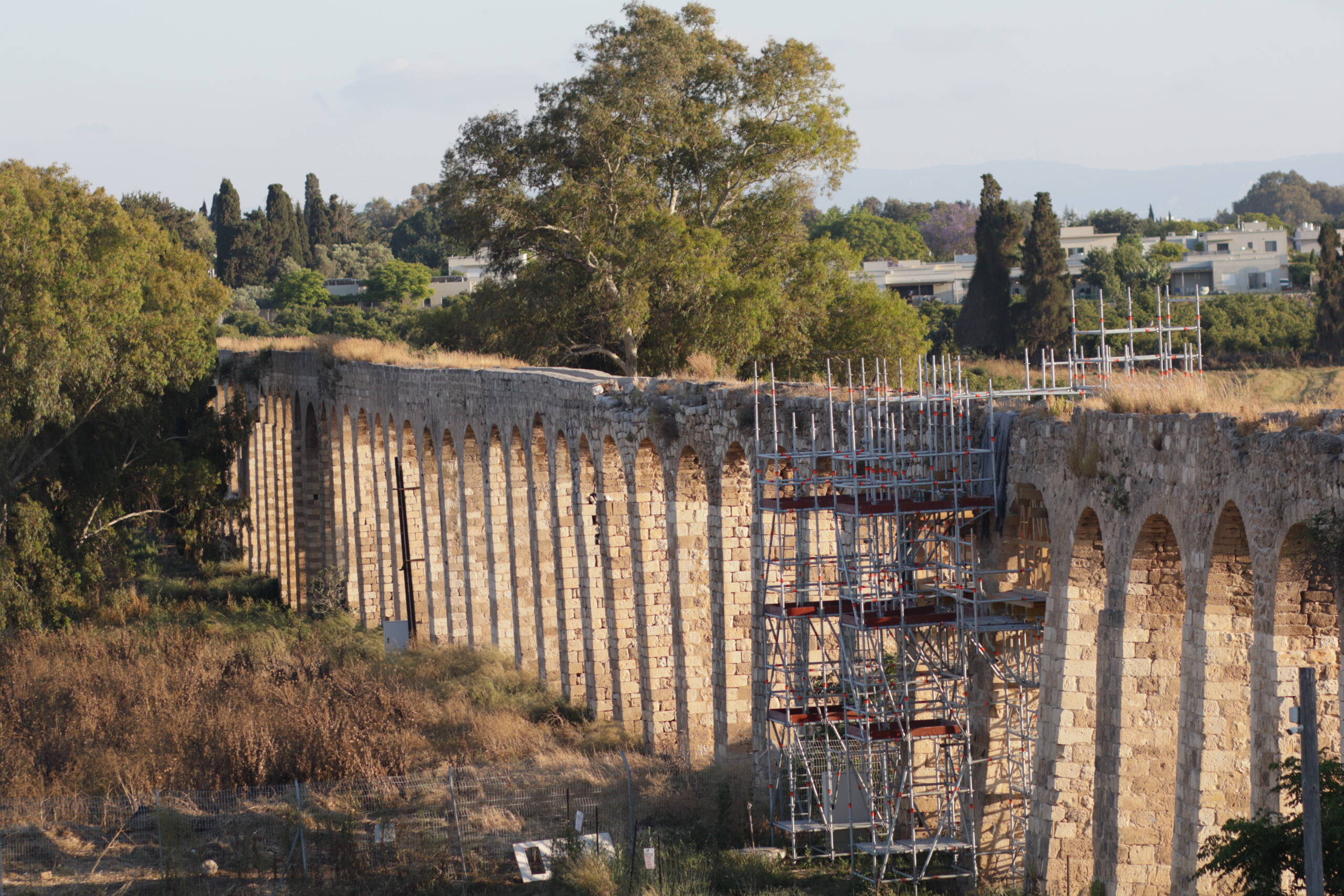
The restoration rig occupies the mid-ground with an almost confrontational frankness — red cross-braces, white verticals, a survey pole array on the upper deck. It does not try to disappear. Against the warm kurkar stone it reads less as an intrusion than as a declaration: someone is paying attention. The dry grass below, the eucalyptus and cypress behind, the residential rooftines of modern Akko visible through the canopy — all of it compresses into a single frame where the eighth century, the eighteenth, and the twenty-first share the same focal plane.
Technically the image benefits from the low sun angle, which does the work no flash could replicate, modeling every stone course and mortar joint without flattening the wall into a surface. The slight haze softens the background just enough to keep the aqueduct primary. Shot from an elevated position slightly south of the structure, giving the perspective its mild diagonal sweep.
It’s a common conflation: aqueducts read as Roman because Rome made them famous, but the engineering concept persisted through Byzantine, Crusader, Mamluk, and Ottoman periods. This is the Ottoman aqueduct of Acre, built in the 1780s by Daher el-Omar, the Arab ruler who made Acre into a regional power.
The tells that this isn’t Roman work are visible in the image itself. Roman aqueducts typically ran on continuous barrel-vaulted arcades with uniform semicircular arches and opus incertum or opus quadratum stonework in strict courses. What you’re seeing here is coursed kurkar limestone with slightly irregular voussoirs, Ottoman proportions, and that characteristic blind arcade on the upper wall — a decorative and structural approach much more common to 18th-century Levantine construction than to classical Roman engineering.
The genuinely Roman aqueduct infrastructure in this region is mostly at Caesarea Maritima, about 50 kilometers south — two parallel channels, one Herodian, one Hadrianic, and unmistakably classical in their profile.
That said, there’s a reasonable historical argument that Daher el-Omar’s aqueduct may have followed an earlier route — possibly Byzantine or even Roman-era — but the standing structure is Ottoman through and through.