Most people who visit the Petit Palais see the street facade, walk through the entrance portico, and go directly to the galleries. The interior courtyard garden stops them cold. Nothing about the Beaux-Arts exterior prepares you for it.
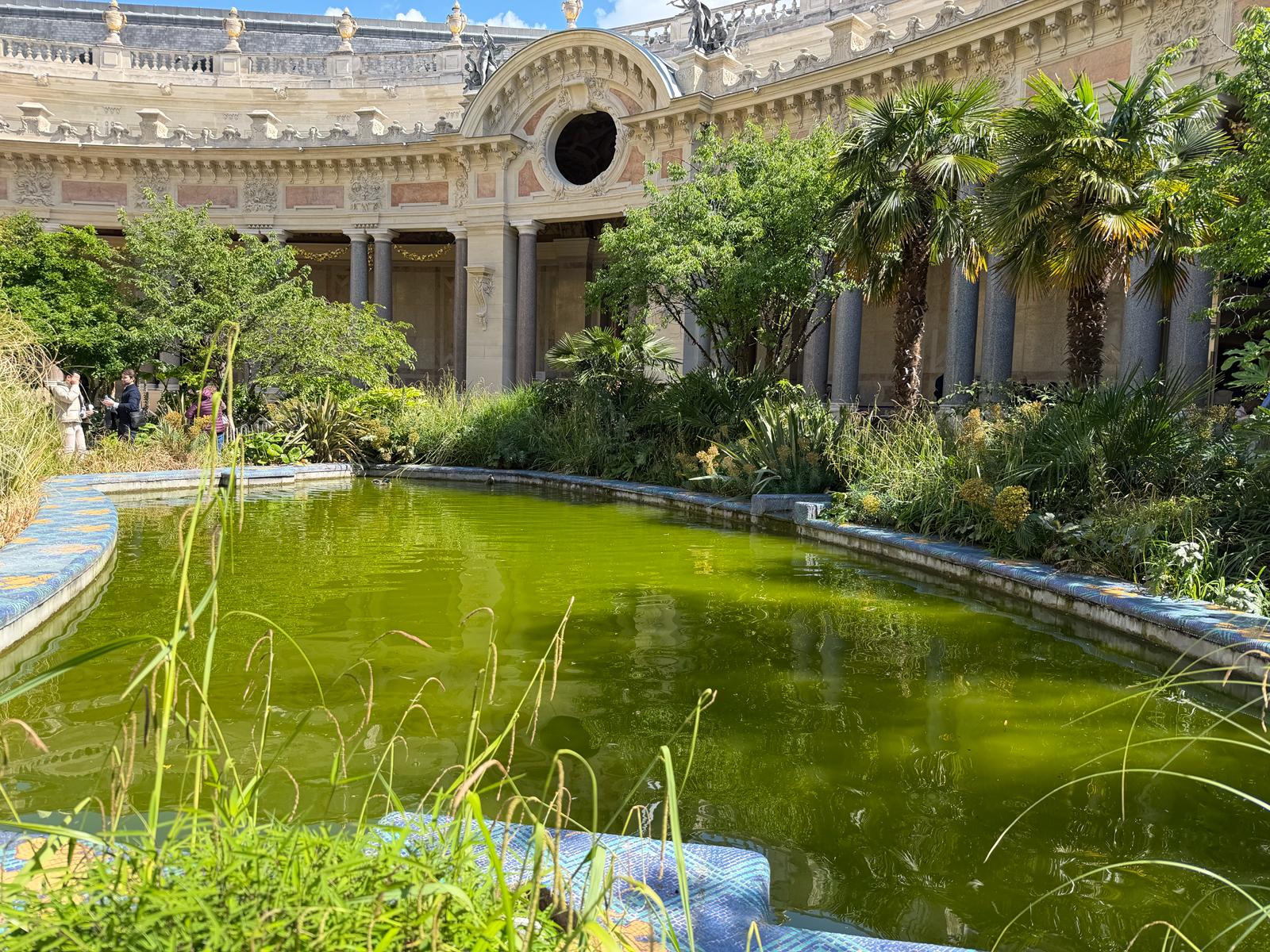
The garden is arranged around an oval basin at its center, the water running a deep algae-green that in certain light reads as olive or amber. The color is not a maintenance failure — it is the condition of an outdoor basin planted around with grasses, reeds, and subtropical vegetation that has been allowed to grow into something closer to a conservatory than a formal French garden. Palms rise above the planting line. Climbing plants work their way up the colonnaded arcade that wraps the perimeter.
The arcade itself is the architectural surprise. The street facade is cream limestone, restrained, classical. The interior elevation is polychrome — ochre and terracotta tones in the arched bays, decorated friezes, painted surfaces that read as almost Italian against the Parisian exterior. The circular oculus above the central bay punches through to open sky. The whole composition curves around the basin in a continuous arc.
Architect Charles Girault designed the Petit Palais for the 1900 Exposition Universelle, and the courtyard was always part of the scheme — a Mediterranean pause at the center of a northern European public building. What has happened to the planting over time has made it more interesting than any manicured version would be. It feels inhabited rather than maintained.
The café opens directly onto the courtyard. If you are going to the Petit Palais for the permanent collection or a temporary exhibition, build in time to sit here. The garden operates on a different clock than the galleries. That is the point of it.