The Petit Palais sits on Avenue Winston Churchill in the 8th arrondissement, built for the 1900 Universal Exposition and never relinquished. Paris kept it, converted it into the city’s municipal fine arts museum, and has been filling it ever since. Admission to the permanent collection is free. The temporary exhibitions — the banner here advertises a Roly Ferenczy show — run on a separate ticket.
The building is Beaux-Arts at full expression: a colonnade that wraps the entire facade, sculptural programs above every cornice line, a central dome in dark patinated copper that anchors the composition from any approach. The entrance portico on the Churchill side is the set piece — arched, deeply recessed, flanked by allegorical statuary, and designed to communicate institutional permanence before you’ve reached the door.
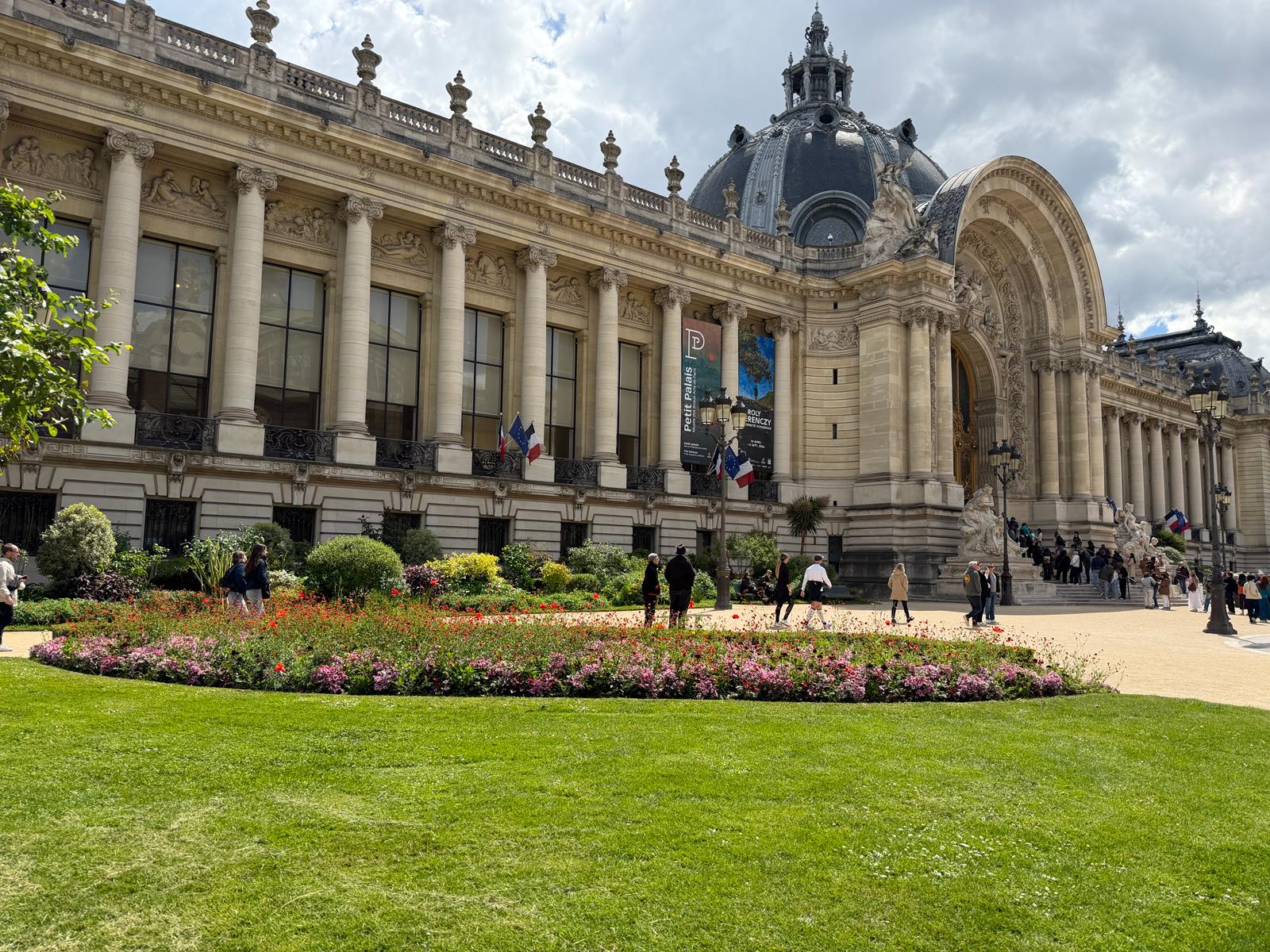
The garden forecourt is what separates the Petit Palais from comparable institutions. The planted beds run to poppies and pink blooms in spring, set against clipped lawn, and the whole arrangement sits between the building and the street at a scale that feels generous rather than ceremonial. People stop here without going in. That’s a design success, not a failure.
The Grand Palais is directly across the avenue and currently undergoing phased renovation. The two buildings were conceived as a pair — same exposition, same architect Charles Girault for the Petit, same moment of Third Republic ambition made stone. Seeing them together, even with scaffolding on one, clarifies the urban logic of this stretch of Paris.
If you’re working the 8th, the Petit Palais fits cleanly into a morning that starts at the Champs-Élysées and ends somewhere near the Seine. The permanent collection runs strong on 19th-century French painting and decorative arts. The café inside the building opens to a covered courtyard garden that most visitors walk past entirely.