The Île de la Cité is where Paris started, and the Palais de Justice is what eventually consumed most of it. The complex occupies the western half of the island and has functioned as a seat of French judicial power for centuries, though what you see on the facade today is largely the result of 19th-century reconstruction under Haussmann and architect Joseph-Louis Duc. The bones are older. The Conciergerie, attached to the same complex, dates to the medieval royal palace that preceded everything.
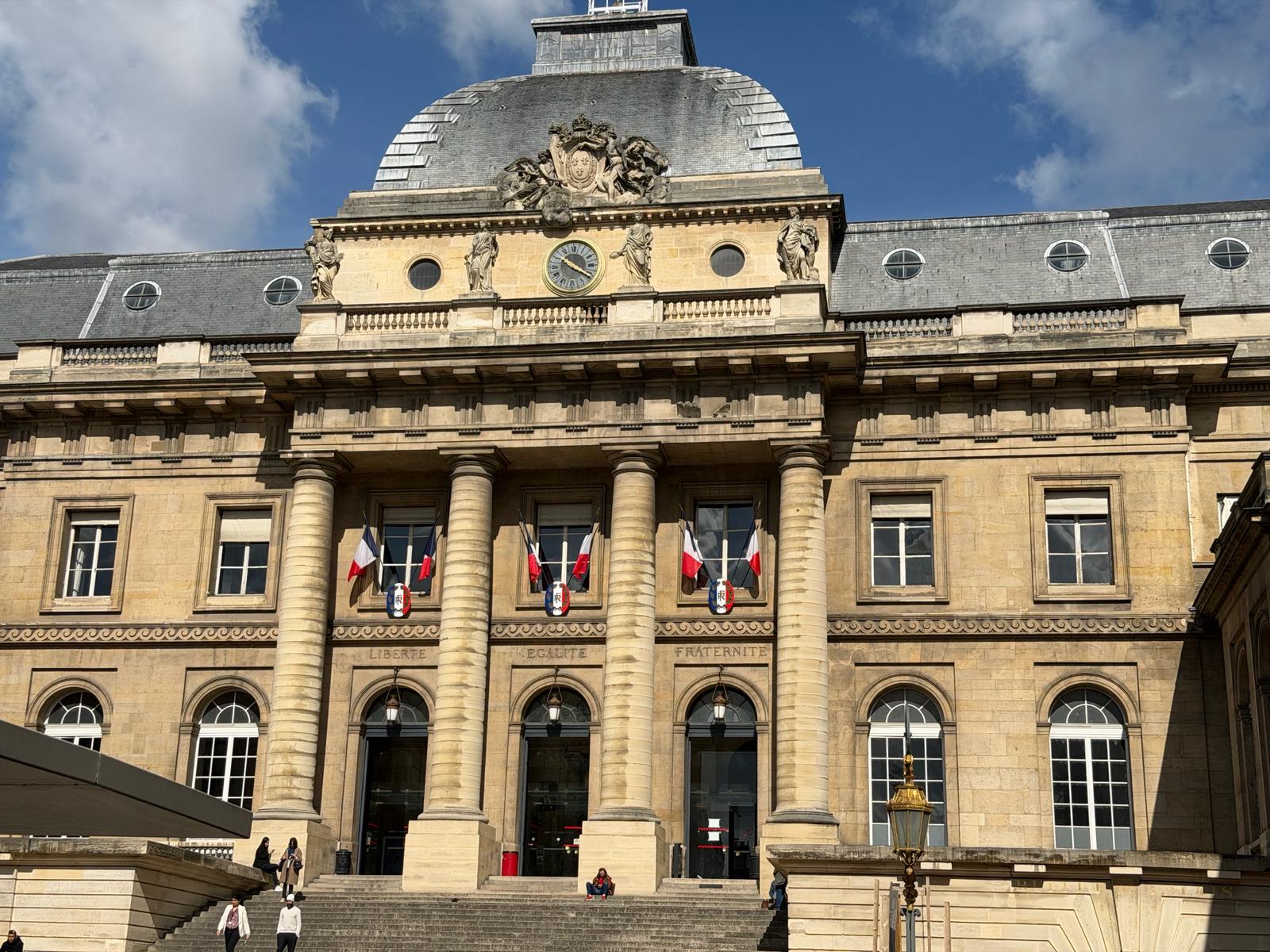
The main entrance facade faces the Boulevard du Palais and delivers exactly what a courthouse is supposed to deliver: columns, mass, and inscribed stone. LIBERTÉ ÉGALITÉ FRATERNITÉ runs across the entablature between the pilasters — not decorative, not incidental. Six tricolor flags hang from the entrance bays. The message is institutional and deliberate. This is where the Republic judges.
Above the cornice, a clock flanked by allegorical figures marks the pediment line. Higher still, a sculpted group bearing the Republic’s coat of arms sits beneath a zinc mansard dome. The warm limestone catches afternoon sun on the western exposure and turns the whole facade golden in a way that softens the severity somewhat. The steps descend to a forecourt open to the public and heavily trafficked by people with no judicial business at all.
The Sainte-Chapelle is inside the complex, accessible through a security checkpoint. Most visitors come to the island for Notre-Dame, now fully reopened after the 2019 fire, and miss both the Conciergerie and the Sainte-Chapelle entirely. The latter has arguably the finest medieval stained glass in existence. The Palais de Justice as a whole is still an active court — hearings run on weekdays and the building is not a museum.
If you are routing through the 1st arrondissement and crossing to the Île de la Cité, the facade alone is worth the stop. The forecourt steps are where Parisians sit when the sun is out. You will not be the only one.