• Skip to main content
  • Skip to secondary menu
  • Skip to footer

Travel Marketing

Travel and Tourism Trends

  • Sponsored Post
  • Travel Event Calendar
  • Travel Market
  • Travel Magazine
  • About
  • Contact

Marianne von Werefkin at the Albertina Museum: Echoes of The Blue Rider

October 28, 2025 By admin Leave a Comment

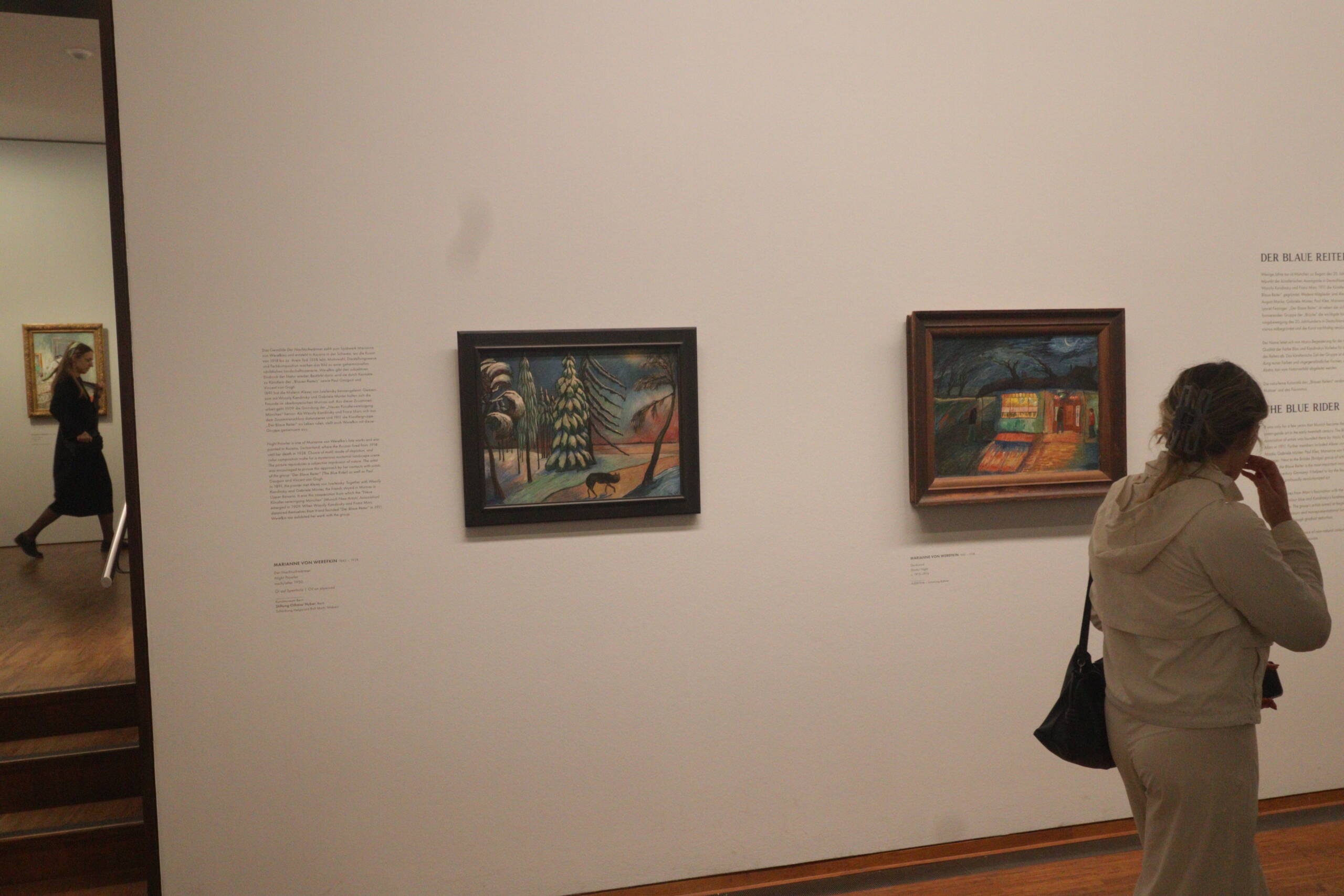
The Albertina Museum in Vienna has a way of staging art so that history feels close at hand, as if you’ve stepped not just into a gallery but into the atmosphere of another era. In this photograph, that effect is palpable. Two paintings by Marianne von Werefkin hang side by side, modest in scale but charged with the intensity of the Der Blaue Reiter (The Blue Rider) movement, which reshaped European art in the early 20th century.
Marianne von Werefkin at the Albertina Museum: Echoes of The Blue Rider

The left canvas is a wintry landscape with almost surreal tension: snow-heavy trees stand like figures themselves, and beneath them a dark animal—a dog or perhaps a wolf—moves across a path. It’s not simply a forest; it’s a psychological stage. The stark silhouettes and cool tones pull the viewer into a state of heightened awareness, as if danger and beauty are fused in one breath. To the right, a different mood emerges. A cabin glows from within, its windows lit with warm reds and oranges, but it sits against a backdrop of a restless, shadow-drenched night. The brushwork is turbulent, the landscape unsettled. Werefkin manages to paint not just a place but an emotion—a fragile balance between shelter and isolation, warmth and darkness.

The wall text references Der Blaue Reiter, reminding visitors of how Werefkin was woven into the orbit of Wassily Kandinsky, Franz Marc, and Gabriele Münter. Unlike many of her male peers, she never enjoyed the same level of fame, but her work carried equal weight. She translated landscapes into visions of the soul, often infusing nature with symbols of human vulnerability. These paintings at the Albertina are a testament to how she worked on the edge of expressionism and spirituality, blurring the line between outer scenery and inner turmoil.

The photograph itself, though, tells another layer of story. To the far left, a woman in dark clothing strides briskly through a doorway, her body in motion, a fleeting presence. In the foreground, another visitor dressed in light beige pauses, caught in thought as she studies the wall text, hand lifted to her mouth in a gesture of concentration. Between them, Werefkin’s two paintings glow quietly on the white wall, as if immune to the shifting rhythms of the gallery space. It’s a beautiful contrast: movement and stillness, everyday distraction and deep engagement, all orbiting around works that were created more than a century ago yet still reach into the present.

That’s the charm of the Albertina. It doesn’t just hang paintings; it creates a dialogue between the art, the space, and the visitors who pass through. Standing in front of Werefkin’s works here, you feel part of the story of The Blue Rider—a movement that was never about one voice but about a chorus of artists daring to let inner visions break free on canvas.

Filed Under: News

Reader Interactions

Leave a Reply Cancel reply

Your email address will not be published. Required fields are marked *

Footer

Recent Posts

  • Teze Bazar, Baku: The Sour-Fruit Market Behind Azerbaijani Cooking
  • Dolma With Cornelian Cherry and Yogurt at Old Garden, Baku Old City
  • Baku Travel Guide: Flame Towers, the Walled Old City, and Azerbaijan’s Land of Fire
  • Chebureki and the Georgian Table: A Culinary Tourism Guide to the Caucasus
  • Radisson Blu Resort Phu Quoc Launches “Blu Escape” Summer Family Getaway
  • The Acre Aqueduct at Golden Hour
  • Expedia Group Turns 30 and Pushes Travel Into the AI Era with New Partnerships and a Sustainability Push
  • The Mona Lisa Queue Is Everything Wrong With How We Visit Museums
  • Why You Should Order the Steak at a Paris Pizzeria
  • Palais de Justice, Paris: The Courthouse on the Island Where the City Began

Media Partners

Lisbon’s Seven Hills: A Walking Guide That Tells You the Truth
New Orleans: An American City That Plays by Different Rules
Ha Long Bay Without the Cruise Brochure
Istanbul at the Threshold: A City That Has Always Been Two Things at Once
Iceland’s Ring Road: What the Drive Teaches You That No Photograph Can
Marrakech’s Medina: How to Read a City That Was Not Designed for You
Torres del Paine: What You Are Actually Getting Into
Kyoto in Autumn: What the City Looks Like When the Maples Turn
Disneyland Paris Rewrites Its Script With World of Frozen and Disney Adventure World
Wallace Fountain: Carrying Water, Carrying Values

Media Partners

The Immersive Experience in the Museum World
Japan, China, and Taiwan: A New Triangle of Risk — and a Window of Opportunity for Japan
Ghost Kitchens as Infrastructure: The Shift from Restaurants to Intelligent Food Networks
The Zoom Divide Nobody Saw Coming
The Perfect Budget Content-Creator Kit
Reimagining Prague’s Tourism Future Through Immersive Media and VR Museums
Israel’s Urban Paradox: Tel Aviv Moves, the Rest Stand Still
American Express Global Business Travel (GBTG): Understanding the Business and the Investment Case
Why the Canon R8 Paired With the New RF 45mm f/1.2 Lens Quietly Becomes the Content Creator’s Sweet-Spot
The Future of Travel: A $15.5 Trillion Industry

Copyright © 2026 Travel Marketing

Media Partners: Timey · Publishing House · Ancient Rome · Photography · Calendarial · Transportational