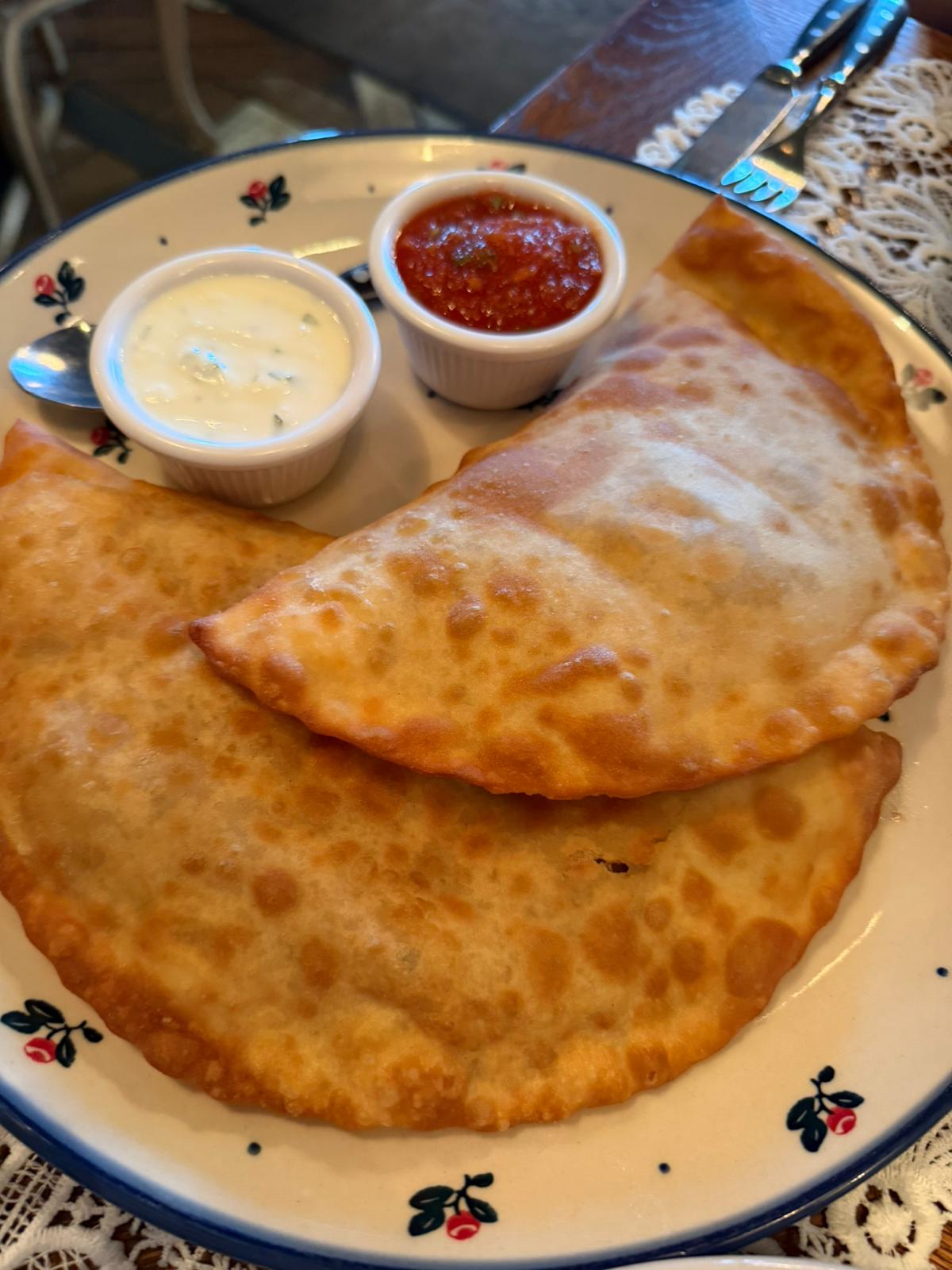
Two golden half-moons arrive blistered and shining, the dough so thin in places it has gone translucent over the filling. On the side: a white sauce flecked green with herbs and garlic, and a red one with the rough texture of a fresh tomato relish. This is chebureki, and it is one of the most reliable ways to understand why Georgia rewards travelers who plan their trip around the table rather than the map.
What You’re Looking At
Chebureki is a fried turnover of unleavened dough, rolled thin, filled with minced meat, onion and spice, and dropped into hot oil until it puffs and bubbles into that signature blistered crust. The name and the technique are Crimean Tatar in origin, and the dish traveled with that diaspora across the Black Sea and through the Caucasus, where it settled into the casual end of the Georgian menu. You’ll find it at roadside stands, in unpretentious cafés, and on plates like this one, served fast and eaten hot with whatever sauces the kitchen pours.
The pleasure is textural. A good chebureki shatters at the edge and stays juicy at the center, the rendered fat and onion having steamed the meat inside its sealed pocket. It is not refined food and isn’t trying to be. It is the thing you order when you’ve been walking a market all morning, and it is the gateway to everything else Georgia does with dough, fat and walnut.
Georgia Is a Food Destination First
Plenty of countries have good food. Georgia has a food culture that organizes the whole society, and that is the distinction worth chasing. Eating here is not a break from sightseeing; it is the sightseeing. The country sits at a crossroads of Persian, Ottoman, Russian and Mediterranean influence, and it absorbed all of them without losing a stubborn identity built on cheese, walnuts, pomegranate, fresh herbs and clay-fermented wine.
For the culinary traveler, that means a destination where the average neighborhood restaurant outperforms the special-occasion restaurant in most cities you’ve visited. The barrier to a great meal is low. The ceiling is very high.
The Supra
To understand Georgian eating, you have to understand the supra, the traditional feast that turns dinner into ritual. Dishes don’t arrive in courses; they accumulate, plate stacked on plate until the table disappears. Presiding over it is the tamada, the toastmaster, who steers a long sequence of toasts to peace, ancestors, women, the homeland and the people present. Wine is poured generously and drunk on cue. If you are invited to a real supra in someone’s home, cancel your other plans. Nothing on a guidebook itinerary will teach you more.
What to Order
Build your trip around a short list and you’ll eat well anywhere:
Khachapuri is the national obsession, a cheese bread with regional variants worth seeking out individually. The Adjaran version is shaped like a boat, filled with molten cheese, and crowned with a raw egg and butter you stir in yourself. The Imeretian version is a simpler round disc of cheese-stuffed bread. Order both, in different regions, and taste the rivalry.
Khinkali are the soup dumplings of the mountains, pleated into a twisted knot at the top and filled with spiced meat and broth. There is a correct way to eat them: pick one up by the knot, bite a small hole, drink the broth, then eat the body. You leave the tough little knot on your plate, and a Georgian will count them to see how many you managed.
Pkhali and badrijani are the cold starters that show off the walnut. Pkhali are vivid pâtés of spinach, beet or bean bound with ground walnut, garlic and herbs. Badrijani are eggplant slices rolled around walnut paste and topped with pomegranate seeds.
Lobio, a slow-cooked bean stew often served in a clay pot with cornbread, and churchkhela, the candle-shaped string of walnuts dipped repeatedly in thickened grape must, round out the education. The latter is sold everywhere and looks like a colorful candle; locals sometimes call it Georgian Snickers.
Wine From Clay
Georgia makes a serious claim to being the birthplace of wine, with archaeological evidence of winemaking stretching back roughly eight thousand years. The method that earned UNESCO recognition is qvevri winemaking: fermenting and aging in large egg-shaped clay vessels buried in the ground. The amber wines that result, made by leaving white grapes in contact with their skins, are tannic, structured and unlike almost anything in the Western wine canon. Pair them with the walnut dishes and you understand why the cuisine and the wine evolved together.
Where to Eat It
Tbilisi is the obvious base, a city where sulfur baths, wine bars and bakeries occupy the same crooked streets. Kakheti, to the east, is the wine country, all rolling vineyards and family marani cellars where qvevri are still buried in the floor. Adjara, on the Black Sea coast around Batumi, gives you that egg-topped khachapuri at its source along with a humid, subtropical food culture distinct from the highlands. And in the mountain regions you’ll find khinkali at their most authentic, dense and meaty enough to fuel a day’s hiking.
Chebureki won’t headline any of these regions. It is the in-between food, the thing you eat standing up between the cellar and the next meal. But that’s exactly why it belongs at the start of a culinary tour of Georgia. It sets the register: generous, unfussy, deeply satisfying, and best enjoyed without overthinking it. Order two, ask for both sauces, and let the rest of the country unfold from there.