• Skip to main content
  • Skip to secondary menu
  • Skip to footer

Travel Marketing

Travel and Tourism Trends

  • Sponsored Post
  • Travel Event Calendar
  • Travel Market
  • Travel Magazine
  • About
  • Contact

Teze Bazar, Baku: The Sour-Fruit Market Behind Azerbaijani Cooking

June 21, 2026 By admin Leave a Comment

Azerbaijani cooking is built on sourness, and Teze Bazar is where the sourness is sold. Before the dolma and the kebab and the plov, there is the raw material — and at Baku’s oldest food market the raw material is stacked into pyramids and sorted into trays until the whole national palate is laid out in one room. Walk the fruit aisle, then the spice counter, and you have read the menu backward to its source.

The fruit table

It is June, and the tables are a census of the Azerbaijani summer. Apricots — the country’s signature stone fruit — run in two shades of yellow. Donut peaches sit flat beside ordinary ones. Dark cherries and pale Napoleon cherries share a row with mulberries, loquats, and three kinds of plum. And then the green ones: alça, the hard sour cherry-plum that Azerbaijanis eat unripe, dipped in salt, while it is still mouth-puckeringly tart. The sign over the crate says as much. Sourness here is not a flaw to be ripened out of the fruit; it is the reason for the fruit.
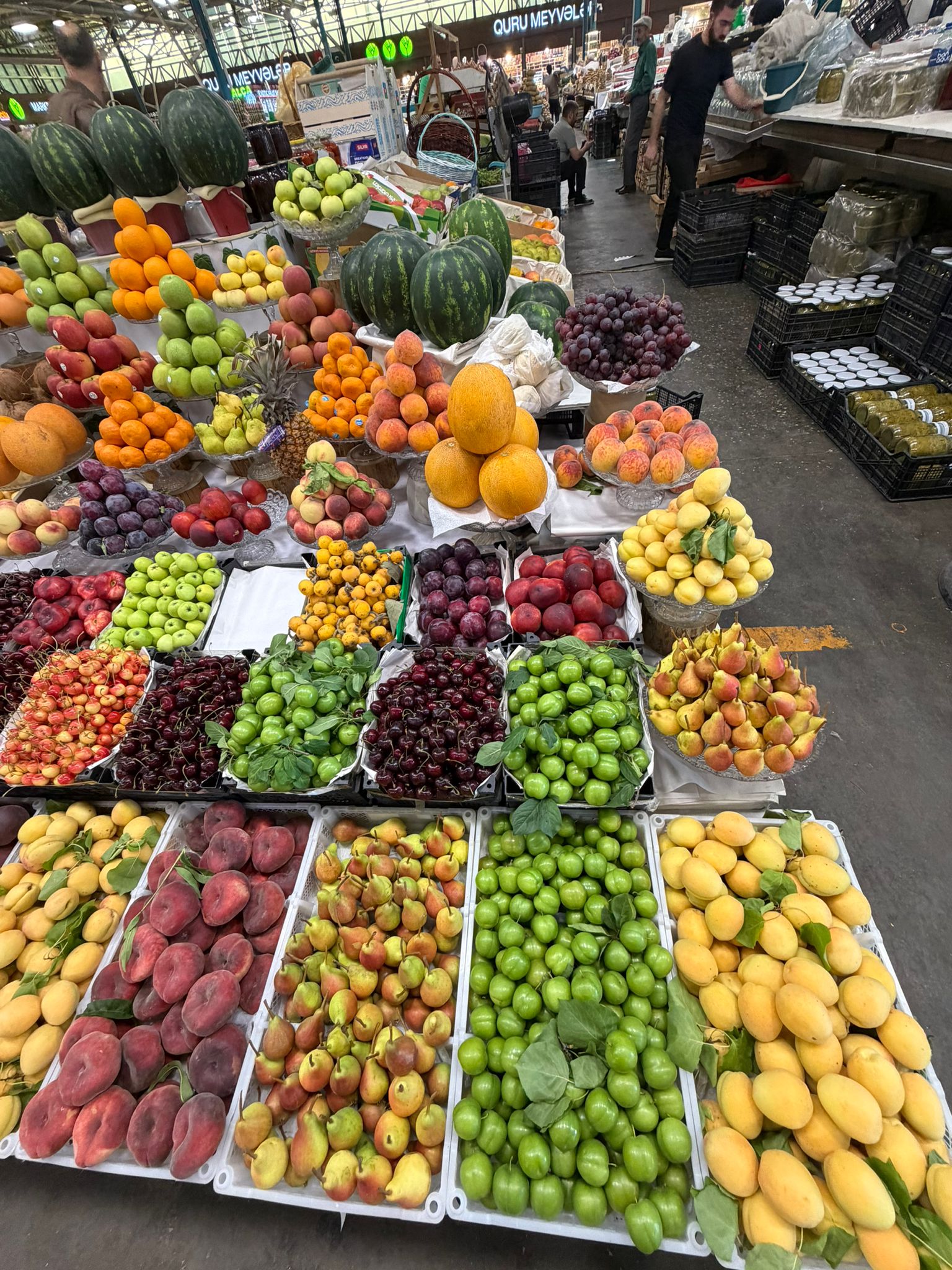
Pyramids of seasonal fruit — apricots, peaches, cherries, green sour plums, melons and watermelons — at a stall in Teze Bazar, Baku
The summer table at Teze Bazar — apricots, donut peaches, cherries, and crates of green alça, the sour plum eaten unripe.

The spice counter

The spice trays make the same argument in powder. Saffron and turmeric for plov, the rice dish that anchors every celebration. Sumac — dark red, lemon-sharp — dusted over grilled meat without exception. Dried barberries, zirinc, the little garnet beads scattered through rice for acid and color. Cinnamon, ginger, paprika, and blends with no English name. This is the Silk Road inventory: Iran to the south, the Caucasus around, the Caspian at the door, all of it metabolized into one Azerbaijani spice rack. Jars of dark cornelian cherry and mulberry preserve hold down the back shelf — the sour fruit from the next aisle over, cooked down and bottled.
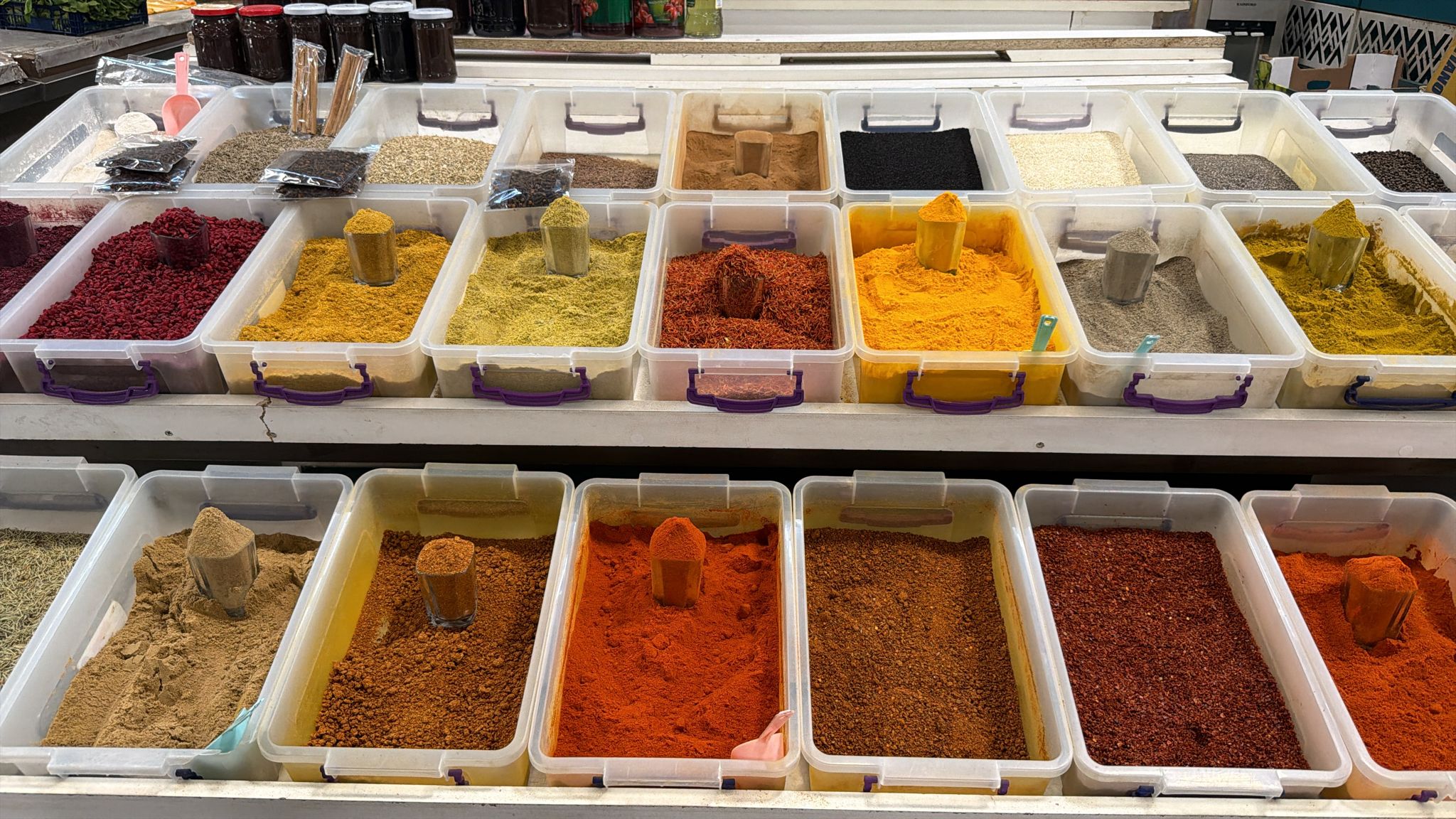
Open trays of spices — saffron, turmeric, sumac, dried barberries, paprika and blends — at a spice stall in Teze Bazar, Baku
Saffron, turmeric, sumac, barberry — the Silk Road sorted into trays, with cornelian cherry preserve behind.

The market

Teze Bazar — “New Bazaar,” though it has stood some eighty years — sits on Samad Vurgun street, a short walk from the boulevard and the Old City. It is a working market, not a tourist set piece: butchers, a dairy hall, Caspian fish and black caviar, walls of dried fruit, pickles by the jar. Vendors will hand you a cherry to taste before you commit. Come in the morning, when the pyramids are still intact and the light through the roof is doing the produce favors.

The dolma comes with cornelian cherry sauce because the cornelian cherry was here first. Teze Bazar is the argument; dinner is only the conclusion.

Filed Under: News

Reader Interactions

Leave a Reply Cancel reply

Your email address will not be published. Required fields are marked *

Footer

Recent Posts

  • Château de Monbazillac, Dordogne: A difficult childhood. One château too many.
  • Fora Hits $1 Billion Valuation as AI Transforms the Future of Travel Planning
  • The Open Kitchen Experience: Dining Where You Can Watch the Cooking
  • Holland America Line Adds Flåm and Hellesylt to Five 2027 Norway Fjord Cruises
  • La Cité du Vin, Bordeaux: The Building That Looks Like Wine in a Glass
  • EU Border Delays: ETIAS Pre-Travel Authorization Pushed to Late 2026 as EES Chaos Continues
  • Toledo’s Old Town: A Mudéjar Watchtower Hiding an Antiques Shop
  • Piazza del Duomo, Catania: Where a Black Lava Elephant Guards Sicily’s Baroque Heart
  • Château de Fougères: Inside Europe’s Largest Medieval Fortress
  • Château de Vitré: The Medieval Fortress Guarding Brittany’s Eastern Gate

Media Partners

  • Virtual Travel Guide
  • Ancient Rome
Bilbao’s Quiet Renaissance: From Industrial Port to Design Destination
Lisbon’s Seven Hills: A Walking Guide That Tells You the Truth
New Orleans: An American City That Plays by Different Rules
Ha Long Bay Without the Cruise Brochure
Istanbul at the Threshold: A City That Has Always Been Two Things at Once
Iceland’s Ring Road: What the Drive Teaches You That No Photograph Can
Marrakech’s Medina: How to Read a City That Was Not Designed for You
Torres del Paine: What You Are Actually Getting Into
Kyoto in Autumn: What the City Looks Like When the Maples Turn
Disneyland Paris Rewrites Its Script With World of Frozen and Disney Adventure World
Water Across the Empire: Roman Aqueducts and the Hydraulic Logic of Conquest
The Oath of the Horatii: David's Roman Republic in Paint
Jean-Léon Gérôme: The Victorian Gaze on Rome
Ostia: The Port That Fed Rome
Roman Naval Warfare: The Sea They Called Their Own
The Roman Grain Ship: How Rome Fed Itself Across the Sea
Trajan's Column: Rome's Greatest Comic Strip
Caesarea Maritima: A Roman City Built from Nothing
Damnatio Memoriae: Rome's War on Memory
Faustina the Younger: The Woman Behind the Philosopher Emperor

Media Partners

The Immersive Experience in the Museum World
Japan, China, and Taiwan: A New Triangle of Risk — and a Window of Opportunity for Japan
Ghost Kitchens as Infrastructure: The Shift from Restaurants to Intelligent Food Networks
The Zoom Divide Nobody Saw Coming
The Perfect Budget Content-Creator Kit
Reimagining Prague’s Tourism Future Through Immersive Media and VR Museums
Israel’s Urban Paradox: Tel Aviv Moves, the Rest Stand Still
American Express Global Business Travel (GBTG): Understanding the Business and the Investment Case
Why the Canon R8 Paired With the New RF 45mm f/1.2 Lens Quietly Becomes the Content Creator’s Sweet-Spot
The Future of Travel: A $15.5 Trillion Industry

Copyright © 2026 Travel Marketing

Media Partners: Timey · Publishing House · Ancient Rome · Photography · Calendarial · Transportational