• Skip to main content
  • Skip to secondary menu
  • Skip to footer

Travel Marketing

Travel and Tourism Trends

  • Sponsored Post
  • Travel Event Calendar
  • Travel Market
  • Travel Magazine
  • About
    • Redrawing the Map of Travel Marketing
    • How We Work with Tourism Ministries to Promote Travel Destinations
    • Why Travel Agencies Should Partner with TravelMktg.com – Let’s Promote Destinations Together
  • Contact

Destination First: How Places Market Themselves Before Selling Anything Else

February 8, 2026 By admin Leave a Comment

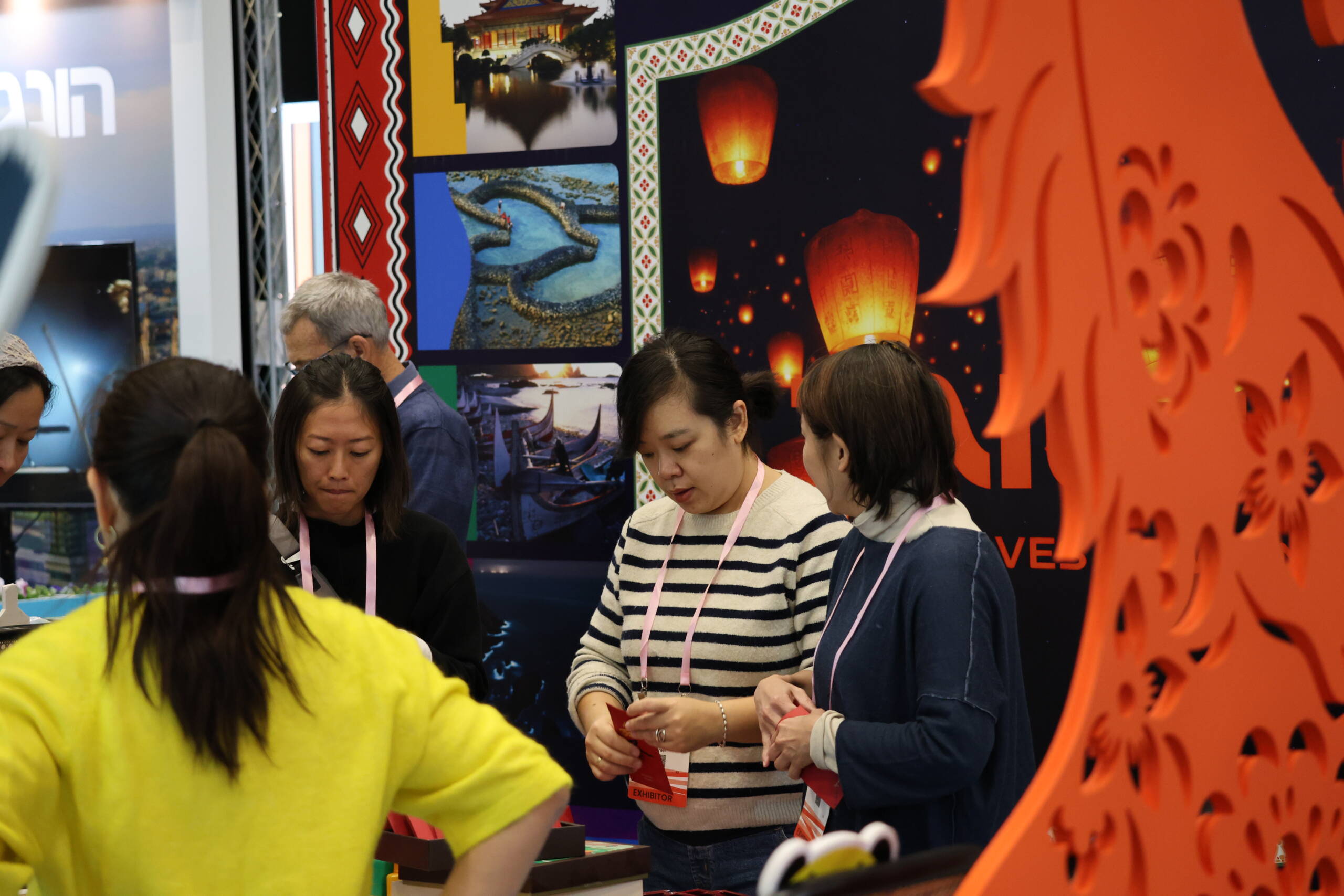
The photo catches a moment that feels almost incidental, which is exactly why it works. At the Taiwan pavilion at IMTM 2026, a small group of exhibitors stands close together behind a counter, heads slightly bowed, hands busy with brochures and badges, the choreography of a trade fair happening without performance. Pink lanyards cut clean lines across sweaters and jackets, soft neutrals interrupted by a striped knit and a denim-blue layer, all of it grounded, human, unpolished. In the foreground, a flash of bright yellow from a visitor’s top partially blocks the frame, reminding you this isn’t a staged shot but a lived one, a photographer passing through. Behind them, the wall does the real talking: glowing orange lanterns floating against a deep night sky, ornate cut-out shapes in warm red, and a grid of photographs showing water, stone, boats, bridges, rituals. Taiwan is not explained here. It’s suggested, quietly but insistently.
Destination First: How Places Market Themselves Before Selling Anything Else

That’s destination-focused travel marketing in its most honest form. Nothing is being sold directly. No hotel names shout for attention, no price points intrude, no itineraries demand commitment. Instead, the pavilion lets imagery do the slow work of persuasion. Lanterns evoke festivals and shared evenings, waterways hint at geography shaped by patience and craft, boats suggest movement without urgency. Even the textures matter: glossy photos next to patterned borders, matte wall elements next to luminous prints. The place becomes a mood before it becomes a plan. You don’t ask what package is available; you ask yourself what it might feel like to be there, and that question lingers longer.

What’s striking is how the people at the booth almost recede into the concept, by design or instinct. They are facilitators, not the headline. Their posture is focused but calm, transactional without being pushy, as if the destination itself is doing most of the talking. This is a subtle but powerful shift in travel marketing logic. The destination is the product, and everything else—airlines, hotels, guides—becomes modular, optional, secondary. In a world saturated with deals and discounts, this kind of restraint reads as confidence. It says: if the place resonates, the rest will follow.

IMTM 2026 made that contrast especially visible. Amid louder booths chasing attention with screens and slogans, the Taiwan pavilion leaned into atmosphere. It trusted that travelers, agents, and partners are no longer convinced by volume but by coherence. A destination that knows its visual language, its symbols, its emotional temperature, doesn’t need to over-explain itself. Standing in front of that wall of images, watching those lanterns hover in permanent dusk, you can almost feel the shift happen. You stop thinking like a buyer and start thinking like a visitor. And that, in the end, is the quiet victory of destination-first travel marketing.

Filed Under: News

Reader Interactions

Leave a Reply Cancel reply

Your email address will not be published. Required fields are marked *

Footer

Recent Posts

  • Marienplatz, Munich: The Square That Runs the City
  • The Almudena Cathedral in Madrid, The Cathedral That Was Told to Stand Down
  • JetBlue Opens Boston–Barcelona, Adding Spain’s Second City to Its Transatlantic Map
  • The Royal Palace of Madrid: Scale as Statement
  • Inside the Almudena: Madrid’s Cathedral of Colour and Stone
  • Europe’s Entry/Exit System Goes Live — and the Airports Fell Apart
  • Travelzoo Pushes New U.S. Club Offers With Iceland, Croatia, Sonoma, South Florida and Grand Cayman in the Mix
  • Princess Cruises Bets on a New Generation with Three Giant Voyager-Class Ships
  • Expedia’s AI Trust Gap Report Shows Travelers Plan with AI, Book with Brands
  • Taiwan Stakes Its Claim as Asia’s Cruise Gateway at Seatrade Cruise Global 2026

Media Partners

Disneyland Paris Rewrites Its Script With World of Frozen and Disney Adventure World
Wallace Fountain: Carrying Water, Carrying Values
Make the Most of It: IMTM 2026, Tel Aviv
The Capture of Orange: A Chanson de Geste in Wood and Paint
Delta Air Lines Takes Flight Inside Sphere
Don’t Be That Tourist: A Small London Reminder Starring One Very Patient Horse
From the Temple of Debod to the Royal Palace: Madrid Reveals Itself
Finding Egypt in Madrid: My Afternoon at the Temple of Debod
Galicia and Galicia: Echoes Across Europe
A Sacred Niche in the Hills: Elijah’s Cave in Haifa

Media Partners

The Immersive Experience in the Museum World
Japan, China, and Taiwan: A New Triangle of Risk — and a Window of Opportunity for Japan
Ghost Kitchens as Infrastructure: The Shift from Restaurants to Intelligent Food Networks
The Zoom Divide Nobody Saw Coming
The Perfect Budget Content-Creator Kit
Reimagining Prague’s Tourism Future Through Immersive Media and VR Museums
Israel’s Urban Paradox: Tel Aviv Moves, the Rest Stand Still
American Express Global Business Travel (GBTG): Understanding the Business and the Investment Case
Why the Canon R8 Paired With the New RF 45mm f/1.2 Lens Quietly Becomes the Content Creator’s Sweet-Spot
The Future of Travel: A $15.5 Trillion Industry

Copyright © 2022 TravelMktg.com

Market Analysis & Market Research, Photography