Pieces like this one don’t simply sit in a museum case — they radiate a specific moment in European history when objects were made not for utility, but for display, diplomacy, and identity. The artifact in your photo is a luxurious Renaissance-era tazza or presentation plate, most likely produced in the late 16th to early 17th century, and today preserved in the Kunsthistorisches Museum Wien. These pieces typically belonged to princely Kunstkammern — early precursors to museums — where rulers collected wonders of craftsmanship, exotic materials, and technical mastery.
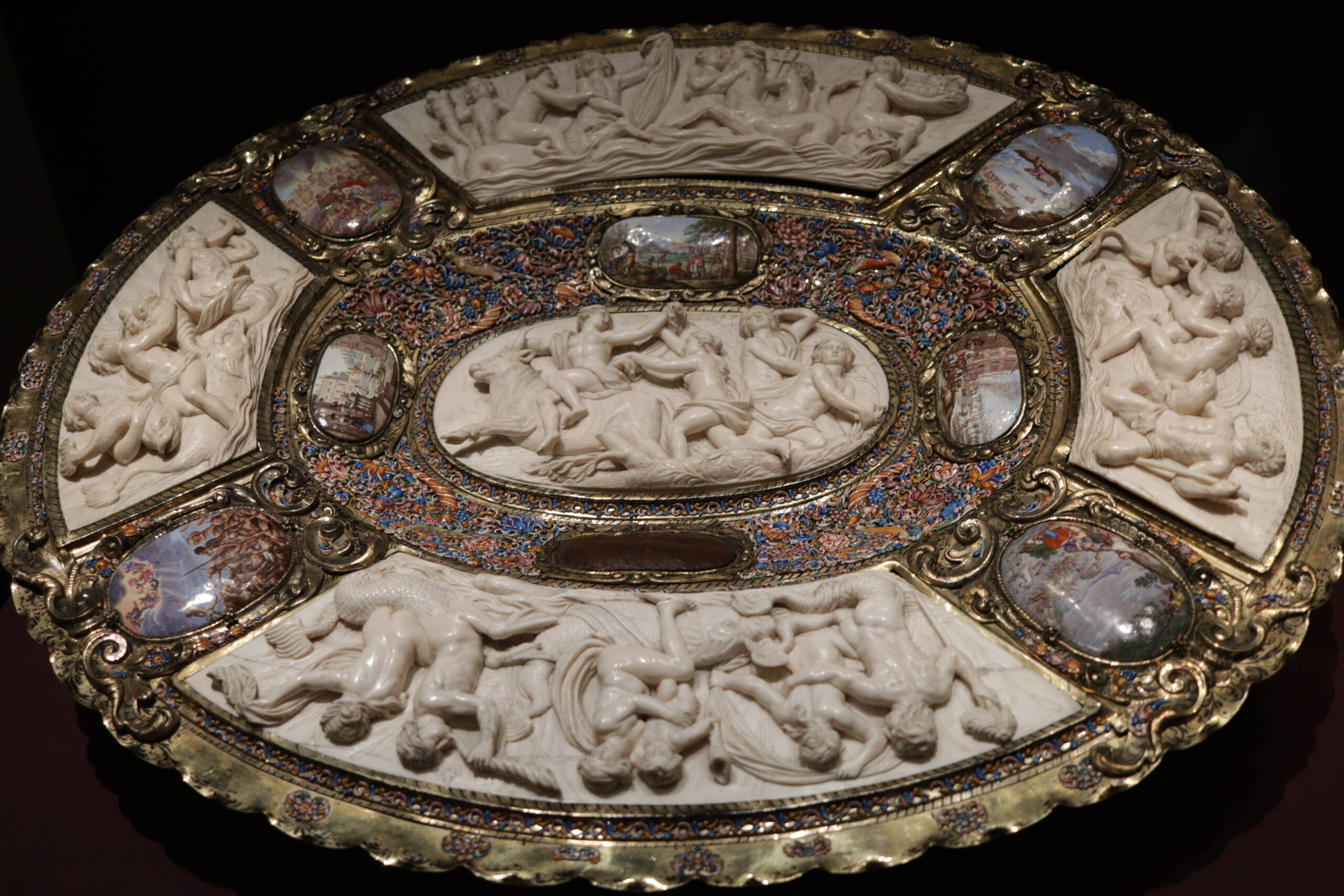
This particular example blends several prestigious materials, each chosen deliberately. The central and surrounding reliefs are crafted from carved ivory, a luxury medium imported through Portuguese colonial networks from Africa and Asia. The figures depicted — reclining nymphs, mythological sea creatures, and putti — reflect the Renaissance fascination with classical antiquity and revived Greco-Roman mythology. Workshops in Augsburg, Nuremberg, and Prague were known for this style, and the carving technique suggests links to the circle of Leonhard Kern or Georg Petel, both masters working with ivory during the time of Emperor Rudolf II.
The frame surrounding the ivory scenes is equally important. The dazzling surface of swirling color is champlevé enamel, a labor-intensive decorative method in which recesses are carved or cast into metal and then filled with powdered glass before firing. The enamel here forms dense floral ornamentation, echoing Mannerist visual style — where complexity and virtuosity mattered more than restraint. The gilded metalwork, most likely silver gilt, acts as a unifying structure and demonstrates the role of goldsmiths in elite artistic production.
Inset among the ivory panels are small painted miniatures on mother-of-pearl or enamel, another layer of refinement. These miniature scenes — landscapes, city views, or mythological vignettes — were often executed with needle-thin brushes, sometimes even a single hair, by artists trained in illumination and court miniature portraiture. Their inclusion creates a visual rhythm: carved myth, enamel pattern, painted narrative, repeating around the rim like a carefully orchestrated sequence.
Objects like this were never used as dining ware. Instead, they served as ceremonial gifts or princely display items — placed in treasuries and “wonder rooms” alongside clocks, scientific instruments, coral, rock crystal, and exotica. They reflected economic power, global trade reach, and cultural literacy.
Seeing it today in Vienna, the craftsmanship still speaks clearly: carving requires control and understanding of ivory’s grain; the enamel requires temperature precision — one mistake, and an entire band fractures; miniature painting requires near-surgical steadiness. Nothing about this object was quick or improvised.
It survives not just as decoration, but as evidence of the Renaissance belief that mastery over material was a form of status — and that beauty could assert power just as firmly as armies or territory.
For a visitor to Kunsthistorisches Museum, encountering it is like opening a page from Europe’s early history of collecting: a reminder that art was once both a treasure and a statement.
Leave a Reply