Wander far enough into Toledo’s tangle of medieval streets and you’ll run into buildings that seem to be doing two jobs at once — part fortress, part shopfront. This stone tower, crowned with a wrought-iron weathervane and built from the rough-hewn masonry Toledo is famous for, is a textbook example of mudéjar-influenced construction: the twin horseshoe-arched windows near the top, the alternating brick-and-stone banding, and the defensive, almost watchtower-like massing all point to a building shaped by centuries of overlapping Christian, Muslim, and Jewish craftsmanship.
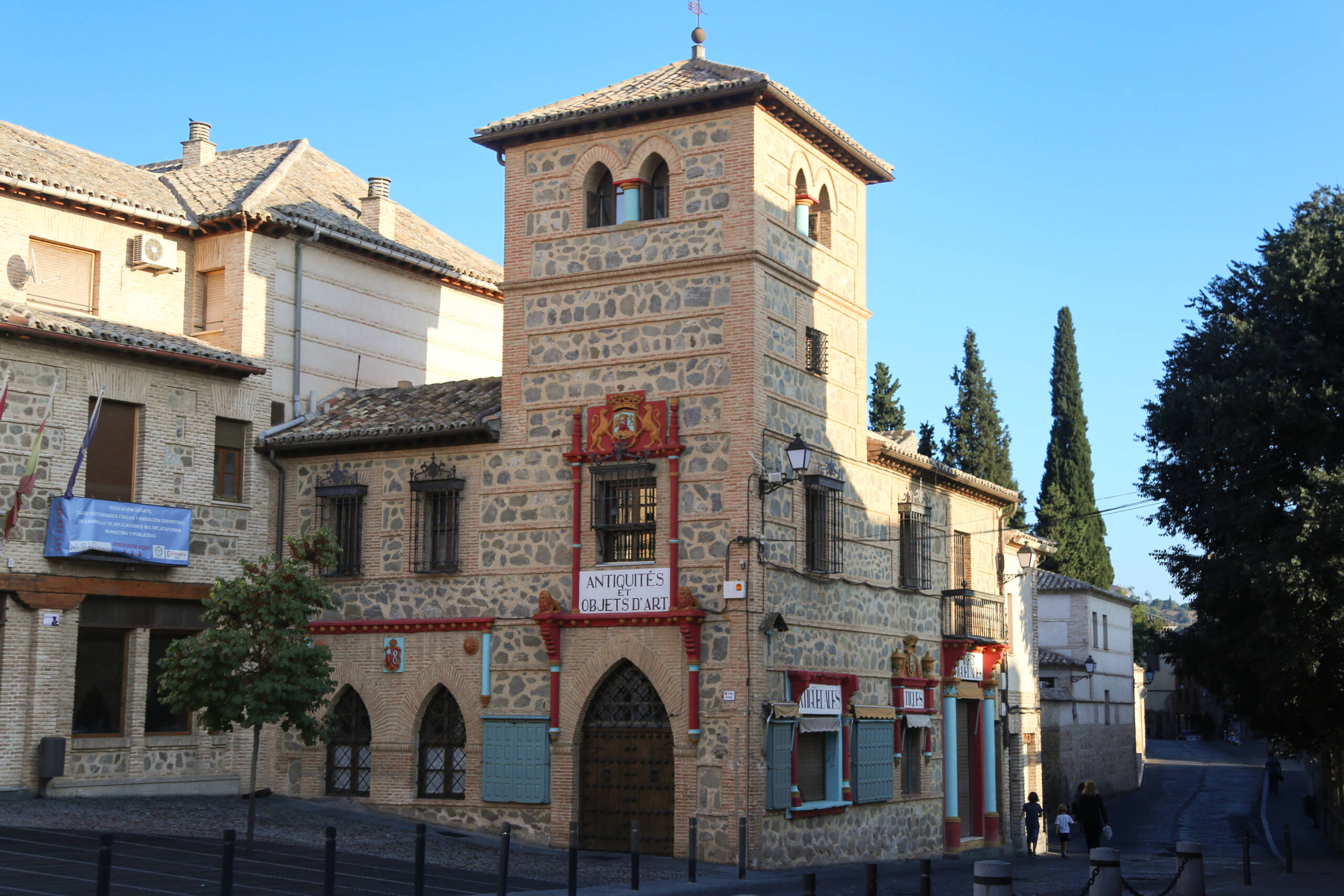
Toledo earned its UNESCO World Heritage status precisely for this layering. Known historically as the “City of Three Cultures,” it served for centuries as a meeting point where Islamic, Jewish, and Christian architectural traditions didn’t just coexist but actively borrowed from one another — hence brickwork techniques inherited from Al-Andalus applied to a building topped with an iron cross.
Today the ground floor does what old Toledo buildings do best: adapt. A hand-painted sign reading “Antiquités et Objets d’Art” marks an antiques dealer tucked behind a pointed Gothic archway, with turquoise-shuttered windows adding a splash of color against the gray stone. It’s a small, unglamorous detail, but it captures how Toledo works as a living city rather than a museum piece — locals still run shops out of buildings older than most nations.
The steep, narrow streets radiating outward reward aimless walking more than a fixed itinerary. Golden-hour light hits the stone particularly well, catching the warm ochre tones of the brick against a deep blue sky.