There is a moment, wandering the lava-stone streets of Catania, when you realize this city has been telling stories for a very long time. The evidence is everywhere — in the baroque facades, in the volcanic black cobblestones of Piazza del Duomo, in the fish vendors at La Pescheria who haggle in a dialect so thick it sounds like a separate language. And occasionally, it is cast literally in bronze.
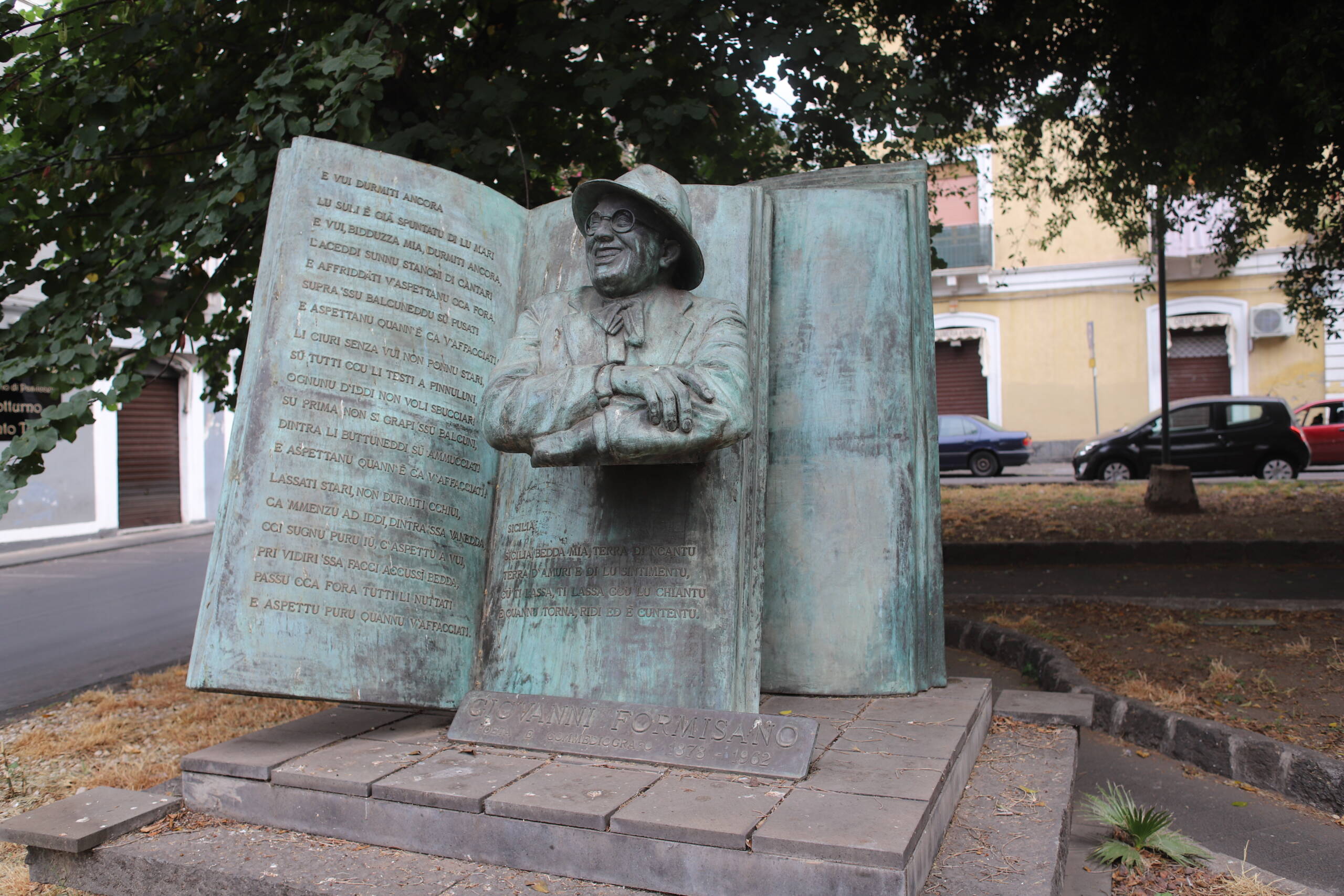
On one of Catania’s quieter streets stands one of Sicily’s most inventive literary monuments: a life-sized figure of Giovanni Formisano, poet and dialect writer, emerging from a giant open book. The patina has gone deep verdigris with age. His arms are crossed, his hat tilted at a satisfied angle, and across both bronze pages his verse unfolds in Sicilian — including the famous lines of longing that open with Sicilia bedda mia, beautiful Sicily, land of enchantment. It is the kind of monument that stops you cold and makes you want to find out who this man was.
Giovanni Formisano and the Sicilian Dialect Tradition
Formisano (1871–1962) lived nearly a century and spent much of it celebrating Sicily in its own tongue. Writing in Sicilian dialect was a political as much as an aesthetic choice — a refusal to let the standardizing forces of unified Italy flatten the island’s cultural distinctiveness. His work sits within a long tradition of Sicilian dialect literature stretching back to the medieval Scuola Siciliana, the 13th-century court poets of Frederick II who effectively invented the Italian lyric tradition. That Catania would honor him with a monument of this ambition — a man stepping out of his own book — says something about how seriously Sicily takes its writers.
Catania’s Literary Giants
Formisano is the city’s lesser-known literary son. The famous ones draw pilgrims from across the world.
Giovanni Verga (1840–1922) is the titan. Born in Catania, he became the founder of verismo — Italian literary realism — with novels like I Malavoglia and Mastro-don Gesualdo that portrayed Sicilian peasant life with an unflinching, documentary precision that felt revolutionary in its time. His birthplace on Via Sant’Anna is now the Casa Museo Verga, preserved largely as he left it, with his writing desk, personal library, and correspondence intact. It is one of the finest writer’s house museums in Italy and almost never crowded.
Vitaliano Brancati (1907–1954), born in Pachino but deeply associated with Catania, wrote biting satirical novels about Sicilian masculinity and fascism — Don Giovanni in Sicilia and Il bell’Antonio among them — that feel startlingly contemporary. His work was adapted for film by Mauro Bolognini and remains widely read in Italy.
Luigi Capuana (1839–1915), a close friend of Verga and fellow verismo pioneer, was born nearby in Mineo and is woven into the same literary circle that made late 19th-century Catania one of the most intellectually alive cities in the Mediterranean.
The Literary Geography of Catania
The city rewards walking. The Casa Museo Verga is the essential stop, but the surrounding streets of the historic center carry their own literary atmosphere — the baroque grandeur that Verga described, the market life that appears in his fiction, the shadow of Etna that hangs over everything. Sicilian literature is inseparable from the volcano; it appears as backdrop, metaphor, and geological fate in writers from Verga to the contemporary novelist Nino Haader.
The Biblioteca Civica di Catania, housed in the former monastery of San Francesco, holds significant regional literary archives and is worth visiting for the building alone.
For those willing to venture slightly beyond the city, the town of Vizzini — about an hour’s drive — was Verga’s family home and the setting for several of his stories. The landscape there, rugged and sun-bleached, looks almost exactly as his fiction describes it.
Practical Notes for the Literary Traveler
- The Formisano monument is on a residential street away from the main tourist circuit — finding it feels like a genuine discovery rather than a scheduled stop.
- Casa Museo Verga is closed Mondays; book ahead as capacity is limited and it sells out on weekends.
- La Pescheria, Catania’s famous fish market, runs mornings only and is over by early afternoon — Verga wrote about markets exactly like this one.
- Catania is best used as a base: Taormina, Siracusa, and the Etna wine country are all within an hour, each with their own literary associations.
- The dialect inscribed on the Formisano monument is genuine Sicilian — not Italian — and even fluent Italian speakers will find it largely opaque. That’s the point.
Sicily has always known that its stories were worth telling. It took the rest of the world a little longer to agree. Come to Catania and let the city make its own case — in basalt and baroque and bronze, in dialect verse carved into the pages of a book that will never close.