Brussels is not the first city that comes to mind on the European literary tourism circuit. Paris gets the expatriates, Dublin gets Joyce, Prague gets Kafka. But linger near the Grand-Place long enough and you’ll find a city with a remarkably rich intellectual tradition — and a bronze mayor who embodies it perfectly.
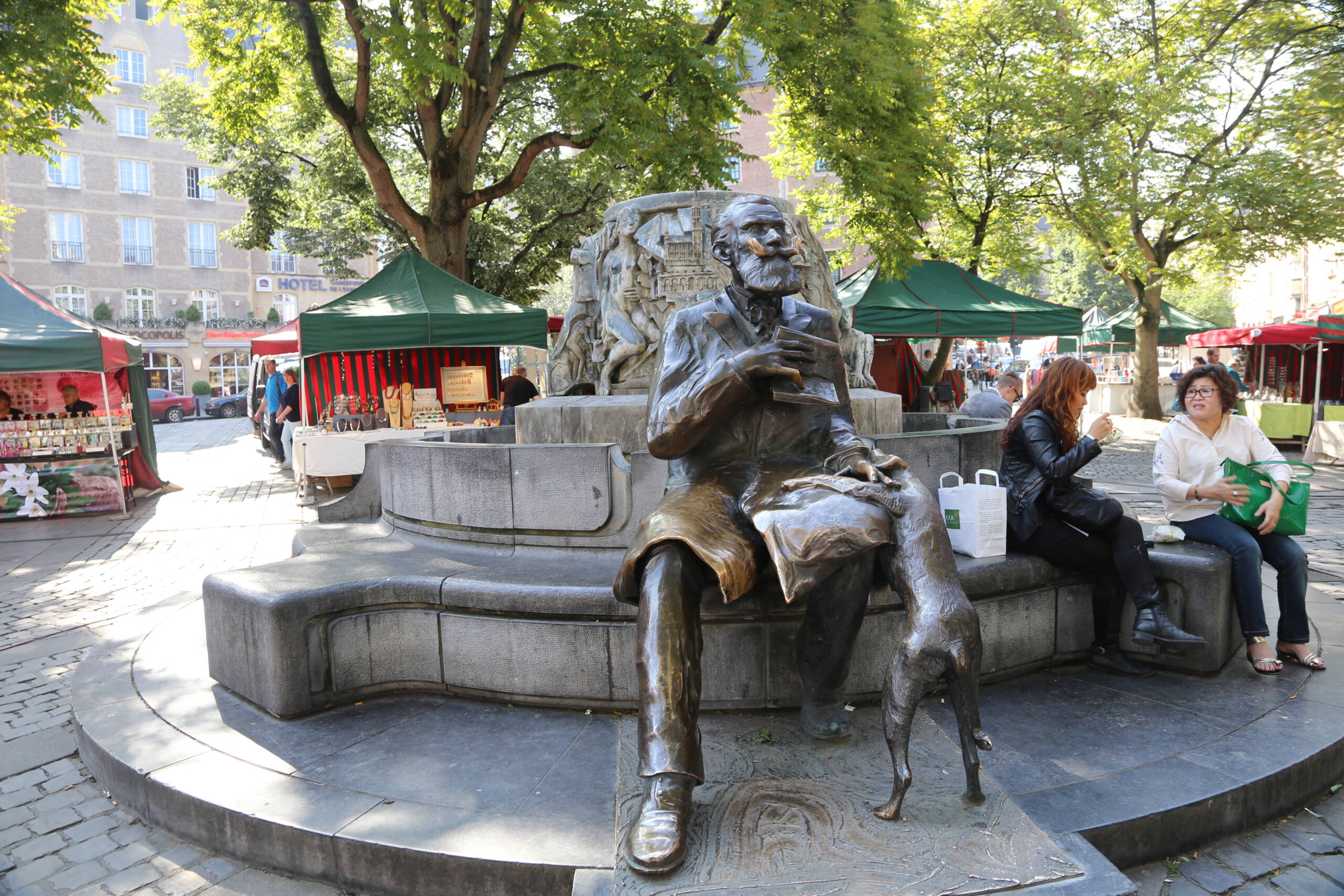
Just steps from the Grand-Place, in the sunlit cobblestones of Agora Square, sits Charles Buls. Not a statue in the heroic mold — no horse, no raised sword — but a relaxed, life-sized bronze of a bearded man seated on a fountain ledge, a book in hand, his dog lean and attentive at his feet. Tourists sit beside him daily, and that’s entirely the point.
Who Was Charles Buls?
Karel Buls served as Mayor of Brussels from 1881 to 1899, and the city owes him more than it typically acknowledges. When late 19th-century urban planners proposed driving a grand boulevard straight through the historic heart of Brussels — a project that would have gutted the medieval fabric around the Grand-Place — Buls fought back. He won. The Grand-Place, now a UNESCO World Heritage Site, survived largely because of his conviction that a city’s beauty was inseparable from its identity.
But Buls was not merely a politician. He was an educator, an art historian, and a writer. His book Esthétique des villes (The Aesthetics of Cities), published in 1893, was a serious work of urban theory — arguing that the organic, human-scaled city was worth defending against the bulldozer of progress. It placed him squarely in the intellectual tradition of the era, a contemporary of Ruskin and Morris in spirit if not in nationality.
The fountain-monument, created by sculptor Julien Dillens in 1898, captures that spirit: not power, but pensiveness. A man thinking about his city.
The Intellectual Geography of Central Brussels
The Grand-Place itself is the logical next stop, and it rewards the visitor who knows its history. Victor Hugo lived in Brussels in exile and called the square the most beautiful in the world — a verdict he shared in letters that are still quoted on tourist placards today. Charlotte Brontë visited Brussels twice in the early 1840s, studying French and falling into a complicated emotional attachment to her teacher Constantin Heger. She processed the experience in both The Professor and Villette, and the city appears in both with barely disguised geography. The building that housed the Pensionnat Heger where she studied still partially stands on Rue Isabelle — a modest but moving pilgrimage site for Brontë readers.
Maeterlinck, Simenon, and the Belgian Literary Tradition
Belgium produced two of the 20th century’s most important writers, and neither gets nearly enough tourist attention. Maurice Maeterlinck, who won the Nobel Prize in Literature in 1911, was born in Ghent but is woven into the cultural fabric of the entire country. His symbolist drama Pelléas et Mélisande — later set to music by Debussy — helped define a generation of European modernism.
Georges Simenon, born in Liège, created Inspector Maigret and became one of the most translated authors in history. Brussels figures repeatedly in his work, and the foggy, gas-lit, morally ambiguous city of his novels is not so far from the Brussels of the Belle Époque that Buls was trying to preserve.
Practical Notes for the Literary Traveler
- The Charles Buls fountain at Agora Square is steps from the Grand-Place — free, always accessible, and best photographed in morning light before the market stalls crowd the frame.
- The Musée de la Ville de Bruxelles, inside the Grand-Place itself, covers the city’s history including the Buls era in detail.
- Charlotte Brontë’s Brussels can be followed using the Charlotte Brontë in Brussels walking guide, available through the Brontë Society and various Brussels tourism resources.
- The Bibliothèque Royale de Belgique (KBR) holds major literary archives and runs public exhibitions — worth checking for current programming before your visit.
Brussels rewards the traveler willing to look past the waffles and the Manneken Pis. Sit beside Charles Buls for a moment. He spent twenty years thinking about what makes a city worth caring about. The answer, it turns out, is still sitting right in front of you.