• Skip to main content
  • Skip to secondary menu
  • Skip to footer

Travel Marketing

Travel and Tourism Trends

  • Sponsored Post
  • Travel Event Calendar
  • Travel Market
  • Travel Magazine
  • About
  • Contact

Piazza del Duomo, Catania: Where a Black Lava Elephant Guards Sicily’s Baroque Heart

July 6, 2026 By admin Leave a Comment

At the center of Catania’s Piazza del Duomo stands one of Sicily’s most recognizable and least explained monuments: a smiling elephant carved from black lava stone, balancing an ancient Egyptian obelisk on its back like it’s the most natural thing in the world.
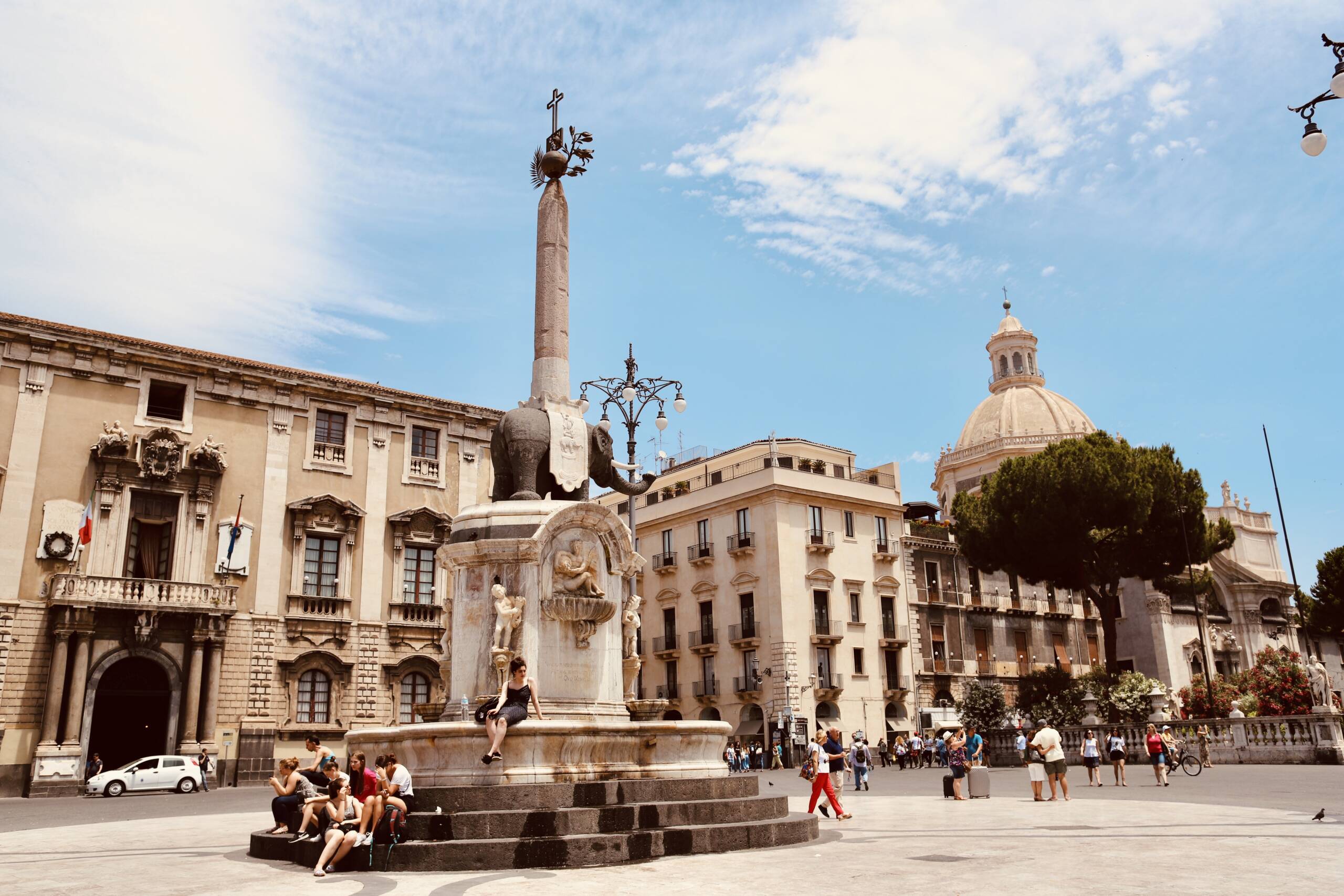
Piazza del Duomo, Catania: Where a Black Lava Elephant Guards Sicily's Baroque Heart

The Fontana dell’Elefante dates to 1736, when architect Giovanni Battista Vaccarini redesigned the square after the catastrophic 1693 earthquake leveled much of eastern Sicily. The elephant itself — nicknamed “u Liotru” by locals — is far older than its 18th-century fountain base, likely a Roman-era or even earlier volcanic rock carving that had been a talisman for the city for centuries before Vaccarini repurposed it. The granite obelisk on its back, capped with a cross, a palm branch, and the palm of Saint Agatha, Catania’s patron saint, was salvaged from a much older structure and simply added to the composition — a very Sicilian layering of Roman, Egyptian, and Christian symbolism into a single object.

The piazza around it earns its UNESCO World Heritage status honestly. To the west, the Palazzo degli Elefanti (Catania’s town hall) shows off the exuberant Sicilian Baroque style that swept the region after the earthquake forced a near-total architectural rebuild. To the east, the dome of Catania Cathedral, dedicated to Saint Agatha, rises above rooftops — its interior holds the tomb of composer Vincenzo Bellini, a native son.

What makes the square work as a travel stop isn’t grandeur so much as ease. It’s compact, walkable, and constantly in motion — locals cutting across on their way somewhere else, visitors perched on the fountain’s black-and-white marble steps, the volcanic stone underfoot a quiet reminder that Mount Etna looms just a few miles inland and built this city’s building material one eruption at a time.

Best visited early morning before the heat sets in, or at dusk when the lava stone buildings pick up warm light against the sky.

Filed Under: News

Reader Interactions

Leave a Reply Cancel reply

Your email address will not be published. Required fields are marked *

Footer

Recent Posts

  • Toledo’s Old Town: A Mudéjar Watchtower Hiding an Antiques Shop
  • Piazza del Duomo, Catania: Where a Black Lava Elephant Guards Sicily’s Baroque Heart
  • Château de Fougères: Inside Europe’s Largest Medieval Fortress
  • Château de Vitré: The Medieval Fortress Guarding Brittany’s Eastern Gate
  • Miroir d’eau at Blue Hour: Bordeaux’s Water Mirror Comes Alive
  • Blue Hour on the Garonne: Dinner Cruises and Bike Traffic Along Bordeaux’s Quays
  • Bourse Maritime, Bordeaux: A Night Scene Along the Garonne
  • Château d’Angers: Where a Medieval Fortress Anchors a Living French Roundabout
  • Saint-Goustan: The Old Port Quarter Hiding Under Auray’s Stone Bridge
  • Auray’s Hôtel de Ville at Blue Hour: Brittany’s Quietest Grand Facade

Media Partners

  • Virtual Travel Guide
  • Ancient Rome
Lisbon’s Seven Hills: A Walking Guide That Tells You the Truth
New Orleans: An American City That Plays by Different Rules
Ha Long Bay Without the Cruise Brochure
Istanbul at the Threshold: A City That Has Always Been Two Things at Once
Iceland’s Ring Road: What the Drive Teaches You That No Photograph Can
Marrakech’s Medina: How to Read a City That Was Not Designed for You
Torres del Paine: What You Are Actually Getting Into
Kyoto in Autumn: What the City Looks Like When the Maples Turn
Disneyland Paris Rewrites Its Script With World of Frozen and Disney Adventure World
Wallace Fountain: Carrying Water, Carrying Values
Water Across the Empire: Roman Aqueducts and the Hydraulic Logic of Conquest
The Oath of the Horatii: David's Roman Republic in Paint
Jean-Léon Gérôme: The Victorian Gaze on Rome
Ostia: The Port That Fed Rome
Roman Naval Warfare: The Sea They Called Their Own
The Roman Grain Ship: How Rome Fed Itself Across the Sea
Trajan's Column: Rome's Greatest Comic Strip
Caesarea Maritima: A Roman City Built from Nothing
Damnatio Memoriae: Rome's War on Memory
Faustina the Younger: The Woman Behind the Philosopher Emperor

Media Partners

The Immersive Experience in the Museum World
Japan, China, and Taiwan: A New Triangle of Risk — and a Window of Opportunity for Japan
Ghost Kitchens as Infrastructure: The Shift from Restaurants to Intelligent Food Networks
The Zoom Divide Nobody Saw Coming
The Perfect Budget Content-Creator Kit
Reimagining Prague’s Tourism Future Through Immersive Media and VR Museums
Israel’s Urban Paradox: Tel Aviv Moves, the Rest Stand Still
American Express Global Business Travel (GBTG): Understanding the Business and the Investment Case
Why the Canon R8 Paired With the New RF 45mm f/1.2 Lens Quietly Becomes the Content Creator’s Sweet-Spot
The Future of Travel: A $15.5 Trillion Industry

Copyright © 2026 Travel Marketing

Media Partners: Timey · Publishing House · Ancient Rome · Photography · Calendarial · Transportational