Every travel influencer has the shot. The candy-colored houses reflected in a still canal. The glass furnace glowing orange in a dim workshop. The narrow back street with laundry strung between facades like bunting at a festival. The photos are real. The experience behind them is almost entirely manufactured — and the gap between image and reality is one of the more reliable disappointments in European tourism.
This is not a contrarian take for its own sake. Murano and Burano are genuinely photogenic. But photogenic and worth your time are different things, and the tourism industry has spent decades conflating the two at the visitor’s expense.

The Burano canal postcard — colorful houses, bobbing boats, a scattering of visitors. Note the “Glass Factory” shop already visible at street level. You are thirty seconds off the vaporetto.
The standard pitch goes like this: Murano is an island of master glassblowers, a living craft tradition going back to 1291. Burano is a fishing village where the wives of fishermen painted their houses in bright colors so their husbands could find their way home through the lagoon fog. Both islands are “authentic” Venice — the real thing, away from the cruise ship crowds of San Marco.
None of this is false, exactly. The glassblowing tradition is real. The houses are genuinely colorful. But the framing strips out everything inconvenient. The fishing economy on Burano collapsed decades ago. The population has been in freefall — the island had over 9,000 residents in the mid-20th century; today it hovers around 2,500, skewing elderly. What’s left isn’t a fishing village. It’s a set.
Murano tells a similar story in a different register. The glassmakers are real. The furnaces are real. But the island’s public face — what tourists actually encounter — is almost entirely commercial infrastructure layered over a quietly depopulating residential core. The signature piece of public art, a massive blown-glass sculpture in the main campo, is spectacular and completely disconnected from anything a local resident’s daily life requires.
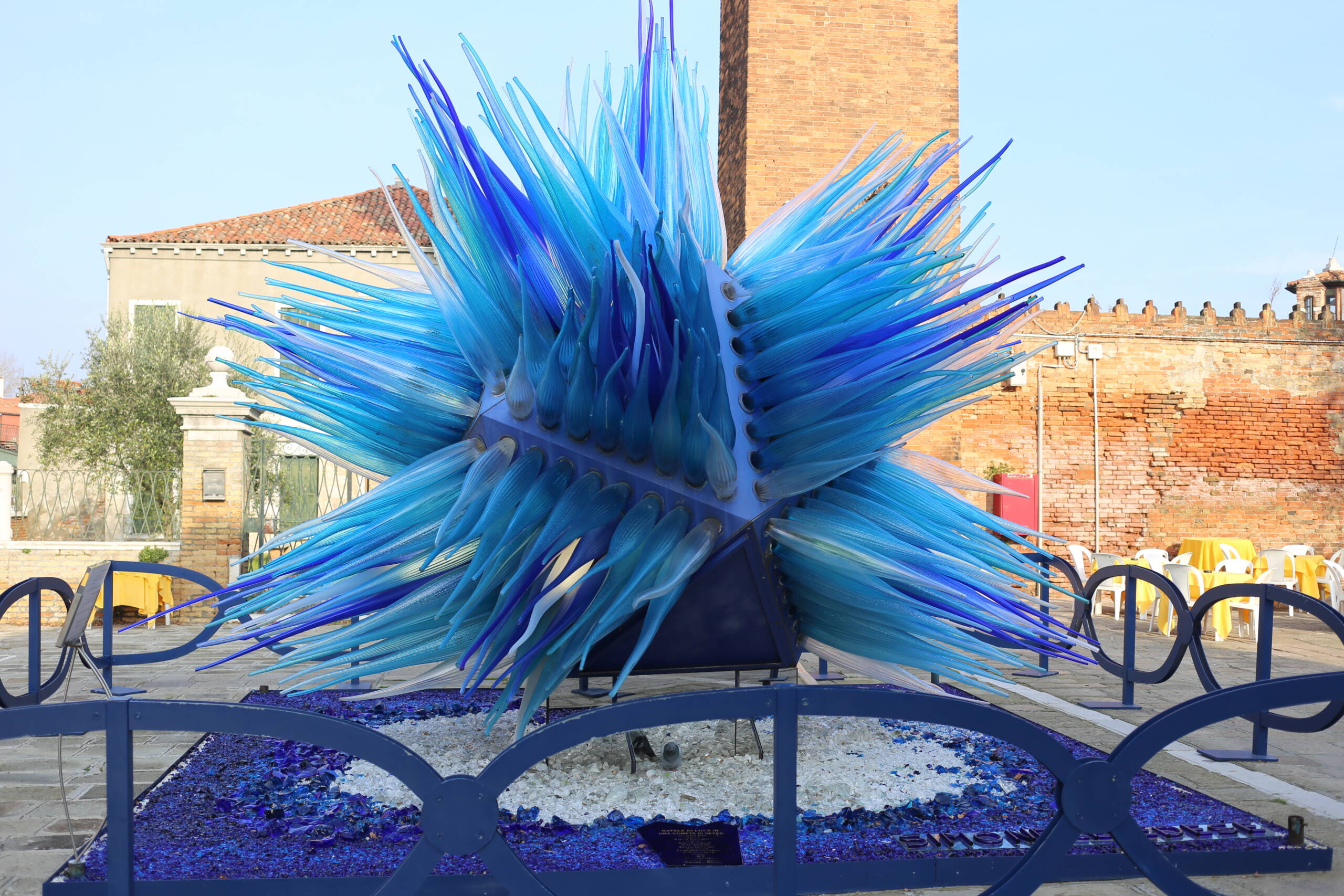
A monumental glass installation in Murano’s main square — technically impressive, visually striking, and about as connected to working glassblowing culture as a Hard Rock Cafe is to music. This is tourism infrastructure dressed as heritage.
Walk off the vaporetto on Burano and the first thing you encounter is a gauntlet of shops. Burano was once famous for its handmade lace — another dying craft, this one essentially dead. Most of what’s sold now is machine-made, much of it imported. The shops know this. Some will tell you if you ask directly. Most won’t.
On Murano, the equivalent gauntlet runs along Fondamenta dei Vetrai from the moment you dock. The shops there are beautiful. The window displays are legitimately arresting — glass parrots, chandeliers in acid green, vases in forms you haven’t seen before. The craft that produced them is centuries old and technically demanding. None of that changes what the experience of shopping there actually is: a high-pressure showroom visit, preceded by a demonstration designed to make you feel obligated.
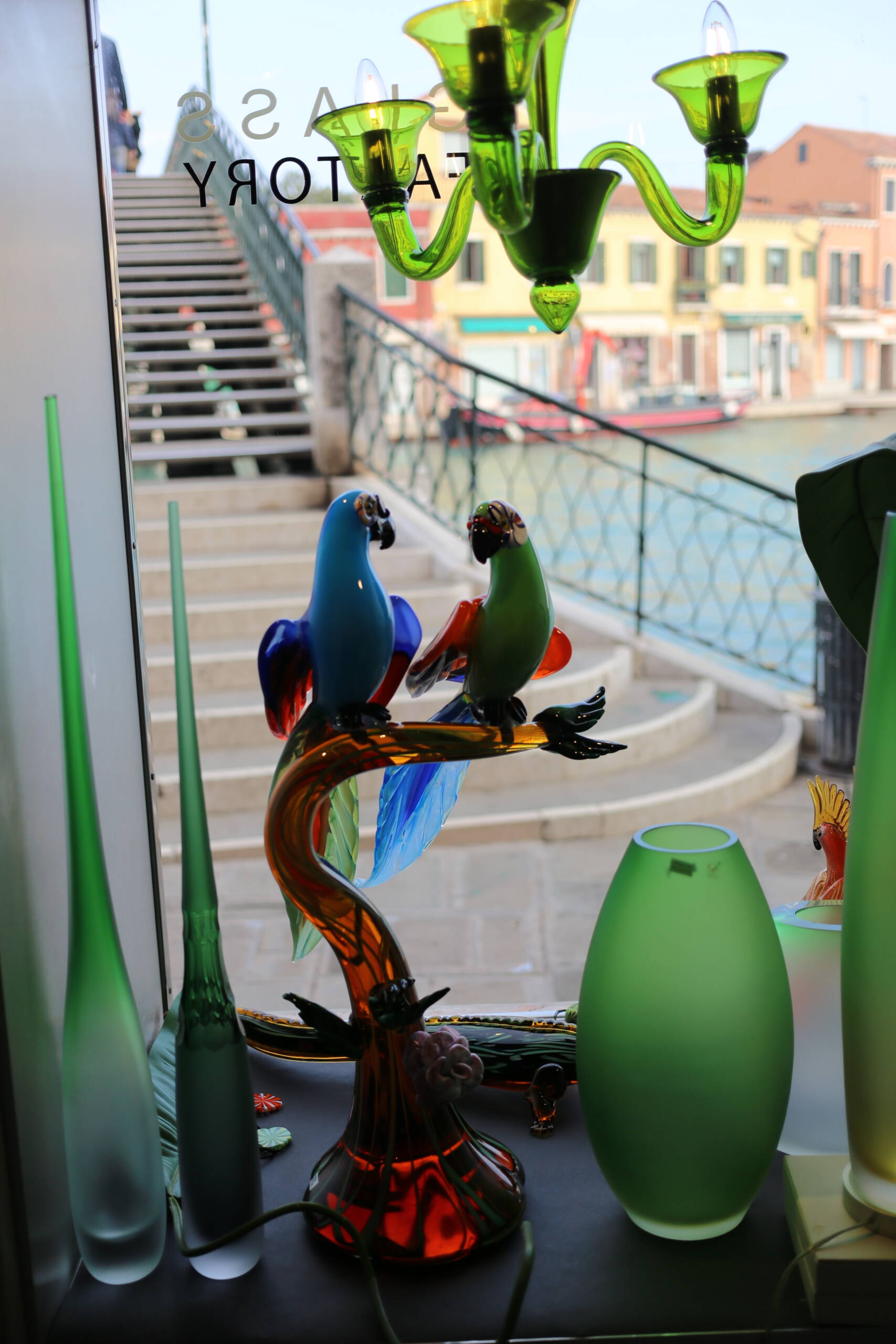
A Glass Factory display window on Murano — genuinely beautiful objects in a genuinely beautiful setting. The canal is right outside the door. The price tags are just out of frame. The parrot figurines start at €180.
The demonstrations are the pivot point of the Murano experience and worth examining honestly. Groups are ushered into furnace rooms on a rotating schedule — typically every thirty to forty-five minutes — for a fifteen-minute show in which a skilled glassblower shapes molten glass into a horse or a vase while a handler narrates in three languages. It is impressive. The craft is real. But it’s also a sales funnel with a spectacular opening act. The moment the demonstration ends, the group flows directly into an adjacent showroom. The transition is seamless and intentional.
The showroom itself is where the economics become clear. Carnival figurines in hand-blown glass — genuinely skilled work, no question — run €150 to €300 for a single piece. Sets cost more. The Murano glass clown has become such a cliché of the tourist souvenir market that it now reads as kitsch even when the execution is flawless. You’re paying for craft and leaving with something your friends will recognize as a Venice souvenir, which is a different thing entirely.
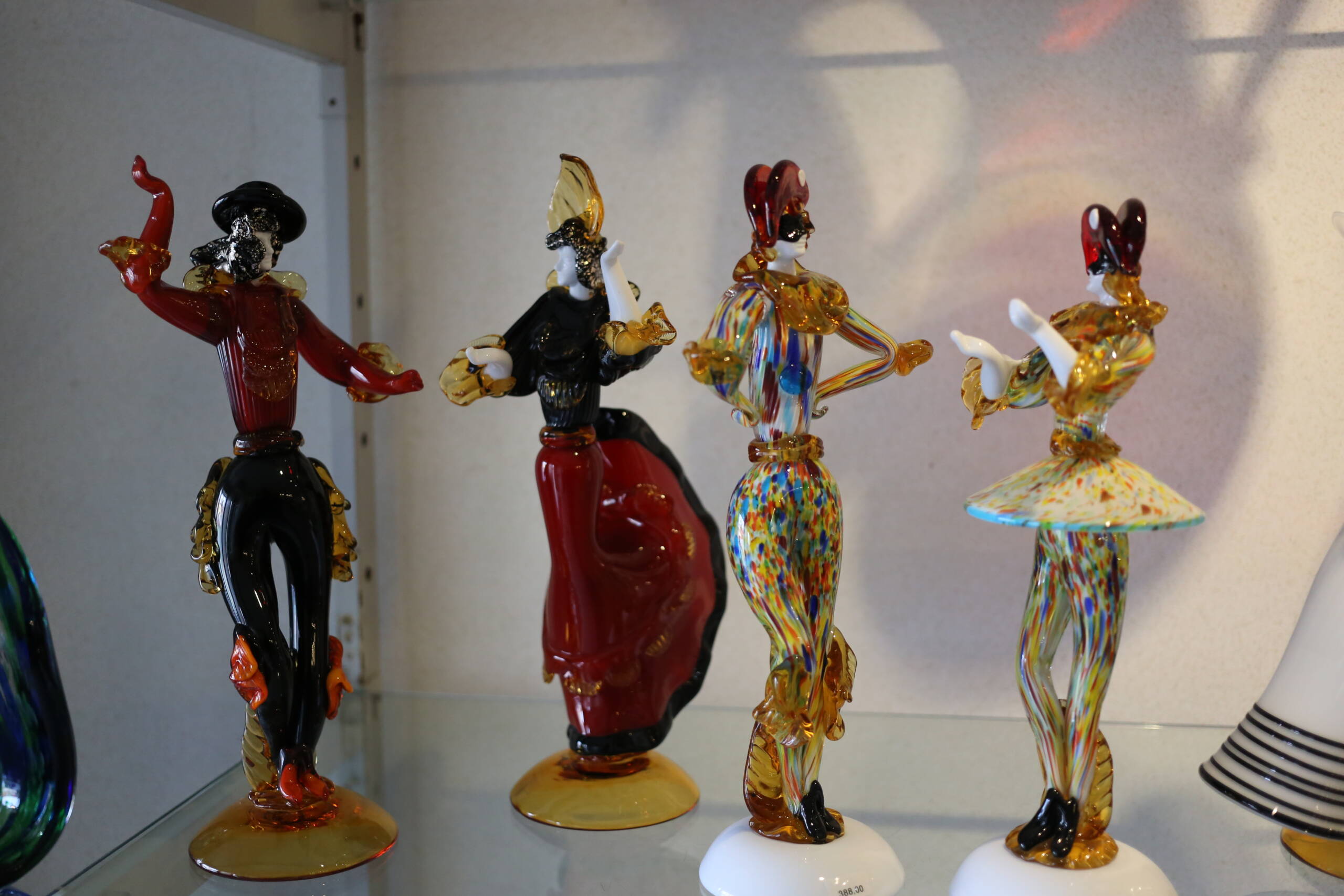
Glass Carnival figurines on a showroom shelf. The craftsmanship is genuine. The price tag on the rightmost figure reads €188.30. The question isn’t whether they’re worth making — it’s whether you came to Murano to buy one.
Away from the shop frontage, both islands reveal what they actually are: quiet, slightly tired, genuinely scenic in a minor key. Murano’s back canals are attractive in the way that any Venetian canal is attractive — which is to say, very. The church of Santi Maria e Donato is worth twenty minutes and is almost always empty. The residential streets feel like a small Italian town that happens to be surrounded by water and visited by thousands of people daily who don’t particularly see it.
The working canal on Murano tells the island’s real story better than the showrooms do. Delivery boats cutting through the grey water, the Trattoria Al Frati with its dock-side terrace, peeling facades on buildings that have been here for four hundred years — this is what remains of an actual place. It is not especially dramatic. It doesn’t need to be. But it has nothing to do with the island experience being sold.

A delivery boat runs the main canal on Murano. In the background, Trattoria Al Frati. This is the working island — supply chains, boat maintenance, a restaurant whose customers are divided between tourists and the people who actually live here. The ratio tilts heavily one way.
The restaurants on both islands operate on captive-audience economics. You’ve taken a forty-minute boat ride. You’re not getting back on the vaporetto hungry. The operators know this, and they price accordingly. On Burano, pasta runs €18–24. The risotto di go — the traditional local dish, made from lagoon fish — costs €28–35 and varies considerably in quality depending on where you order it. Wine lists are short and marked up aggressively. The service ranges from indifferent to harried depending on season and staffing.
None of this is a scandal. It is simply what happens when you remove competition from an equation. There’s nothing to push prices down, so they don’t go down. The food is not bad. It is also not good enough to justify the prices, and the setting — however scenic — cannot fully compensate for the feeling that you are being efficiently processed.
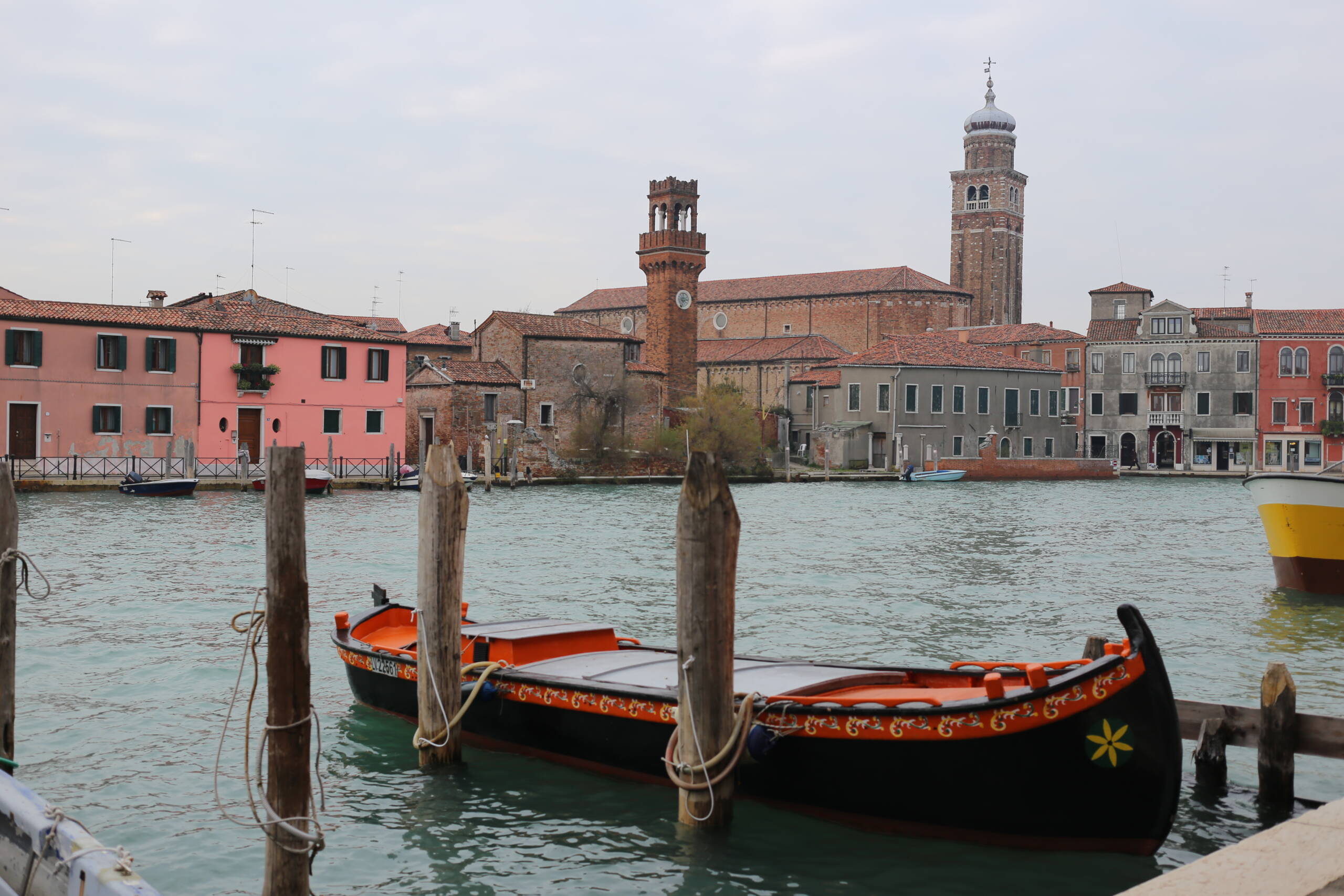
Murano’s waterfront from the dock — ornate gondola-style boats in the foreground, the Campanile of San Pietro Martire behind. Genuinely beautiful. Also: overcast, quiet in the wrong direction, and about thirty minutes from having seen everything the island’s main circuit has to offer.
The deeper issue with both islands is temporal. They are genuinely beautiful in the first five minutes — the arrival, the first canal view, the initial hit of color or craft. That beauty is real and not to be dismissed. But it doesn’t sustain. After the first twenty minutes on Burano, you’ve walked the main canal, photographed the primary street, and stood in front of four lace shops. There are more streets. They look like the first ones. The island is small. The novelty compresses fast.
The back streets of Burano, away from the tourist circuit, are where the island’s residual reality is visible. Laundry hung between buildings in full color saturation. Satellite dishes bolted to hot-pink facades. The evidence of people actually living in these houses — older residents, predominantly, the generation that didn’t leave when the fishing collapsed. These streets are quieter and more honest than anything on the main drag. They are also the streets the guidebooks aren’t sending you to, because they don’t photograph as cleanly.
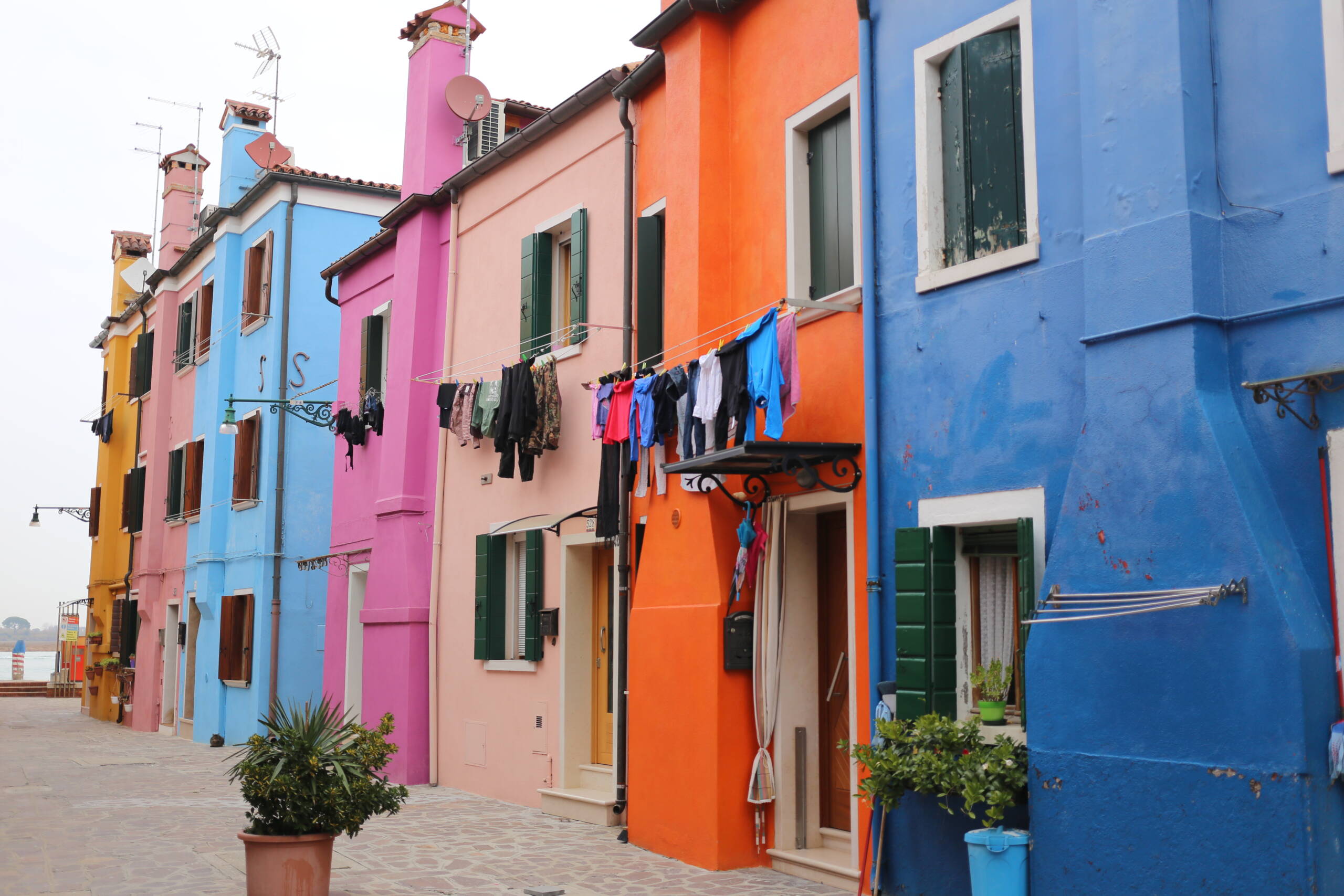
A back street on Burano, empty except for the laundry. This is the actual island — peeling paint on the blue house at right, satellite dish on the pink one, nobody selling you anything. It takes about ten minutes to find this. Most visitors don’t bother.
What the Day Actually Costs
Round-trip vaporetto from Venice using a day pass: €20–25 per person. If you’re buying individual tickets at the tourist dock without reading the signs carefully, expect to pay significantly more.
Lunch for two with wine on Burano: €70–100, conservatively.
A piece of Murano glass from a showroom: €80 minimum for anything you’d actually want.
Lace from Burano that was made in Burano: good luck.
Total spend for two people covering both islands in a day: €200–280 is not unusual. For that money, you could eat extraordinarily well in Venice proper, visit the Accademia and the Peggy Guggenheim on the same day, take a traghetto across the Grand Canal, and not spend ninety minutes on a vaporetto staring at the lagoon.
Who Should Still Go
If you’re a serious collector of Venetian glass and want to buy directly from independent makers — not the showroom operations, but the smaller workshops on the back canals — Murano is worth the trip. The craft is real and the best of it is genuinely significant. Skip the demo shows. Find the workshops that don’t advertise.
If you have children who will be straightforwardly delighted by brightly colored houses and gelato, Burano delivers that cleanly and without complication.
If you’re a photographer willing to be there by 7:30am before the day-trippers arrive, the light on those canals in the early morning is extraordinary and the streets are empty enough to shoot without managing crowds.
For everyone else: go once, spend half a day, take your photos in the first hour, eat a modest lunch, and leave with accurate expectations. The islands are beautiful. They are also finished in about twenty minutes of honest looking. The mythology has simply outrun the reality by several decades, and nobody in the tourism infrastructure has much incentive to close that gap.
The fishing village is in the history books. What’s there now is a very pretty operation built on its memory, photographed several hundred thousand times a year by people who will get home and realize the photos were the whole story — and that the story was over almost as soon as it started.