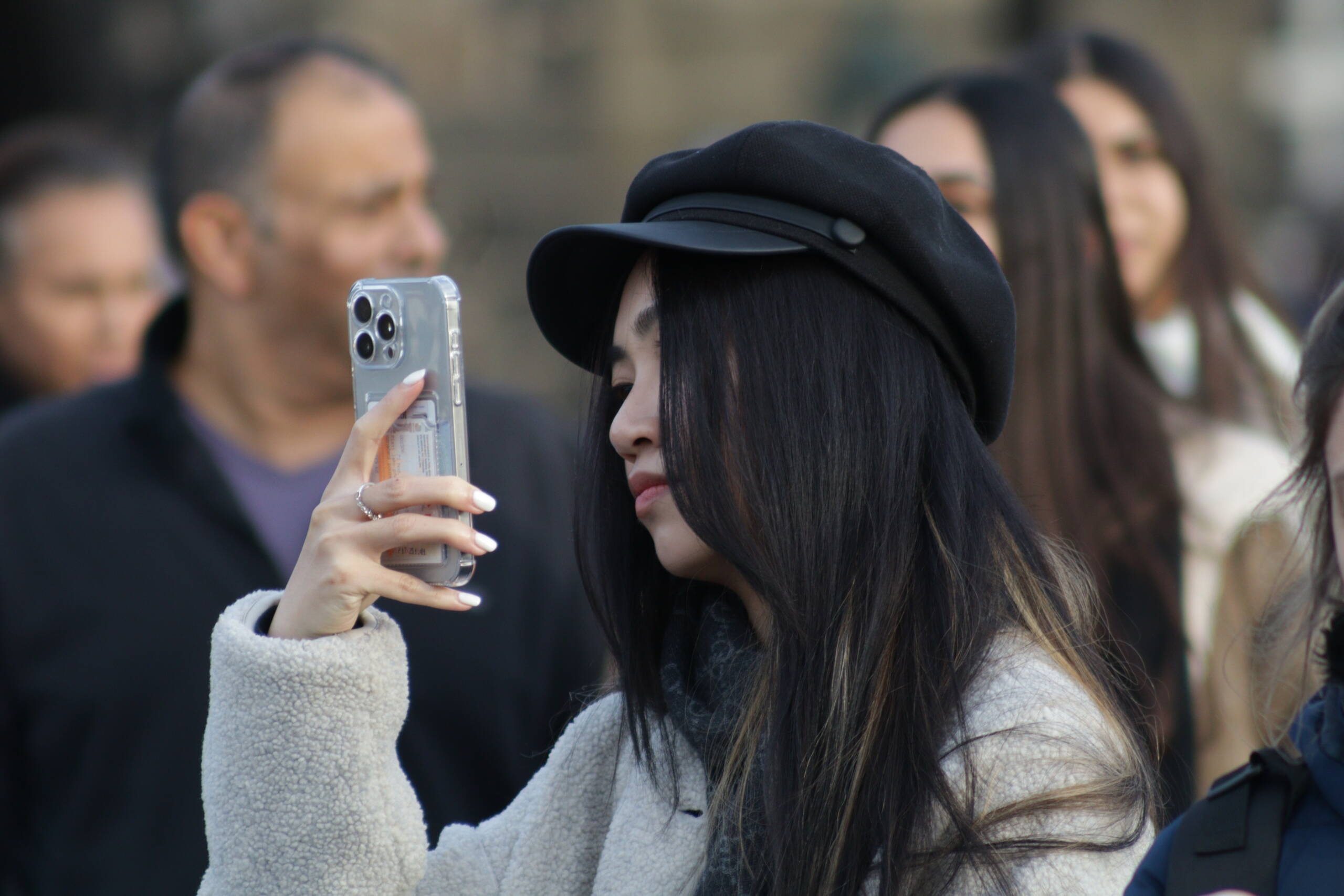
There is a kind of poetry in how this moment was caught. A young woman in profile holds her phone up with practiced ease, fingers balanced on the edges as if the device were part of her hand. The phone carries the corner-mounted triple lens of an iPhone Pro, and its clear case is stuffed with cards. Real life sits right behind the polished screen. It is a passport to visibility as much as a camera.
Her outfit finishes the picture. A soft, textured white coat, a structured black cap angled just enough to suggest style without effort, long dark hair falling forward and half hiding her face. Around her the crowd blurs into background, as if the street had stepped back to make room. That is the influencer moment in one frame: cutting yourself off from the noise while broadcasting it to everyone else.
Photograph hosted by TravelMktg.com.
The Camera Bag Is Gone
Not long ago, a travel shot meant a heavy camera raised to the eye and some fiddling with dials. Now the lens lives in a pocket, and the posture tells its own story. Elbow tucked in. Chin lowered a fraction. The phone tilted with intent. She is composing for an audience on the other side of the glass, maybe a portrait, maybe a slice of street atmosphere, maybe a quick Story that disappears tomorrow.
Phone makers have noticed. When Apple launched the iPhone 17 Pro in September 2025, it pitched the phone squarely at content creators, with 48 megapixel sensors on all three rear cameras, recording from the front and back cameras at once, and pro video features meant to slot into a film workflow. The redesign also moved the cameras from the corner square in this photo into a bar across the back. So her phone is an earlier Pro model, which says something about how fast the gear cycle turns. For many creators one device now does what used to take a phone plus a vlogging camera.
The cards in the case matter too. The same object is a wallet, a boarding pass, a map, a studio and a diary. Lose it on the road and you lose most of your trip.
What Brands Are Paying For
For travel marketers this is the shift that matters. Hotels, cruise lines and tourism boards now budget for creators the way they once budgeted for print ads and press trips. A comped room, a free cabin or a hosted itinerary in exchange for posts is standard practice. We have covered how that works at sea in how cruise lines structure influencer deals and how cruise influencers are rewriting travel marketing.
The flip side is the crowd effect. Popular spots now come with queues of people waiting for the same frame, a scene we watched play out at Karlskirche in Vienna. Some places push back, and casual documentation in busy markets is getting less welcome, as at Borough Market in London.
The Disclosure Rules Still Apply
A free hotel stay counts as payment. In the United States the Federal Trade Commission’s Endorsement Guides, last updated in 2023, say any material connection to a brand has to be disclosed clearly and conspicuously. That means somewhere the audience will actually see or hear it, without clicking “more”. Platform tools like Instagram’s paid partnership label help, but the FTC still expects a plain disclosure in the post itself. Both the brand and the creator can be held responsible.
In the UK, the Advertising Standards Authority expects an upfront label such as “Ad” at the start of a sponsored post. For travelers the practical lesson is simple. Read the caption before you trust the sunset. If a hotel looks perfect and there is no mention of who paid for the room, ask the question yourself.
Two Cameras in One Frame
There is a quiet irony here. Her phone is capturing a scene, and another camera captured her doing it. Two layers of watching stacked on top of each other. One is for her followers, immediate and polished. The other shows the craft behind the curated lifestyle. Living a moment and recording it at the same time is the core of influencer culture, and in this one posture, cap angled, hand poised mid-air, you can see both the artifice and the authenticity.