Some cities look their best at sunrise. Others are transformed by the evening. Shop shutters come down, café chairs move onto the pavement, music escapes through open doors, and the streets fill with people who have no immediate intention of going home. It is tempting to judge nightlife by the size of a club, the fame of a DJ or the price of a rooftop cocktail, but a city’s true after-dark appeal is often more ordinary and more interesting than that.
There is some evidence behind the familiar names. In August 2026, Time Out’s worldwide nightlife survey, drawing on more than 24,000 local residents across 150 cities and a panel of editors and city specialists, named Bangkok, Berlin, New York City, Melbourne and São Paulo as its top five. Its criteria went beyond nightlife venues to consider affordability, community, welcome and the feeling of being out in a city after dark. That is a much better way to think about a night out than counting nightclubs.
Our selection follows that wider definition. The first five destinations are the survey’s leaders; the others are editorial additions for travelers interested in food, atmosphere, walking, music and the social life of urban streets. They are not a second, invented numerical ranking. And they offer very different kinds of evening.
Bangkok, where dinner and nightlife are almost inseparable
Bangkok is a rare city where a late-night food adventure can be as exciting as the clubs themselves. One evening might move from a rooftop above the city to an intimate cocktail bar, then end with noodles or basil stir-fry at a roadside table. Sukhumvit’s Thonglor and Ekkamai areas are natural starting points for contemporary bars and music; Silom offers another mix, including prominent LGBTQ+ nightlife. The point is not that every street stays awake until dawn, but that there are many different Bangkoks to discover after sunset.
Best for: travelers who want to combine food, nightlife and a city that keeps offering alternatives to the obvious party district. Choose a neighborhood before booking a hotel; Bangkok’s scale makes that decision matter.
Berlin, still the capital of club culture
Berlin’s reputation rests on electronic music and parties that refuse the usual timetable, but it would be a mistake to arrive with one famous club in mind and consider the trip a failure if the door does not open. The social experience begins much earlier in the bars of Kreuzberg and Friedrichshain. Around Simon-Dach-Straße, travelers can spend an entire evening moving between relaxed venues before deciding whether a long night of dancing is really necessary. Berlin’s official tourism guide is a useful starting point for exploring the different districts.
There is also a less romantic reality: commercial pressure and redevelopment have put established clubs under strain. That makes Berlin interesting as a cultural destination, not merely an entertainment product. Its nightlife is something local communities build and defend, not an attraction that can be reproduced on demand.
A great nightlife city does not merely give visitors somewhere to go. It gives residents reasons to stay out, meet one another and make the city their own.
New York City, a different night in every neighborhood
New York can deliver jazz, theater, dance floors, comedy, rooftop views, intimate neighborhood bars and food after the show, often within the same weekend. The Lower East Side offers concentrated bar-hopping; parts of Brooklyn reward visitors prepared to seek out live music and independent venues; Manhattan’s theater districts make a late supper part of the evening. The experience is expensive, though, and planning an itinerary around a specific performance can be more rewarding than simply hunting for a famous club.
New York is best for variety, but not for trying to do everything in one night. Pick a neighborhood and stay with it long enough to see how it changes.
Melbourne, after-dark culture without the spectacle
Melbourne is the understated entry among the global leaders. Its appeal comes from live music, stand-up comedy, neighborhood pubs and the satisfaction of finding a small bar tucked into an ordinary-looking laneway. The central business district is particularly good for exploring on foot, while the wider city offers distinctive music and creative communities. For anyone who dislikes being pushed toward a single megaclub, Melbourne’s eclecticism is a virtue. The official Melbourne after-dark itinerary offers a useful introduction.
São Paulo, where the music scene keeps reinventing itself
São Paulo belongs in any serious discussion of urban nightlife, with samba, house music, vinyl-listening culture and energetic LGBTQ+ spaces sharing an enormous metropolis. Rooftop music nights and bars in adapted historic buildings have helped reshape parts of the city’s after-dark identity. The attraction is less about a single picturesque street than the depth of the scene: there is always another musical community, another bar or another kind of dance floor to discover.
First-time visitors should plan transport between venues rather than assuming that the city works like a compact European old town. São Paulo rewards curiosity, but its distances are real.
Madrid, the art of starting late
Madrid might be the clearest example of nightlife as a public habit rather than a special event. Dinner is not a signal that the evening is over. In Malasaña, the musical soundtrack tends toward indie, rock and alternative culture; Chueca brings an animated LGBTQ+ bar and club scene; the streets around Huertas and central Madrid offer yet another kind of gathering place. Spain’s official tourism guidance captures the variety well.
A useful Madrid strategy is to eat late, walk without a strict route and make a decision about dancing only after you have enjoyed the city’s street life. Not a bad way to spend a holiday evening.
Tokyo, an entire city of small nighttime worlds
Tokyo’s nightlife has an unusual range of scales. Shibuya presents crossings, bright screens and large crowds, while Shinjuku hides tiny drinking establishments in Golden Gai and the food alleys of Omoide Yokocho. Roppongi has a more international bar and club scene. Karaoke, jazz, late-night dining and neighborhood izakaya are as much a part of the experience as dance venues. The official Tokyo nightlife guide helps explain why the city cannot be reduced to neon photography.
For photographers, Tokyo is visually astonishing after dark. For visitors looking for conversation, the smaller bars can be the more memorable discovery, though some have limited seating or their own rules for entry and cover charges.
Athens, old stones and new sounds
Athens is an excellent choice for travelers who want the energy of a late-night city without making clubs the entire purpose of the trip. Psyrri and the streets around Monastiraki are atmospheric places to begin with food and a drink, while Exarcheia has a more alternative character. The combination of outdoor social life, experimental music and contemporary cocktail bars gives Athens an appealing contrast: ancient monuments by day, a very present-tense city by night.
Barcelona, the Mediterranean evening that becomes a night out
Barcelona works especially well for travelers who prefer their nightlife to evolve naturally from dinner. El Born offers narrow streets and a dense collection of cocktail bars; Eixample has an active LGBTQ+ scene and music venues; Poblenou offers larger spaces and clubs. Summer adds another dimension as the city turns toward its Mediterranean setting. The temptation is to do everything near the tourist waterfront, but the best experience often comes from choosing a neighborhood with its own audience.
Barcelona is also a reminder that a famous nightlife destination is a residential city. Keeping the noise down outside venues and respecting neighbors is part of preserving what makes the evening pleasant in the first place.
Mexico City, eating, talking and dancing across the capital
Mexico City’s appeal is the sheer number of ways a night can unfold. Roma and Condesa are familiar starting points for cocktail bars and restaurants, but the wider city encompasses cantinas, live music, contemporary art gatherings and dance venues rooted in different communities. A good evening is often built around food first, then a performance or a neighborhood bar. It is another enormous city, so choose one or two connected areas rather than spending the night commuting between recommendations.
Palermo, proof that a nightlife city does not need megaclubs
Palermo is our deliberately different addition. It does not compete with Berlin’s techno scene or Bangkok’s skyscraper rooftops. Its strength is an evening in which the streets themselves become the destination. Around Vucciria, a historic market district gives way to a lively mix of eating, drinking, music and groups gathering outside. Italy’s national tourism portal describes Vucciria’s transformation after dark; the experience is very much tied to Palermo’s food traditions and its particular urban rhythm.
It is worth exploring the same neighborhood at different times of day. Compare the atmosphere of the market with the evening crowds and consider the culinary backdrop in our guide to Ballarò, Capo and Vucciria and our article on Palermo’s street food. This is the kind of nightlife that can be enjoyed without a ticket, dress code or particular musical taste.
Which nightlife city is right for you?
For all-night electronic music and cultural experimentation, Berlin remains a special destination. For an evening that keeps changing shape between food stalls, cocktail bars and dance floors, start with Bangkok. New York is the strongest choice for a traveler who wants a different show, sound or neighborhood every night; Melbourne makes more sense when live music, comedy and an unforced bar culture are the priorities. São Paulo rewards anyone interested in the contemporary music life of a huge city.
Madrid and Palermo may be the most satisfying for people who do not want an itinerary at all. Both demonstrate how important a lively public realm is to a destination: places to walk, inexpensive opportunities to participate, cafés and food stalls that serve as gathering points, and neighborhoods where the evening still belongs to local residents. Tokyo offers an entirely different kind of street-level discovery; Athens and Barcelona combine urban culture with the pleasure of an outdoor Mediterranean night.
The best nightlife is not necessarily the night with the longest opening hours. It is the one that leaves you feeling that you have seen a city at its most alive.
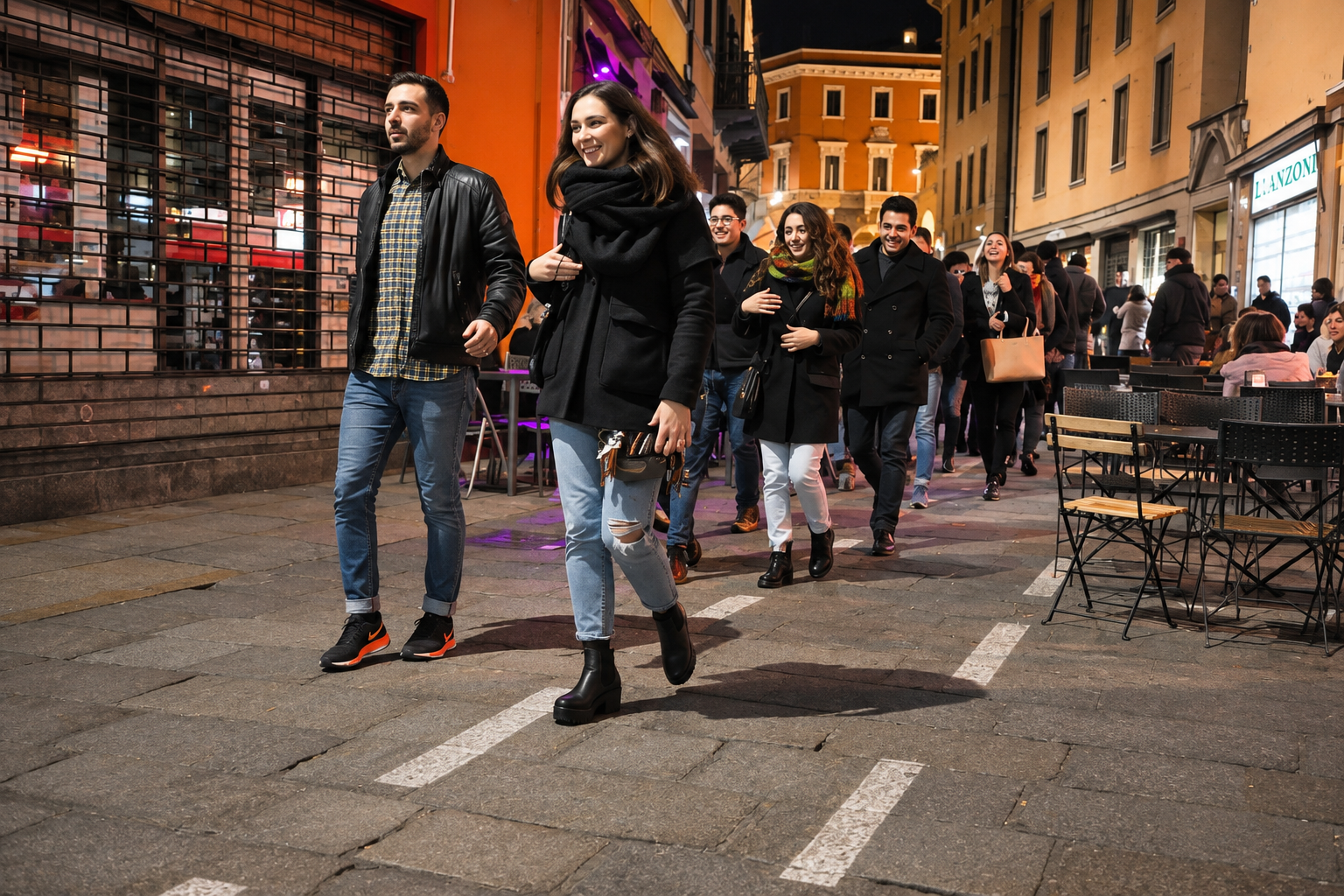
There is a practical lesson here for destination marketing. Promotional campaigns often reach for the same visual language of illuminated skylines, expensive drinks and crowded dance floors. But a convincing night-time photograph can be much simpler: a couple walking past a café, a row of chairs spilling into a square, a familiar street transformed by conversation and light. These are the experiences that make a place feel inhabited rather than staged. For a related look at after-dark travel imagery and atmosphere, see Cities with the Night Vibe and The Glamour of Night Vienna.
Whichever city you choose, look up current venue hours, local transport and neighborhood conditions before going out. Nightlife scenes change quickly, and not every lively district feels the same on a Tuesday as it does on a Saturday. The best plan usually leaves some room for an unplanned turn.
Further reading: Time Out, Best Cities for Nightlife 2026; GO TOKYO nightlife guide; visitBerlin nightlife; and Spain’s nightlife guide.