Four cities · Four frames
The landmark gets you there. Everything around it decides whether you stay.
Porto · London · San Francisco · Prague
I have a slightly odd way of reviewing my own travel photos. When I get home I skip the pictures of the famous things first. Those could have come from a postcard rack at the airport. What I look at instead is the stuff around the edges: a boat that happened to drift into the frame, people half asleep on a bench, a crowd I was annoyed by at the time. Those frames are the ones that tell me what a place actually felt like.
And they keep pointing at the same question. Some cities have everything on paper (the architecture, the museums, the five-star hotels, a full calendar of international events) and still feel strangely flat. Others have peeling paint, broken pavements and a waterfront that looks like nobody planned it, yet I find myself rebooking the flight home to stay three more days. What is the difference?
Four of my photographs, taken in Porto, London, San Francisco and Prague, give four rather different answers. None of them needed a festival or a perfect sunset. Two were taken under a gray sky. One is mostly people sitting down.
Why this matters if you sell places
Destination marketing tends to lead with the icon. That makes sense; a famous tower or bridge is the fastest way to tell someone where you are. But the numbers that matter to a city (how long visitors stay, how much they spend outside the hotel, whether they come back) are decided somewhere else. They are decided in the hours between attractions. A landmark is a reason to visit. The life around it is the reason to linger.
So the most convincing destination branding usually starts with something ordinary: a place where people have a reason to be even when they have no interest at all in sightseeing. That is very hard to fake, which is exactly why it works.
The numbers that matter to a city are decided in the hours between attractions.
City 01 · Porto
Porto, where the river still explains the city
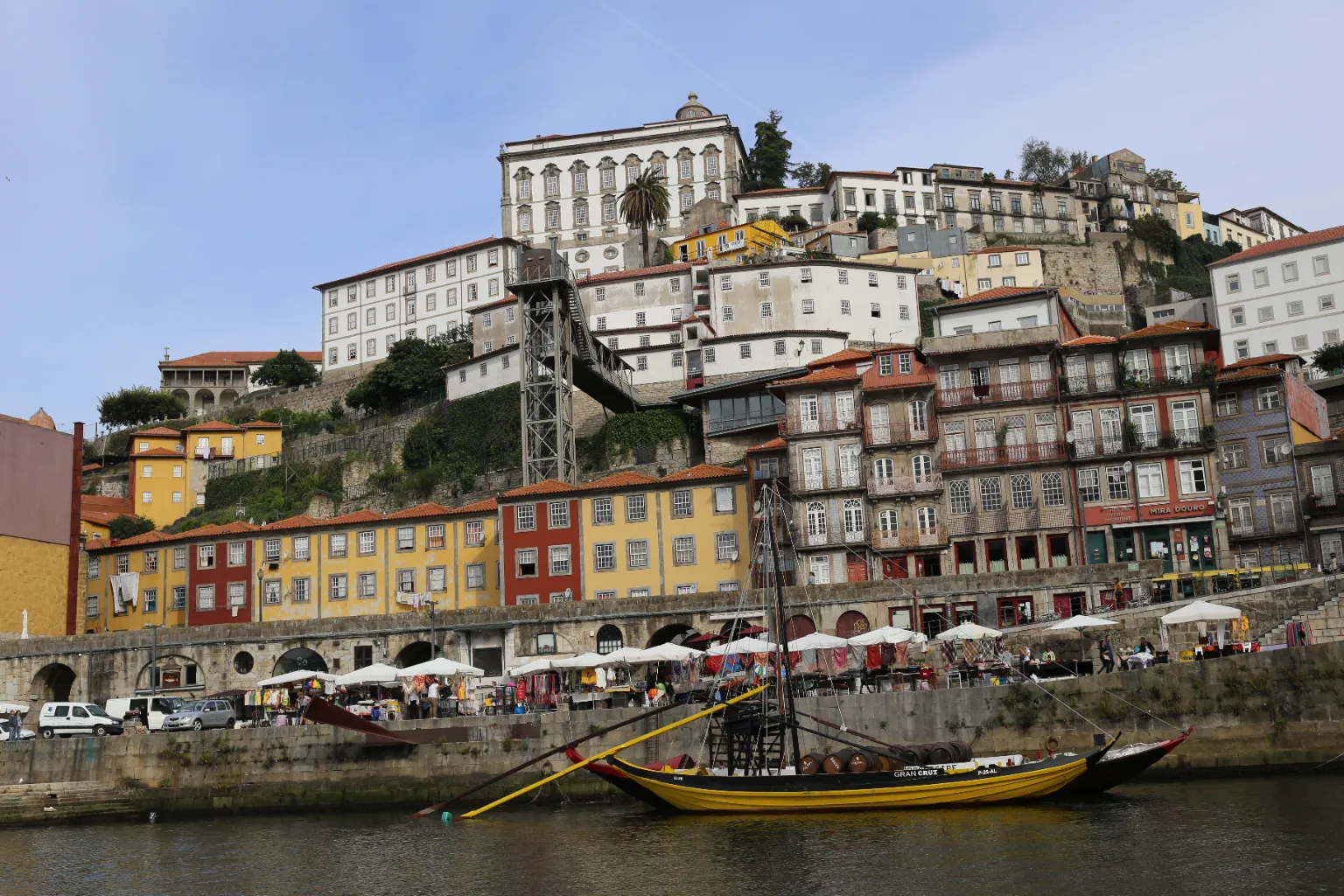
Look at Porto from the Douro. A yellow and black rabelo boat loaded with barrels takes the foreground, its long steering oar cutting diagonally across the water. Behind it, white umbrellas shade the waterfront stalls. Above them climb rows of mustard and brick-red houses, a jumble of tiled facades, balconies, terracotta roofs and weathered granite. The Episcopal Palace sits on top of it all like a referee. And in one window, somebody’s laundry.
The rabelo is the key to the picture. These flat-bottomed boats were built to bring barrels of port wine down a difficult river from the vineyards of the upper Douro to the wine lodges in Vila Nova de Gaia, right across from where I was standing. Railways, then roads and the dams of the twentieth century ended that trade. The boats stayed, moored outside the lodges with their brand names on the sails, and once a year they race on the river around the São João festivities in June.
You could call that tourism imagery, and it is. But it works because it belongs here. Move the same boat to another European waterfront and it means nothing. The whole scene is a cross-section of a city: geography, old trade routes, architecture and plain domestic life stacked on top of each other. The historic center has been on the UNESCO World Heritage list since 1996, and it still looks lived in. There is more of that in Porto Panoramic and Alive.
The laundry test
If you can still see washing hanging from the windows of a historic district, people still live there. If you can’t, you may be walking through a very well restored museum.
Hotels and restaurants have their place. So do grocery shops, workshops, a hardware store, a school. Portugal has spent the past few years arguing about short-term rental licenses in precisely these neighborhoods, and the argument is really about this photograph: who gets to hang their laundry here ten years from now.
City 02 · London
London, and the case for a gray sky
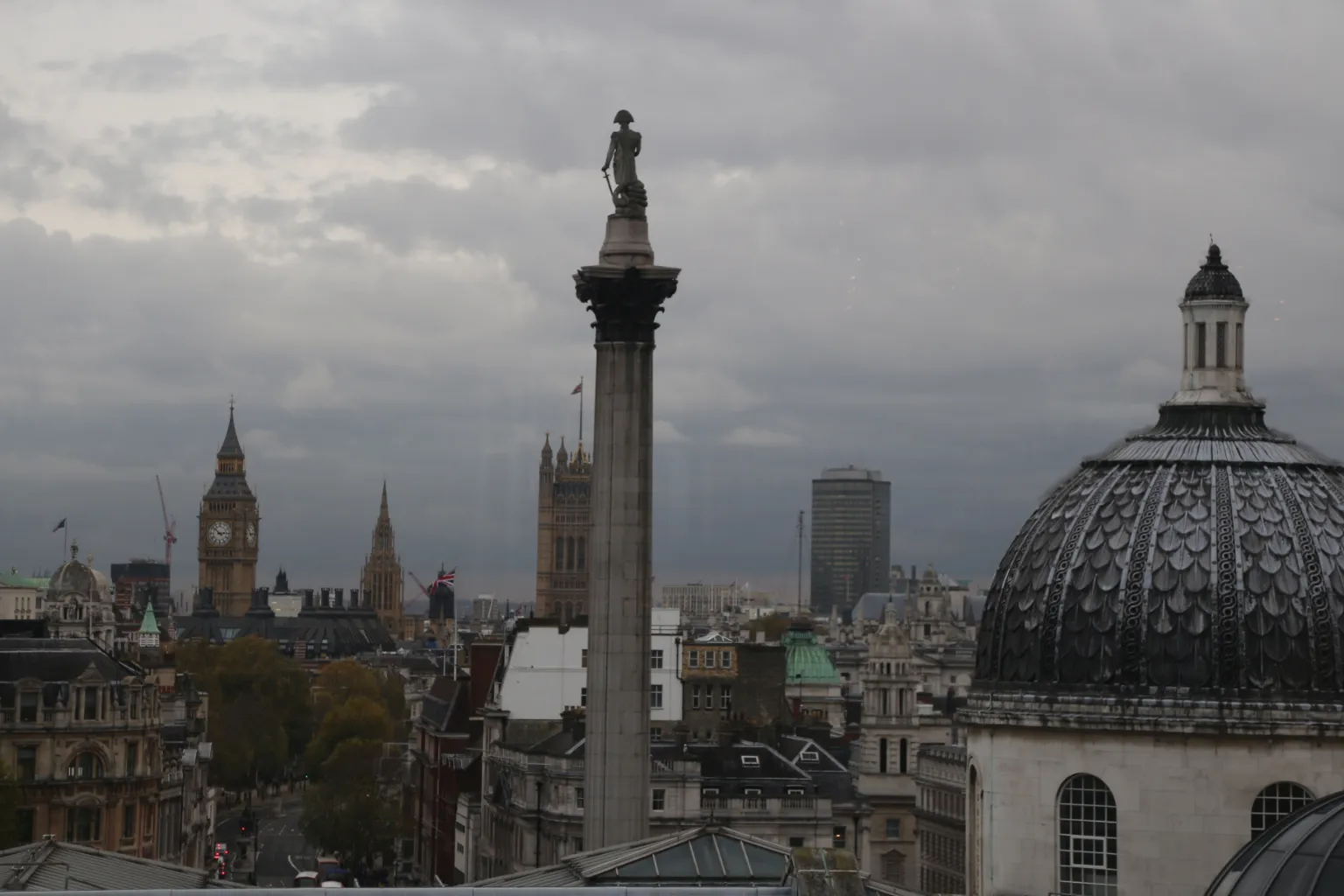
London speaks a completely different visual language. Gray sky. Muted colors. Nelson’s Column rises above the rooftops, the towers of the Palace of Westminster sit in the distance, and a dark, intricately patterned dome fills the right side of the frame. In between the recognizable monuments: ordinary roofs, flags, trees, one blunt modern tower.
Nobody would put this picture in a tourism campaign. Too dull, too gray. Yet it describes London better than any blue-sky shot I have. The city’s energy is not about color or noise. It comes from layers: centuries of building on top of each other, government and institutions next to theaters and pubs, and a sheer density of things to find within a short walk.
Trafalgar Square itself is a good example of a city learning. The column has stood there since the 1840s, but for most of its life the square was a traffic island. When the north side was closed to cars in the early 2000s and joined to the steps of the National Gallery, it became a place to sit, eat a sandwich and watch street performers. Same monument. Different city around it.
The rainy-day index
I’ve started judging cities by a simple question: what happens to my day when it rains? In London the answer is almost nothing. The national museums are free, the galleries and bookshops are close together, and public transport links them. A wet afternoon is just a different afternoon. A destination that only works in sunshine is a seasonal product. One that works in the rain is a city.
City 03 · San Francisco
Union Square, and the value of a place to sit
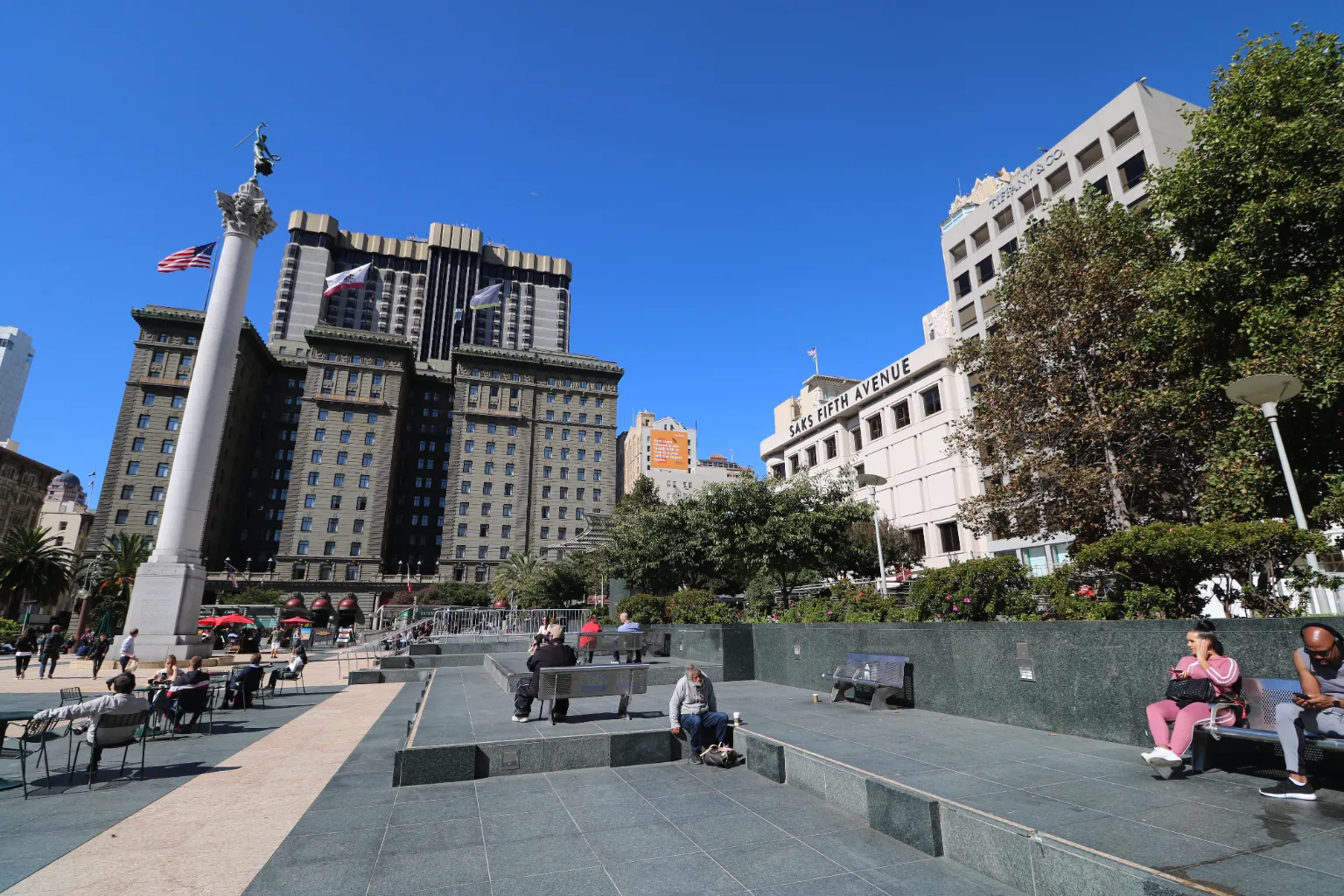
Union Square in San Francisco, under an almost unreal blue sky. The Dewey Monument rises next to the American and California flags, its column topped by the figure of Victory. It was put up to mark Admiral Dewey’s naval victory at Manila Bay in 1898. Hotels and department stores close the square in on every side.
But the most interesting part of this picture is at ground level. People in chairs. People on benches, on their phones, or just sitting with their faces in the sun. Wide paved terraces and planted beds give strangers room to share the same space without having to talk to each other.
Nothing dramatic is happening, which is the whole point. The urbanist William H. Whyte spent years in the 1970s filming New York plazas to figure out why some were full and others empty. His conclusion was almost embarrassingly simple: people sit where there are places to sit. Movable chairs, a bit of sun, something to watch, a food vendor nearby. Jane Jacobs said much the same thing in her own way when she wrote about eyes on the street.
A good square is more than a corridor between shops. It is somewhere you can spend time without buying anything. Downtown San Francisco has had a rough few years, and some big-name stores around this square have left. A plaza built only around shopping is fragile when shopping changes. The chairs, the sun and the people watching each other are the parts that survive.
For a traveler, a bench, some shade, a comfortable walking route and a place to stop for ten minutes can matter as much as the next attraction. These things almost never appear in destination advertising. They quietly decide how long people enjoy a city before their feet give up.
City 04 · Prague
Charles Bridge, where the crowd is the picture
On Charles Bridge the balance shifts again. A procession of pedestrians fills the foreground, passing souvenir stands and dark umbrellas. A pale stone saint rises on the left. Behind, steep Gothic roofs, the Lesser Town Bridge Towers and distant green domes build a dense backdrop.
The bridge was begun in 1357 under Charles IV, and the line of Baroque statues was added much later; most of what you see today are copies, with many originals moved indoors for protection. It is one of the most photographed walks in Europe.
I didn’t try to wait for the people to leave. The people are the subject. Their coats, their faces, the way they move in different directions: all of it turns an architecture photograph into a street photograph.
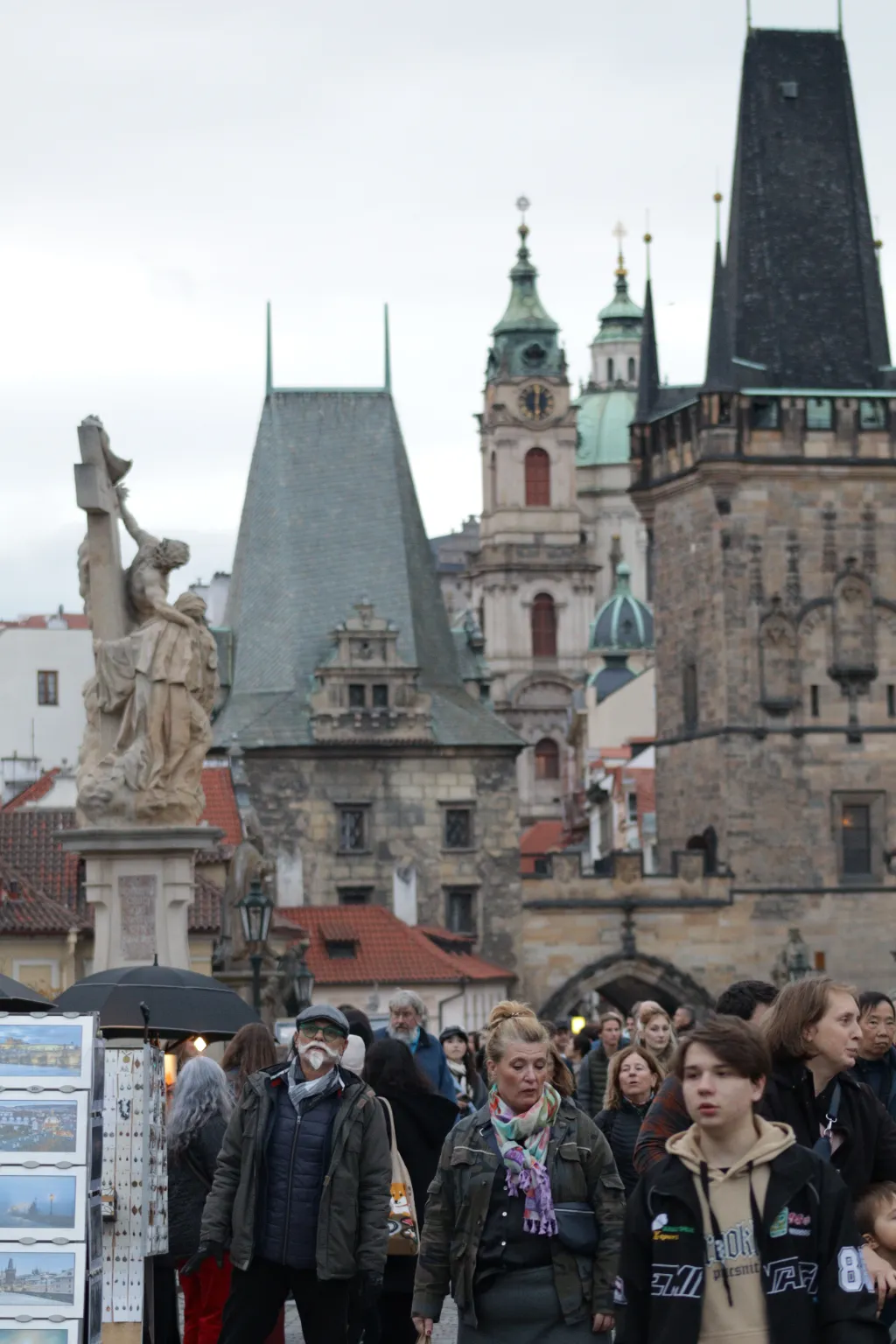
Prague also shows where the idea of vibrancy runs out. A crowd can make a bridge feel wonderfully theatrical. If it gets so thick that you can’t stop, look around or walk at your own pace, the very thing people came for starts to break. Busy is good up to a point. Past that point, it turns into a queue.
The job for tourism management is to spread interest out, rather than simply pile more of it onto one span of stone. Cross at seven in the morning and the bridge is almost yours. Walk down to Kampa underneath it, or look at it from the next bridge along, and you get the view without the elbows. Prague also works well as part of a longer trip, as in our Vienna, Bratislava and Prague itinerary.
Four cities side by side
| City | What carries the life | The signal to look for | The risk |
|---|---|---|---|
| Porto | The river, its old trade and the homes above it | Laundry, corner shops, residents on the waterfront | Short-term rentals emptying the historic center |
| London | Layers of history and a density of things to do | A good day out even in the rain | Cost pushing out the small venues that make the layers |
| San Francisco | Public space that asks nothing of you | Chairs, sun and people who are not shopping | A downtown that relied too much on retail |
| Prague | People moving through a historic set piece | Room to stop and look | Crowding that turns the experience into a queue |
A test for any destination
Put together, these four scenes give me a short test I now run on any city, whether I’m visiting it or writing about it:
- Would this place still be interesting if the famous monument were taken out of the photograph?
- Can a visitor spend a whole afternoon here without booking a single attraction?
- Are there independent businesses, public spaces and cultural venues that reward wandering, or is everyone funneled toward the same few sites?
- Is there somewhere to sit that doesn’t come with a menu?
- What happens to a visitor’s day when it rains?
- And the big one: would locals still have reasons to come here if the tourists stopped arriving?
The answers say more about a city’s long-term appeal than any beautifully designed campaign.
What I do on day one
When I land somewhere new I skip the headline sight on the first day. I find the market, buy something to eat, and sit where locals sit. A food market tells you more about a place in an hour than most formal attractions do in a day, which is why visiting a food market first has become a habit. Then I walk without a plan until I’m lost enough to need the map. The cities that make that walk enjoyable are the ones I come back to.
What city makers and marketers can take from this
Keep the residents
Affordable housing and everyday shops are the infrastructure of atmosphere. Lose them and the historic district becomes a stage set.
Build for bad weather
Free museums, covered markets and good transit turn a rainy day into part of the trip instead of a write-off.
Give people a chair
Benches, shade and open squares extend how long visitors stay on foot. They cost little and almost never make the brochure.
Spread the crowd
Promote the second bridge, the early hour, the next neighborhood. Distributing attention protects the places that drew people in.
Urban vitality isn’t something a tourism board can manufacture with slogans. It comes out of the way streets, buildings, businesses and people work together. When local commerce does well, when streets are pleasant to walk, when public spaces welcome you and when residents can afford to stay in their own neighborhoods, tourism has something real to build on. The marketing job then gets easier. Mostly it means showing what’s already there.
Porto, London, San Francisco and Prague share no climate, no architectural style and no pace of life. What they share, at least in these four frames, is the chance to look past the attraction and find a city around it.
A vibrant city is one where you eventually put the itinerary away, because the next street is reason enough.