The photo is a slice of Borough Market exactly as it lives: messy, loud, full of steam and appetite. In the foreground, a vendor in a maroon apron is working a flat grill piled high with shredded meat, the heat rising in visible clouds that blur his face like a soft curtain of smoke. His hands move with muscle memory — gloved, steady, almost rhythmic — while the scene around him swirls with conversation and waiting and hunger. A woman in a pink top stands just across the counter, holding her phone in one hand and brushing hair or sweat from her forehead with the other, not quite posing for anything, just being a person in a hot, crowded place. Behind her, a man in a navy suit, perfectly out of place and yet completely at home, laughs mid-sentence, maybe with a colleague, maybe with a friend, maybe with someone he just met in line. People don’t perform here; they collide, share air, overlap.
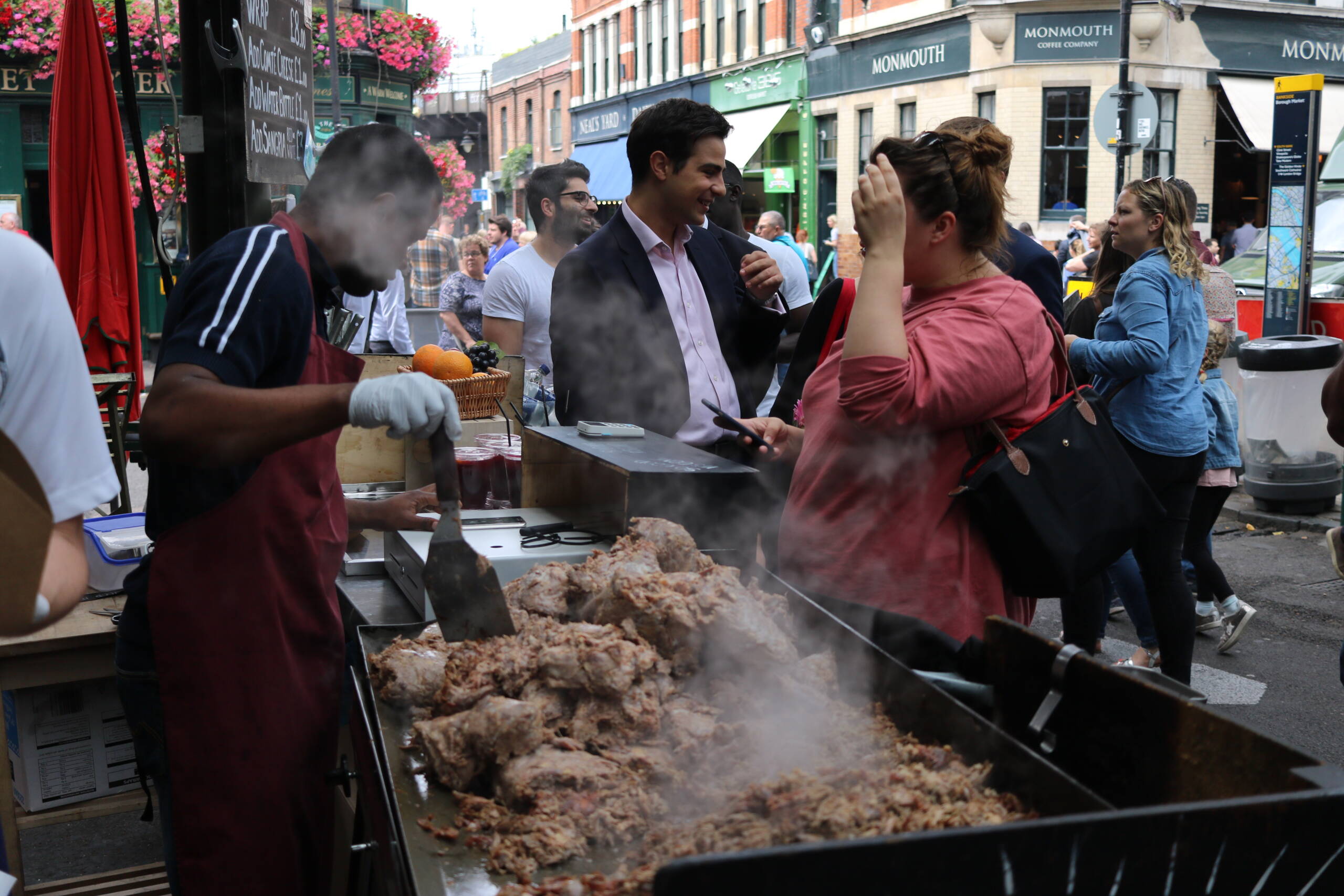
Nothing about this moment looks staged. No tripods, no ring lights, no influencer theatrics. Just steam, meat, breath, street, movement. The kind of moment that would be gone in three seconds if you looked away.
And this, honestly, is the heart of the frustration around Borough Market’s new relationship with photography. These are the kinds of scenes a camera can honor when used with awareness — scenes where the camera isn’t interrupting anything, not rearranging reality, not turning life into content. It’s simply noticing. Seeing. The photo captures what markets are meant to be: not backdrops, but living exchanges of heat, hunger, and everyday theater.
No one in this frame is performing. They are just being. And the camera — the respectful camera — is just witnessing.
There’s a certain irony in wandering through Borough Market, surrounded by mounds of figs, wheels of cheese that look like medieval artifacts, fish laid out like a painting lesson in texture, and then being told to please put the camera away. Not entirely, of course. But the atmosphere has shifted. Casual snapshots taken with a phone are still allowed, yet the moment your lens looks a little too serious or your stance leans into content creator mode, a subtle tension creeps in. Almost like the market collectively holds its breath. Borough Market has formally tightened its rules: anything that looks like professional filming, influencer shoots, commercial cooking videos, or video blogging now requires prior permission. Weekends, especially, are basically a no-go for that sort of thing.
You can see why. This is a working market, not a lifestyle backdrop. People are moving fast, hands wet from the ice on fresh fish, someone shouting the price of chanterelles, another person trying to maneuver a pushchair through the crowd. When someone stands in front of a bakery stall for three minutes trying to capture a perfect slow-motion croissant pull, it can feel like the entire place is being turned into a set. The traders didn’t sign up to be unpaid extras, and visitors just want their sandwich without waiting behind three ring lights.
But comparing this to Japan reveals something deeper than just logistics. In Japan, photography culture has its own strange balance between enthusiasm and restraint. People take photos constantly — the packaging in convenience stores, neon reflections in puddles, the seasonal change of pastries (yes, really). Yet it’s done with a kind of gentle spatial awareness, a quiet mindfulness. And when Japan says no photos here — inside certain shrines, in Gion where geiko and maiko walk, or at markets where vendors have asked for privacy — the reason often has to do with respect. The rule isn’t there to block creativity but to protect the atmosphere, to say: This moment is meant to be experienced with your eyes, not your lens.
In London, the tone is different. The restriction has the flavor of exhaustion. We are tired of being someone’s curated feed. It’s less spiritual and more defensive, more pragmatic. Less “This is sacred” and more “This is work. Please don’t get in the way.”
And yet, banning or restricting photography doesn’t automatically restore authenticity. A camera is just a tool; it becomes intrusive only when used without awareness of others. Some of the most beautiful market images ever made were taken by people who blended in, who observed before they clicked, who treated the place like a living organism rather than a stage.
Maybe that’s the lesson here. The camera isn’t the problem. The attitude behind it is.
A person who takes one photograph to remember the smell of fresh basil and the warmth of a baker’s smile is not the same as someone blocking a walkway to stage a stylized “market lifestyle moment.” And we — all of us traveling, filming, remembering — should know the difference.
So yes, Borough Market’s new rules make sense. But I still hope we don’t slide into a world where vivid, unplanned, human places feel suspicious of being seen. Markets are alive. They breathe. They tell stories. And sometimes, the camera helps us listen a little better.
Take the photo. Or don’t. Just remember to actually be there.
Leave a Reply