A café terrace in Lisbon on a hot afternoon. Teal awning, three words on it: coffee, brunch, bistro. Mint green stools, white folding chairs, azulejos on the wall next to the door, calçada underfoot. Maybe fifteen people at four tables, most of them in their twenties or thirties, most of them not Portuguese. One woman sits slightly apart with a phone in both hands and a red tote at her feet, typing. Behind the glass, an older man in a patterned shirt reads something on a tablet in the cool of the room.
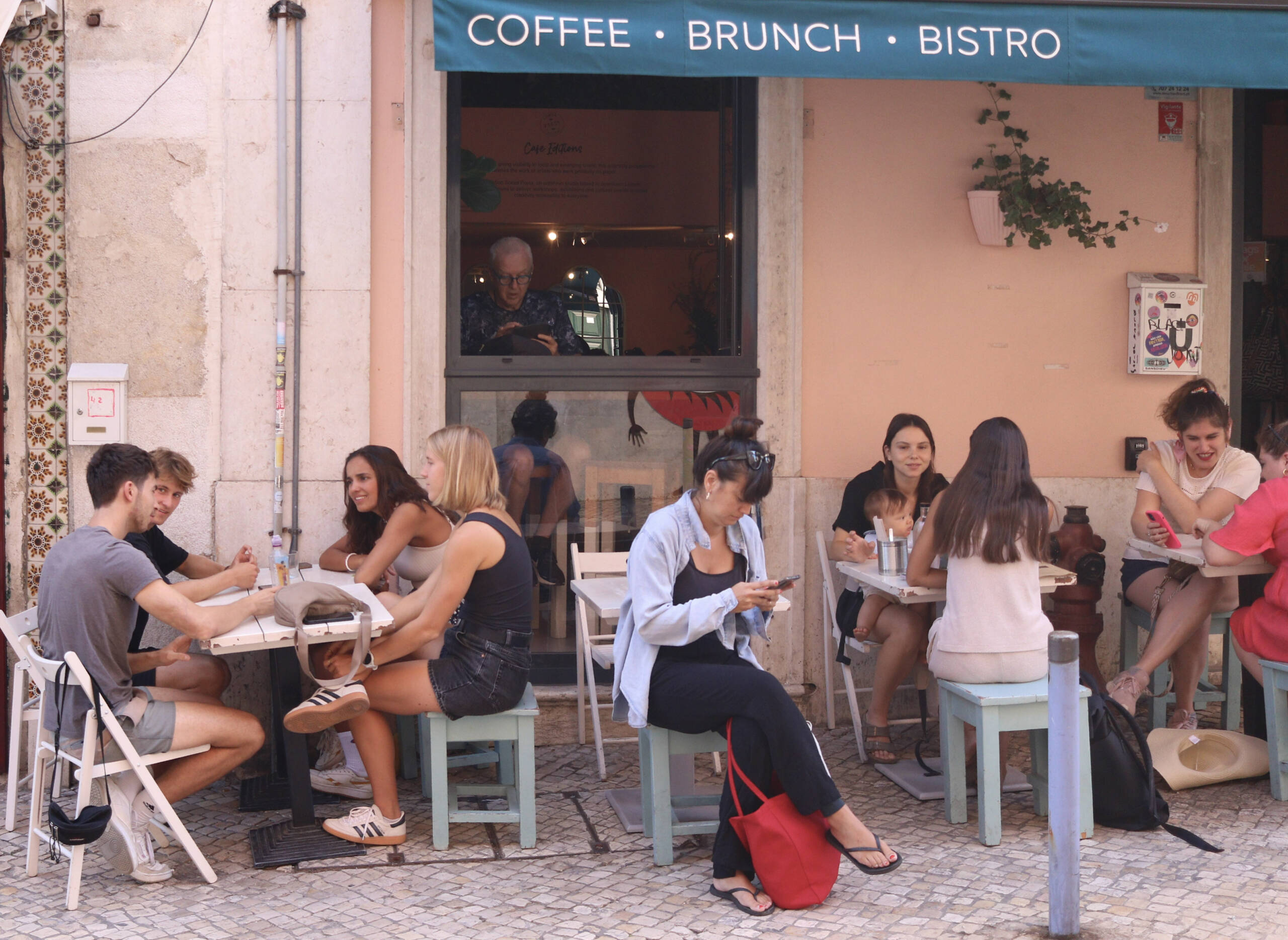
Here’s what isn’t happening in that picture. Nobody is photographing the café.
The café stopped being the subject
There was a stretch, roughly 2015 to 2020, when the room itself was the content. Pink walls, neon script, latte art shot from directly above, a plate of avocado toast styled to within an inch of its life. Owners spent real money on a feature wall because the feature wall did the marketing. That era produced a lot of identical cafés and a lot of identical photos.
It’s mostly over. Not because people stopped posting, but because the café got promoted. It’s not the destination in the story anymore. It’s where the story gets written. This is where you sit down after the morning walk, cull forty photos to four, write the caption, answer the client, book tomorrow’s train. The picture gets taken at the monument. It gets posted here.
That’s a shift in function, and it shows up in the furniture. Look at the table sizes. Look at how long those groups have clearly been sitting there.
Two coffee economies on the same street
Portugal already had a coffee culture, and it runs on completely different economics. A bica at the counter costs under a euro, gets drunk standing up in ninety seconds, and the customer is gone. The bar makes its money on turnover. Hundreds of small transactions, no seat required.
The brunch terrace sells the opposite product. Four or five euros for a flat white, maybe twelve for the eggs, and then two or three hours of table. Do the arithmetic on revenue per seat-hour and the two models barely resemble each other. One of them is a beverage business. The other is renting real estate by the afternoon and throwing in coffee.
Which is why more Lisbon cafés now post no laptops signs, either full time or during the lunch window. It reads as a cultural statement about atmosphere. It’s a yield management decision. A laptop at a two-top during peak service is the difference between three covers and one.
Operators who’ve thought it through don’t ban the behavior. They price it. Minimum spend at peak, laptop-friendly hours posted clearly, a back room for the long sitters and the street tables for the two-hour brunch crowd. Every hospitality media forum has some version of this argument running in a dozen threads, and the operators losing it are the ones who put up a sign, annoy the customer who was going to come back four days running, and then wonder why the terrace is quiet at four in the afternoon.
The template travels better than the city does
The other thing worth naming is how legible that awning is. Three English words, a sans-serif font, a colour palette you’ve seen in Copenhagen and Mexico City and Tbilisi. A visitor who has never set foot in Lisbon can read that frontage from across the square and know exactly what’s inside, what it costs, whether the wifi works and whether anyone will look at them funny for staying.
Kyle Chayka named this AirSpace years ago, and the criticism usually lands as an aesthetic complaint about sameness. The more interesting reading is functional. Standardisation is the product. Legibility at a glance is what a person moving through six cities in three months is actually buying, and the format spread because it solved a real problem for a real customer.
What it costs the neighbourhood is the part nobody in the photo is thinking about. A frontage optimised for arriving strangers is a frontage that stopped optimising for the man in the window with the tablet.
The regulatory turn already happened
The wave that built these terraces is being actively cooled. Portugal’s D8 visa now wants proof of income around €3,680 a month. The old NHR tax regime that pulled a lot of people in has been replaced by something considerably narrower. Central Lisbon rents in the neighbourhoods where these cafés cluster have climbed dramatically since 2020, and short-term rental rules across Southern Europe tightened again through 2026. Barcelona, Valencia and Milan are all pulling in the same direction.
So the terrace in this photo is a snapshot of a model at its peak, not on its way up. That has planning implications for anyone opening one. The remote worker cohort is getting smaller, older and better paid. Volume is going down, spend per head is going up, and length of stay is going up with it. Build for that customer, not for the 2021 one.
What travel businesses should take from it
The café is infrastructure now, which means it belongs in the itinerary the same way transport does. Guests plan around it. If you run accommodation, the honest question isn’t whether your lobby looks good in a photo. It’s whether someone can work there for three hours without apologising to anyone, and whether you’ve told them so before they book.
And if you run the café, the awning is the ad. Three words did more customer acquisition than any campaign you’re going to run.
The old man inside has been there the whole time. Different coffee, different price, different city.