There’s a quiet revolution happening on French dessert menus, and it has nothing to do with Michelin stars. Pull off the autoroute anywhere between Angers and Nantes — or really anywhere in the Loire Valley — and you’ll find it on the ardoise: a black plate bearing three, four, sometimes five miniature desserts, arranged like a tiny edible gallery. The French call it the ménage à trois. The menu doesn’t always use that name, but the wink is very much intentional. I got this menage à trois mini-dessert in some road cafe between Angers and Nantes.
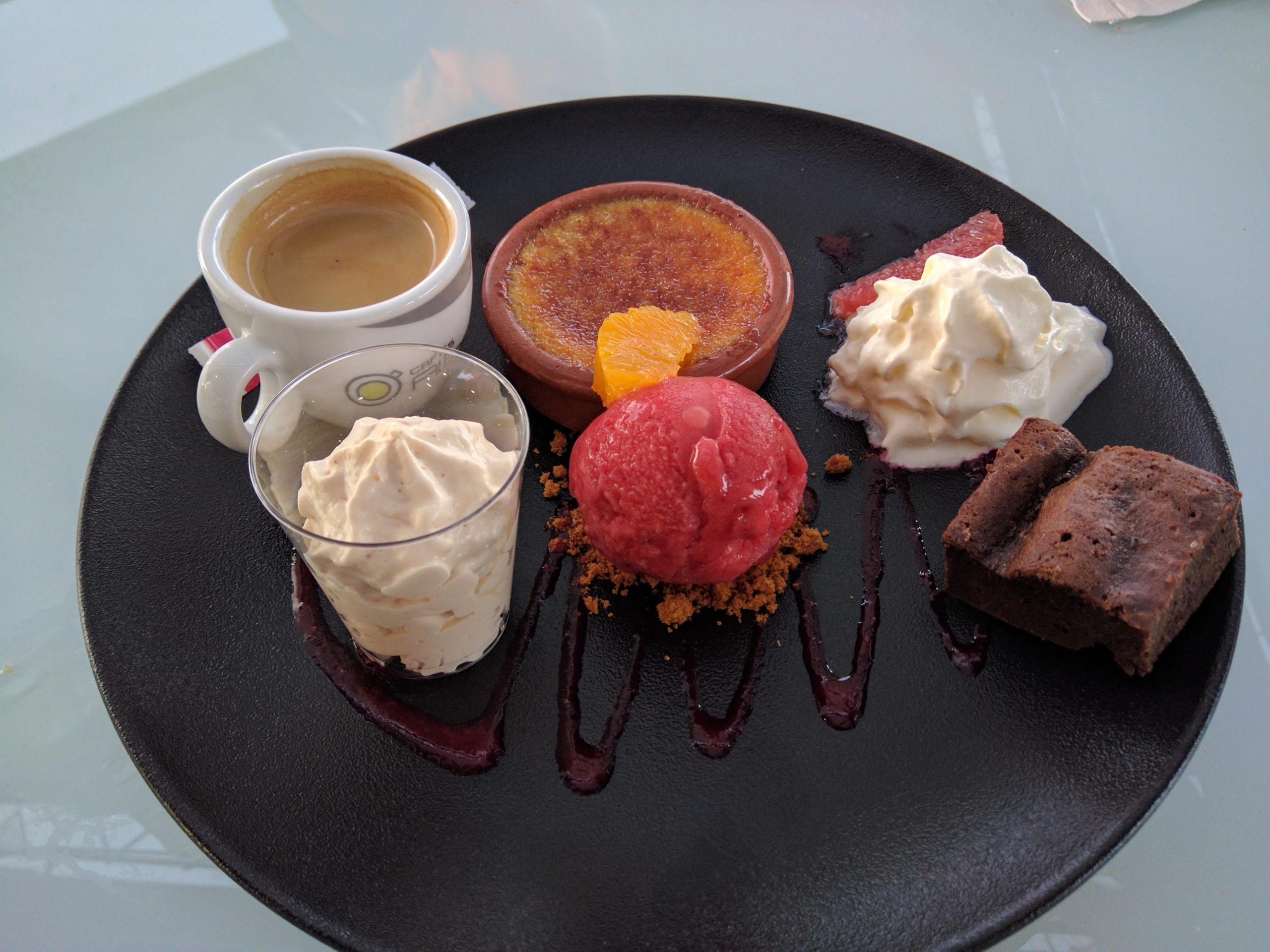
The version pictured here arrived at a roadside café — the kind of unpretentious stop with paper placemats and regional wine by the carafe — and it was, frankly, spectacular in its ambition. On a matte black plate: a perfectly caramelized crème brûlée in a terracotta ramekin, an orange segment resting against it like a garnish. A vivid raspberry or strawberry sorbet perched on a rubble of golden cookie crumbs, still holding its dome. A small glass filled with chantilly or mousse, swirled into a peak. A dense chocolate brownie square with whipped cream draped over it. Chocolate sauce traced in deliberate strokes beneath everything. And — not dessert exactly, but completing the ritual — a white espresso cup, still steaming.
That’s four or five components depending on how you count. The ménage à trois, it seems, has commitment issues.
Why This Trend Works
The logic is simple and elegant. French diners are notoriously resistant to skipping dessert but increasingly health-conscious about finishing a full portion of any single thing. The mini-sampler solves this beautifully: you get the full emotional arc of a dessert course — cold, warm, creamy, crunchy, bitter, sweet — without the weight of a single enormous tarte tatin. It’s portion control dressed up as indulgence, which is a very French solution to a very French problem.
Restaurants benefit too. A composed sampler plate lets the kitchen deploy odds and ends, seasonal fruits, and daily-made mousses in a format that looks far more deliberate and curated than it is. The black plate presentation has become almost standardized — it photographs beautifully, the colors pop, and it signals a certain modernity without the restaurant needing to overhaul its entire identity.
The Loire Valley as Incubator
This stretch of France — the Atlantic Loire corridor between Nantes and Angers, through the wine country of Muscadet and Anjou — has always had a strong local food culture that resists Parisian trend-chasing while quietly absorbing influences from both directions. The region’s dairy tradition (think crémets d’Anjou, local fromage blanc desserts) blends easily into the mousse and chantilly components. The fruit tradition — Loire strawberries, quince, mirabelle — feeds the sorbet and coulis. The chocolate brownie is a concession to globalization, but by this point it’s been adopted without apology.
Road cafés here are not an afterthought. They’re a living part of how the French actually eat — quickly, but without indignity.
The Espresso as Anchor
Worth noting: the espresso is not optional, and it is not an add-on. In the ménage à plusieurs format, the coffee is part of the plate. It anchors the sweetness, provides the bitter counterpoint, and signals to the diner that this is the end of the meal — ceremonially, conclusively. Ordering the dessert sampler without espresso would be like ordering a cheese plate without bread. Technically possible. Socially incorrect.
Traveler Takeaway
If you’re driving between Nantes and Angers — or anywhere through the Loire — resist the impulse to skip lunch stops on the N23 or the D route alternatives. The roadside café is where French food culture is least performative and most honest. When you see the chalkboard say *café gourmand* or *trio de desserts*, sit down. It won’t take long. It will be better than you expect. And it will cost about eight euros, coffee included.
That’s the ménage à trois. No reservation required.