Rising on a rocky spur wrapped by a loop of the Nançon river, the Château de Fougères is widely cited as the largest surviving medieval fortress in Europe. Thirteen towers punctuate its curtain wall, and the whole complex covers roughly two hectares — a scale that’s hard to grasp until you’re standing at the edge of the moat looking up at it.
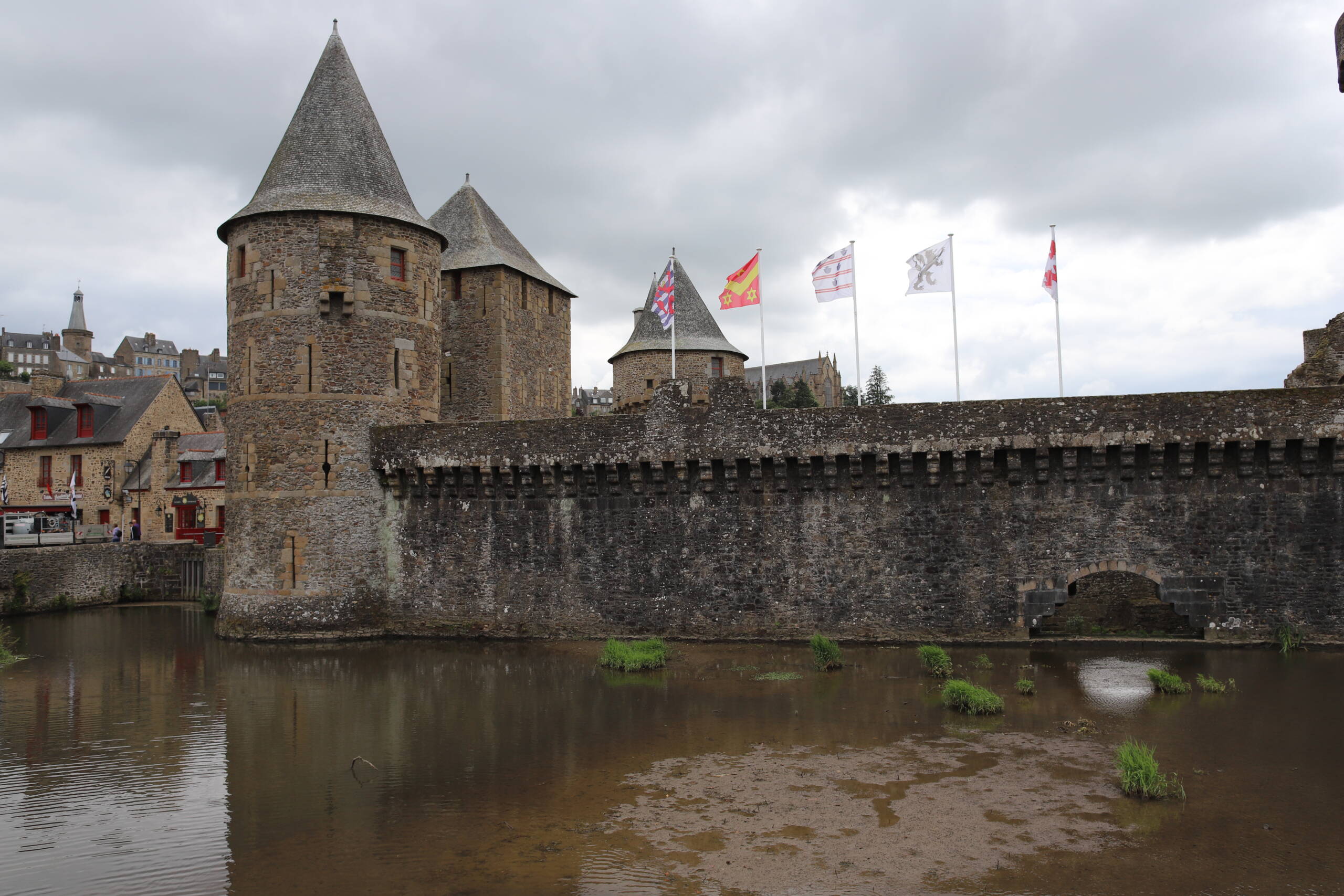
The site’s defenses started as a wooden motte-and-bailey fort around the year 1000, built on a rocky outcrop in a bend of the Nançon. That first structure didn’t last — it was burned down in 1166 after English forces under King Henry II took it by siege. The rebuild came fast and in stone, and the towers, walls, and gatehouses visitors see today are largely the product of centuries of expansion, with much of the current layout dating to major reconstruction in the 15th century.
Fougères sat on the frontier of the Duchy of Brittany, guarding the border against Normandy, Anjou, and Maine, which made it a target through much of the medieval period. The Duke of Brittany seized it by surprise in 1231, only for the French king to retake it soon after, and it was besieged again in 1488 during the Mad War, falling after a week-long siege. Its strategic relevance faded once Brittany was absorbed into the French crown in 1532, and the castle drifted through quieter, stranger chapters afterward — turned into a prison in the late 18th century, then home to a shoe factory during the Industrial Revolution, before the town of Fougères took ownership at the end of the 19th century.
Today the castle anchors a town that’s earned its own “City of Art and History” label, with a medieval quarter, half-timbered houses, and Brittany’s oldest belfry all within a short walk. The ermine flag flying above the ramparts — black tails on white — is Brittany’s traditional symbol, still flown here alongside civic and heraldic banners tied to the region’s history.
Worth the stop if you’re routing between Rennes and Mont-Saint-Michel: it’s close to both, and the fortress rewards even a couple of hours of wandering the ramparts and towers.