Some cities tuck their castles behind ticket gates and manicured lawns. Angers just lets traffic circle around its. At the roundabout where the roads to Paris and Nantes converge, cars, vans, and scooters weave past a bronze statue of King René while, just beyond the railings, seventeen striped stone-and-slate towers rise straight out of the moat like they never got the memo about the twenty-first century.
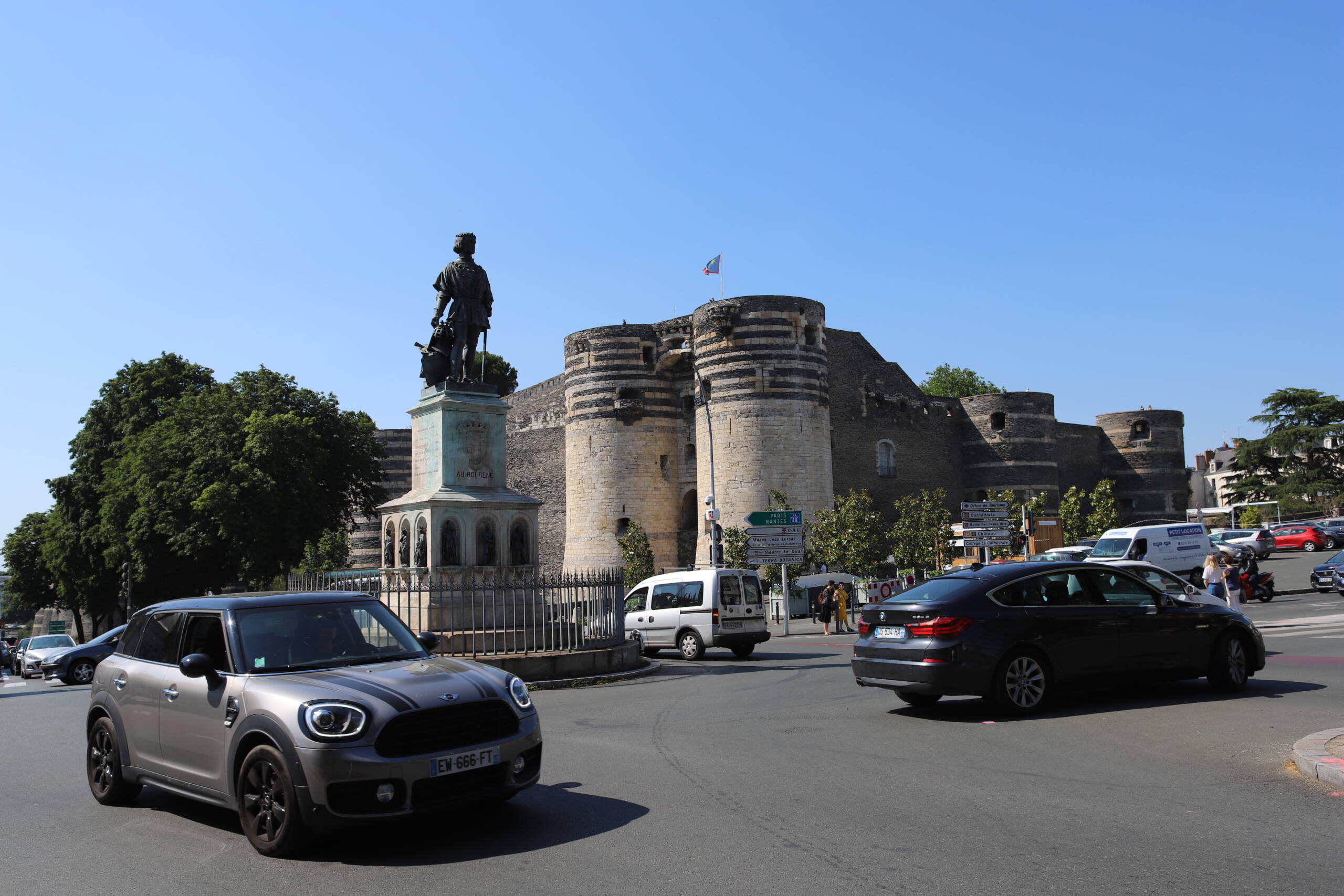
This is Château d’Angers, and the way it sits in the middle of everyday life is exactly what makes it worth the stop.
A Fortress, Not a Fairy Tale
Unlike the Loire Valley’s showier chateaux, Angers was built for defense, not decoration. Its distinctive banding of dark schist and pale limestone gives the towers a striped, almost armored look, and the sheer scale of the walls (some of the tallest surviving medieval fortifications in France) makes it clear this was a serious 13th-century power move by Blanche of Castile and Louis IX.
Inside, the château holds one of the great treasures of medieval art: the Apocalypse Tapestry, a 14th-century masterwork over 100 meters long depicting the Book of Revelation. It’s reason enough to go past the moat.
The King in the Roundabout
The statue presiding over the traffic isn’t decorative filler. It’s King René of Anjou, the 15th-century “Good King René,” remembered for turning Angers into a center of art and culture during his reign. His pedestal, inscribed “Au Roi René,” makes him the quiet centerpiece of one of the busiest intersections in the old town, pointing travelers toward the cathedral, the Musée des Beaux-Arts, and Terra Botanica.
Getting There
Angers sits comfortably between Nantes and Tours, an easy stop on a Loire Valley route or a standalone weekend from Paris (roughly 90 minutes by TGV). The château and its surrounding old town are entirely walkable, and the roundabout view, cars and castle in the same frame, is one of those shots that captures a place better than any staged postcard could.