Most visitors to Bruges aim for the Markt and its belfry, then drift away without realizing the city’s real seat of power sits one short street to the east. Burg Square is smaller, quieter, and far older. This is where Bruges began.
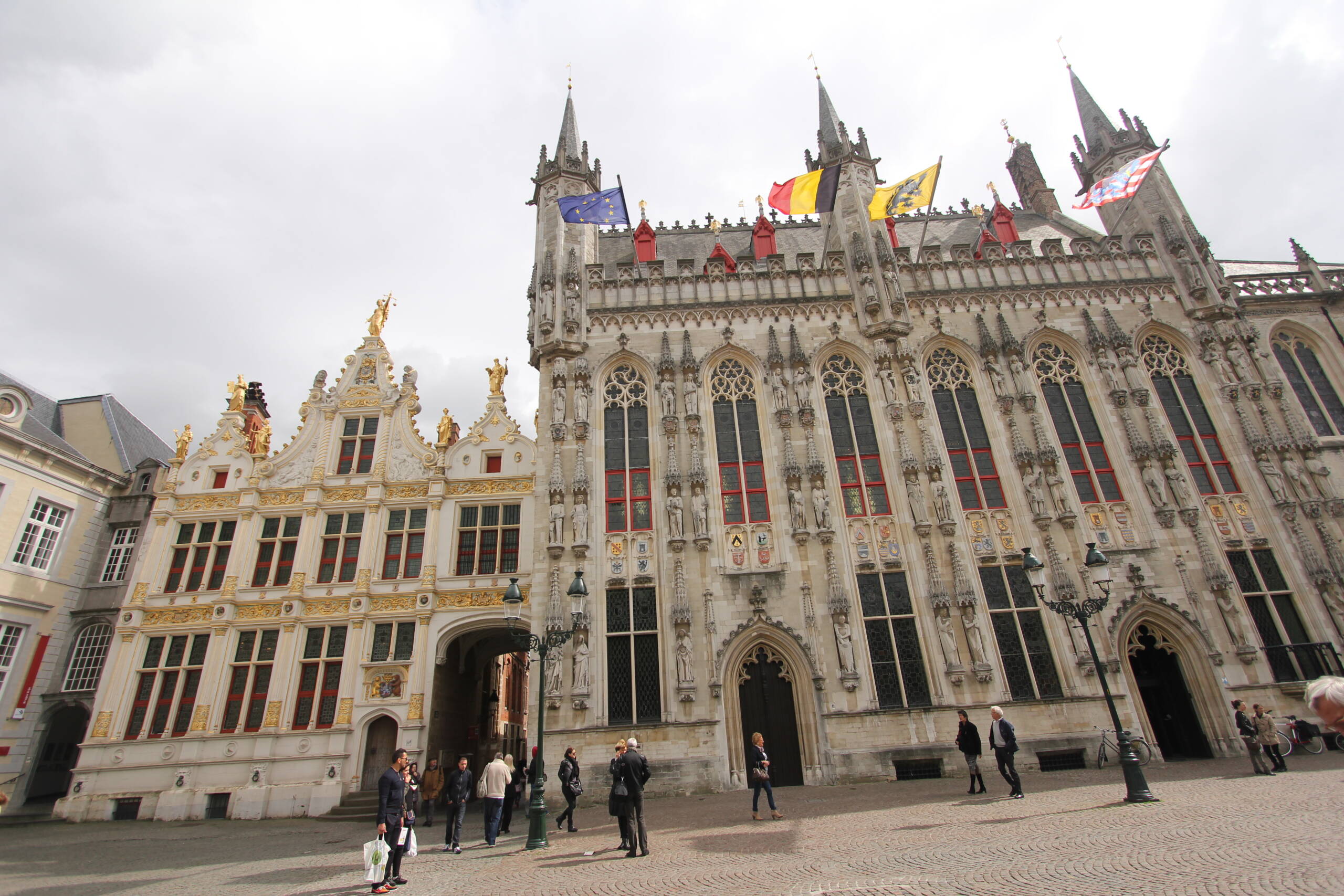
The square takes its name from a fortress that no longer exists. In the ninth century, Baldwin Iron Arm, the first Count of Flanders, built a stronghold here against Viking raids. The castle is gone, but the function never left. For more than a thousand years this compact rectangle of stone has been the administrative and religious heart of the city, and it still is — the Bruges city council meets here every month.
The City Hall: One Building That Set the Standard
The tall Gothic façade with its narrow windows, corner turrets, and rows of statues is the Stadhuis, the City Hall. Construction began in 1376 and ran until 1421, making it one of the oldest town halls in the Low Countries. It mattered far beyond Bruges. Its design directly influenced the city halls later built in Brussels, Ghent, Leuven, and Oudenaarde — this was the template for civic Gothic in Flanders.
The statues lining the front depict the Counts of Flanders and biblical figures. They are not the originals; French revolutionary forces stripped the niches in 1794, and surviving fragments now sit in the Groeningemuseum. What you see today are nineteenth-century replacements, but they restore the façade’s intended logic: a public declaration of power, written in stone.
Go inside. A grand staircase leads up to the Gothic Hall, where a double oak-vaulted ceiling and a sweep of early twentieth-century murals trace the history of the city. The original fourteenth-century polychrome consoles still anchor the room. Downstairs, life-size portraits of the city’s former rulers — mayors, kings, emperors, even Napoleon — line the walls, alongside a multimedia exhibition on how the Burg itself evolved.
The Gilded Neighbor
To the left of the City Hall stands the smaller building heavy with gold leaf and ornament. This is the Old Civil Registry, the Oude Civiele Griffie, finished in 1537. It is one of the rare examples of Renaissance architecture in Bruges, a deliberate stylistic break from its Gothic neighbor. The gilded figures and flourishes catch the light even under the flat grey skies the region is known for, and the contrast between the two façades is the whole point — two centuries of architectural ambition standing shoulder to shoulder.
What Else Sits on the Square
Tucked into a corner is the Basilica of the Holy Blood, one of the smallest buildings here and the one with the strangest story. It holds a relic said to contain a cloth stained with the blood of Christ. The basilica stacks a stark Romanesque lower chapel beneath a vividly decorated Gothic upper one. Every year on Ascension Day, the relic is carried through the streets in the Holy Blood Procession, recognized by UNESCO as intangible cultural heritage.
Practical Notes
The Stadhuis is open daily from 9.30 a.m. and is managed as a museum under Musea Brugge. On weekends, a single City Hall ticket also grants entry to the Liberty of Bruges next door; visit on a weekday and you can return within seven days to see it. Come early. The square fills with tour groups by mid-morning, and Burg rewards the visitor who arrives while it is still empty enough to hear your own footsteps on the cobbles.
The Markt gets the postcards. The Burg holds the history. Skip it and you have seen a beautiful city without ever standing where it was actually run.