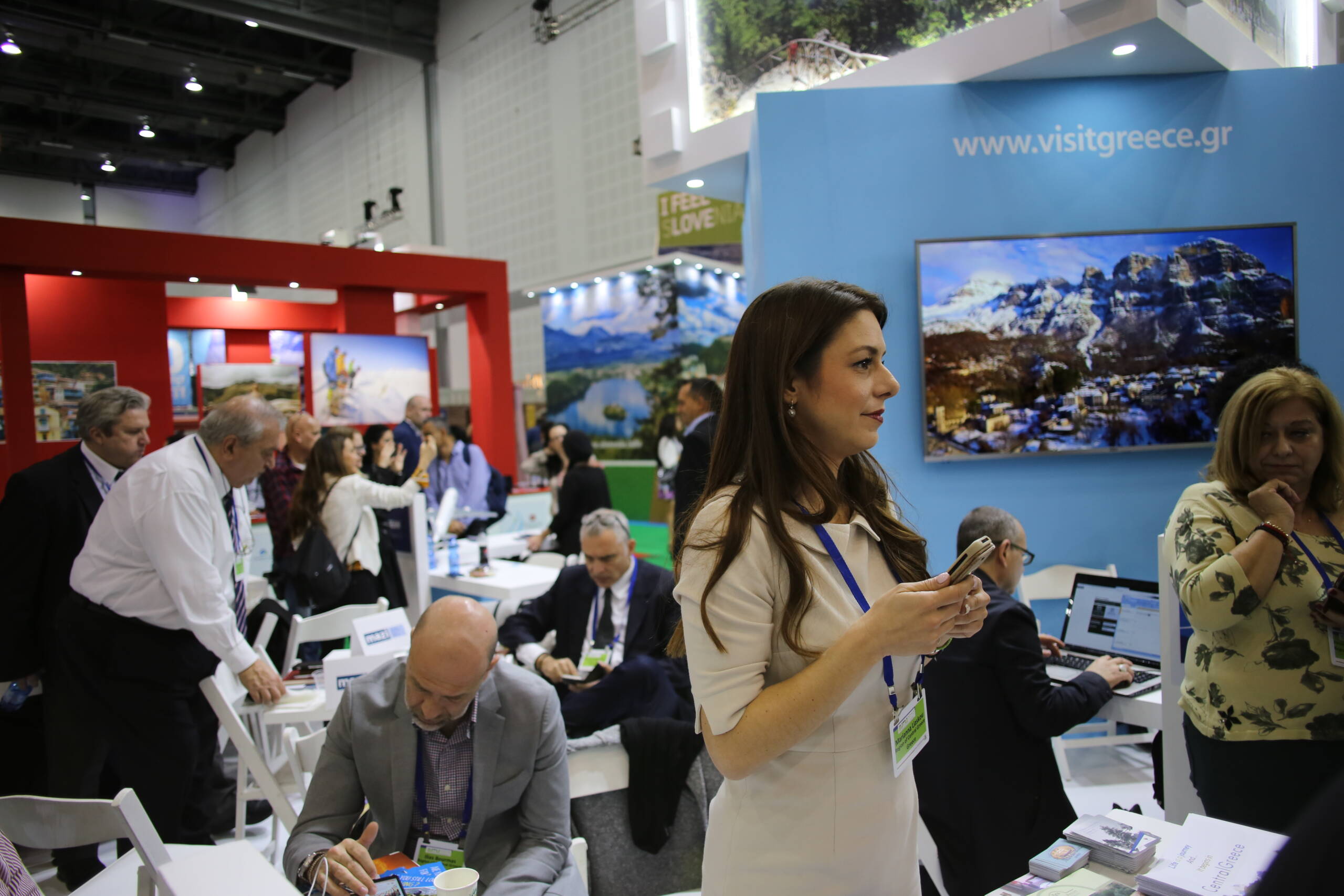
There’s a certain hum that fills the air of a travel trade show, the kind of layered noise that isn’t quite loud but feels alive, like a city square at dusk. The image you’ve shared captures that hum perfectly. You can see clusters of people leaning in toward one another, heads tilted in concentration; the white folding chairs and improvised tables forming little temporary islands of conversation. At the center, a woman in a cream dress holds her phone lightly, poised between tasks, her badge lanyard resting against her collar. Behind her, a large screen glows with a mountain landscape promoting Greece — snow-dusted peaks, a lake catching the light — and there is a small, almost subconscious promise in it: travel is not just about movement, but about the emotional pull of a place. To the side, a man works at a laptop, typing quickly, as though every second counts. A few steps away, brochures are stacked in tidy piles, waiting to be taken. The whole scene looks like motion paused for a heartbeat. It’s a room full of travel professionals, tourism boards, hoteliers, DMOs, airlines, and media — but under that, it’s a room full of ambitions, hopes, deals not yet spoken but already being formed.
There are thousands of reasons to attend events like this, but the most compelling ones are, oddly, not the ones that appear in official brochures. Yes, travel trade shows are places where product is displayed, itineraries are pitched, and deals negotiated. But beneath that is a subtler value: the travel industry is not just transactional, it is relational. The travel world depends on trust, storytelling, and memory more than almost any other field. You can learn about a hotel from a PDF, but you trust the hotelier after a five-minute conversation in a crowded event hall about how they renovated the courtyard to keep an old orange tree standing because guests fell in love with it. Trade shows are places where those tiny stories travel from one person to another, and eventually reach the traveler choosing where to spend their time and money.
Networking here doesn’t feel like the stiff, forced kind that is so common in other industries. The conversations are animated, hands move when people speak, eyes widen when describing a coastline at sunset or a trailhead that smells of rosemary in early morning. People attend because travel is made real in the telling of it. A tourism board can place a thousand ads online, but a single, vivid conversation with the right travel advisor, tour operator, journalist, or creator can ripple outward to thousands of travelers who will all arrive somewhere with the feeling of being gently guided there by someone who cared.
There is also the matter of timing. The travel industry changes faster than most travelers realize. Consumer preferences shift, airline routes open or close, regulations change, currencies fluctuate, and sometimes the emotional mood of travel itself shifts — more experiential this year, more wellness-oriented next, more local and immersive the year after that. At trade shows, this shift is visible in real time. You hear what destinations are rising because of some new trail or cultural initiative, which countries are reducing taxes on tourism infrastructure, which hotels are going boutique after years of being corporate. The floor is a living market of trend forecasting disguised as casual conversation.
For professionals building partnerships, trade shows are the most efficient environment possible. Instead of weeks of scheduling Zoom calls across time zones, you walk a few aisles, shake hands, exchange cards, and breathe in the texture of another person’s presence. You can read body language, tone, warmth, whether someone cares about what they are offering or is just reciting. Deals made like this tend to last longer, because they are anchored in something more real than a signature line on a PDF.
But perhaps the deepest reason to attend is simpler and more personal. Travel is about connection: to places, to cultures, to landscapes, to stories, and — perhaps easiest to forget — to people. In the image, you can almost feel how everyone is there for something larger than themselves. They are carrying their countries, their regions, their towns with them. They are saying, quietly or eagerly, Come see what I see. Come feel what I feel. You attend travel trade shows because that invitation only really works when it is passed hand-to-hand, voice-to-voice, a human offering something sincerely treasured to another human, hoping it will be understood.
The brochures will say you attend to learn, negotiate, and expand your market reach. The truth is you attend because travel, at its best, is an act of shared imagination — and imagination spreads more easily in rooms exactly like this one.