Porta Nuova is one of Palermo’s most recognizable historic landmarks, a monumental gateway standing beside the Norman Palace at the western end of Corso Vittorio Emanuele. At dusk, when the upper loggia glows above the darker stonework, the gate becomes an especially dramatic reminder of Sicily’s long and complicated history.
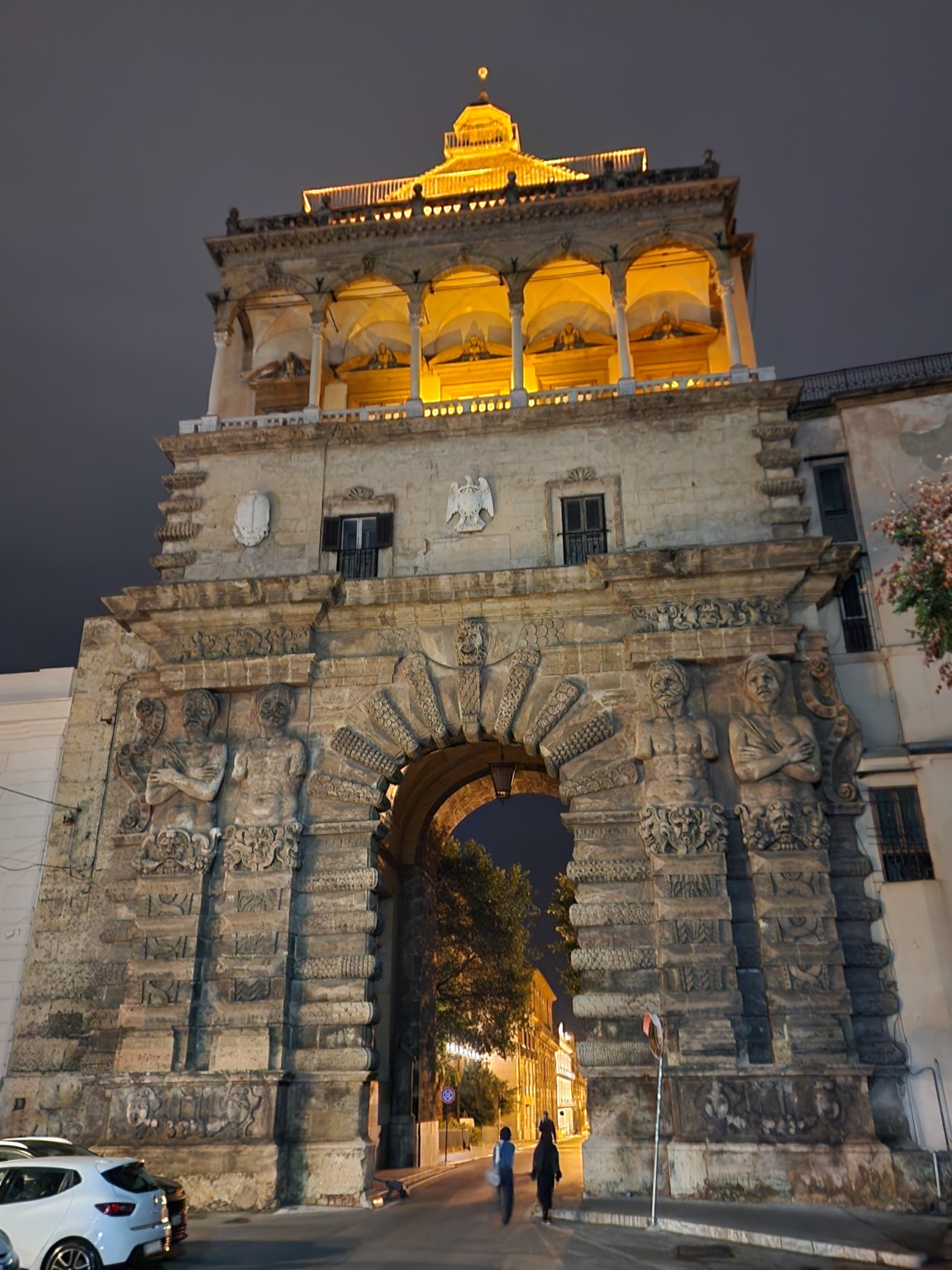
The photograph shows the gateway from street level. Four monumental sculpted male figures flank its central arch, supporting the heavy architectural composition above. A carved lion’s head sits over the keystone, while an eagle emblem appears on the upper wall. Higher still, the open Renaissance loggia is lit in gold, topped by a distinctive tiled pyramidal roof. Two pedestrians passing through the arch offer a useful sense of scale.
Porta Nuova is closely associated with Emperor Charles V, who entered Palermo in 1535 after his campaign against Tunis. The gate’s monumental late-16th-century form celebrated that episode during the era of Spanish rule. The structure was badly damaged by an explosion in 1667 and reconstructed afterward, retaining its ceremonial role at the edge of the old city.
The giant figures on the facade are often interpreted as representations of captured Moors, reflecting the triumphalist political imagery of the period. They are not simply ornamental details: they express the imperial claims and Mediterranean conflicts that shaped Sicily’s place within the Spanish monarchy. Today, the sculptures invite visitors to consider how monuments can preserve both artistic achievement and the ideology of their patrons.
There is a striking contrast between the massive lower arch and the comparatively delicate upper loggia, whose slender columns and illuminated vaults seem almost to float above the heavy stone gateway. The roof’s colorful majolica tradition is more apparent in daylight, but at night the warm lighting gives the entire upper structure a lantern-like appearance.
For travelers exploring Palermo on foot, Porta Nuova makes an excellent starting point. The Palazzo dei Normanni and Cappella Palatina are immediately nearby, and Corso Vittorio Emanuele leads east through the historic center toward Palermo Cathedral and the Quattro Canti. This short stretch of the city contains centuries of Norman, Arab-Norman, Renaissance and Baroque history within easy walking distance.
Photography is particularly rewarding around twilight. From the street in front of the gate, a low viewpoint emphasizes the towering sculpted figures and the depth of the arch, while the lit upper story separates clearly from the evening sky. Including people in the frame, as in this photograph, helps communicate the scale without distracting from the architecture.
Porta Nuova is more than an attractive gateway. It is a ceremonial monument, an urban landmark and a reminder that Palermo’s architectural history extends far beyond the medieval churches for which the city is famous. A few minutes spent studying its facade can turn a simple walk into a revealing encounter with Sicily’s Spanish past.