Monreale is famous for its magnificent Norman cathedral and extraordinary Byzantine mosaics, but one of the most memorable experiences begins outside the church, where the town opens onto a sweeping panorama of Palermo, the Tyrrhenian Sea and the mountains beyond.
Perched on the slopes of Monte Caputo, roughly eight kilometres southwest of central Palermo, Monreale offers a perspective that is difficult to appreciate from the busy streets of Sicily’s capital. From here, Palermo appears as an immense urban landscape stretching across the Conca d’Oro, the Golden Shell, the fertile basin that historically supported the city with citrus orchards, vineyards and agricultural estates.
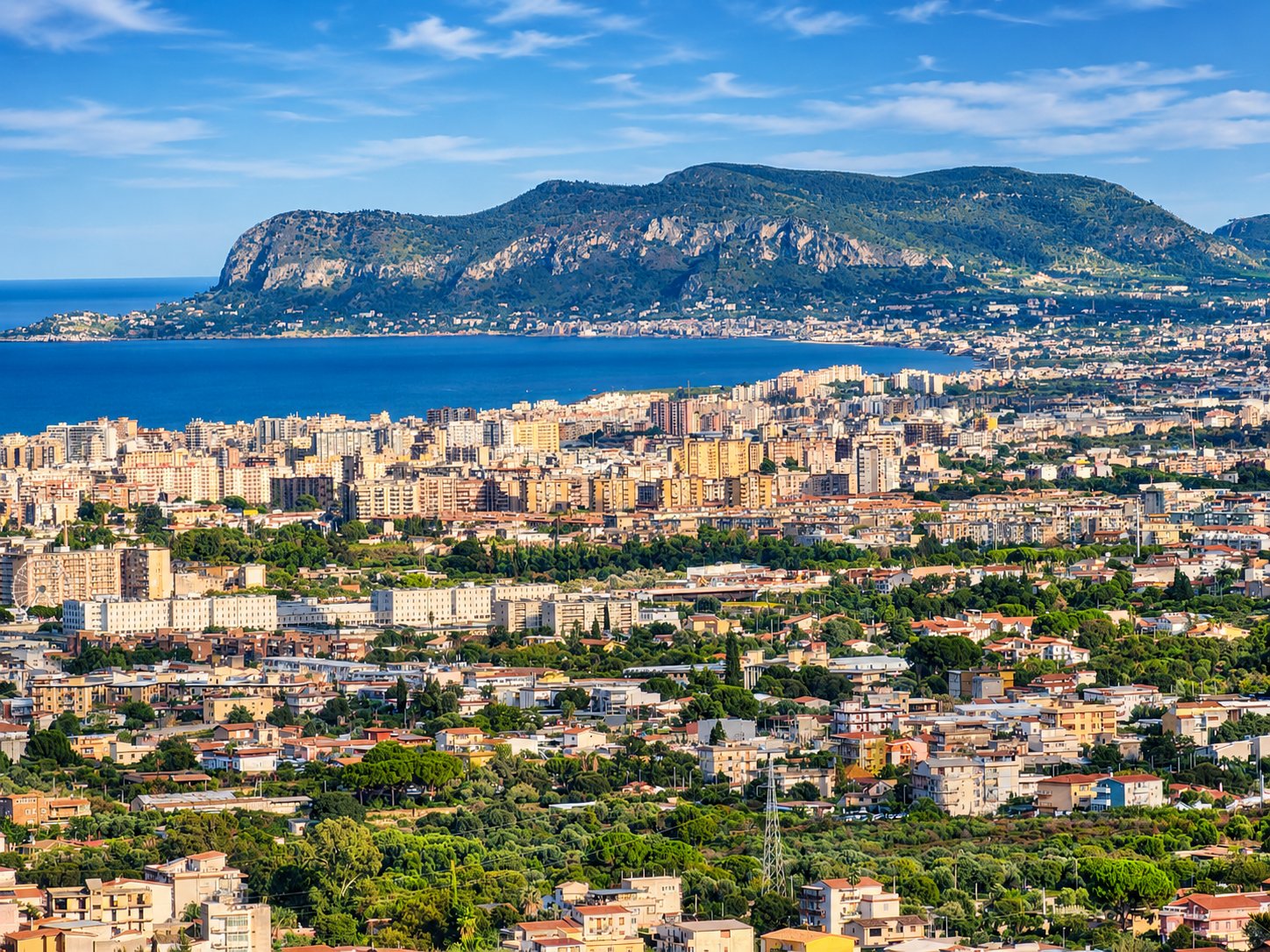
The photograph captures this geography particularly well. In the foreground, residential neighbourhoods with terracotta roofs, scattered apartment buildings and dense Mediterranean greenery descend toward the city. Beyond them, Palermo’s tightly packed urban districts form a broad belt of pale buildings illuminated by the afternoon sun. The sea creates a brilliant blue separation between the city and the enormous mountain massif rising across the gulf.
That mountain is Monte Pellegrino, one of Palermo’s most recognizable landmarks. Its distinctive limestone cliffs dominate the northern side of the city and have inspired travellers for centuries. Goethe praised Monte Pellegrino during his Sicilian journey in 1787, describing it as one of the world’s most beautiful promontories.
What makes the view from Monreale especially interesting is the contrast between Palermo’s different layers. The modern apartment blocks along the coast, older residential districts farther inland, remaining green spaces and dramatic natural landscape all appear in a single composition. The city seems enormous from this elevation, yet its boundaries are clearly defined by the mountains and the sea.
Monreale itself deserves considerably more than a quick stop for photographs. Its cathedral, built in the 12th century under the Norman king William II, is among the greatest monuments of Norman Sicily. The interior contains thousands of square metres of golden mosaics depicting biblical scenes, saints and the monumental figure of Christ Pantocrator. Together with Palermo’s Arab-Norman monuments and Cefalù Cathedral, it forms part of a UNESCO World Heritage Site.
The cathedral’s adjoining Benedictine cloister is another highlight, with intricately carved capitals and paired columns surrounding a peaceful courtyard. It provides a remarkable contrast to the expansive landscape visible from the town’s terraces.
For photographers, Monreale is particularly rewarding when sunlight falls across Palermo while the mountains remain in softer shadow. A telephoto lens compresses the city, coastline and Monte Pellegrino into a dramatic layered composition, as this photograph demonstrates. A wide-angle lens, meanwhile, can emphasize the sheer scale of the Conca d’Oro and the relationship between the historic hill town and the modern metropolis below.
Monreale is easily reached from Palermo by road or public transport, although the climb into the hills makes the journey feel longer than the distance suggests. Allow at least half a day to explore the cathedral, cloister, old streets and panoramic viewpoints without rushing.
There is something satisfying about seeing Palermo from above after spending time exploring its crowded markets, monumental churches and narrow streets. The city suddenly becomes understandable as a whole. Its geography, its relationship with the sea and the protective presence of the surrounding mountains come together in one remarkable view.
Monreale may be celebrated for the golden splendour inside its cathedral, but the panorama outside is another kind of Sicilian treasure.