Just a short journey from Palermo, the Cathedral of Monreale is one of Sicily’s most extraordinary monuments, where Norman ambition, Byzantine artistic traditions and Islamic decorative influences meet. Officially the Cathedral of Santa Maria Nuova, it was commissioned by William II in the 1170s and remains one of the greatest surviving achievements of Norman Sicily.
Monreale is part of the UNESCO-listed Arab-Norman Palermo and the Cathedral Churches of Cefalù and Monreale World Heritage Site. Its relatively restrained western exterior offers little warning of the spectacle inside: an immense basilica whose upper walls, arches and sanctuary glow with golden biblical mosaics.
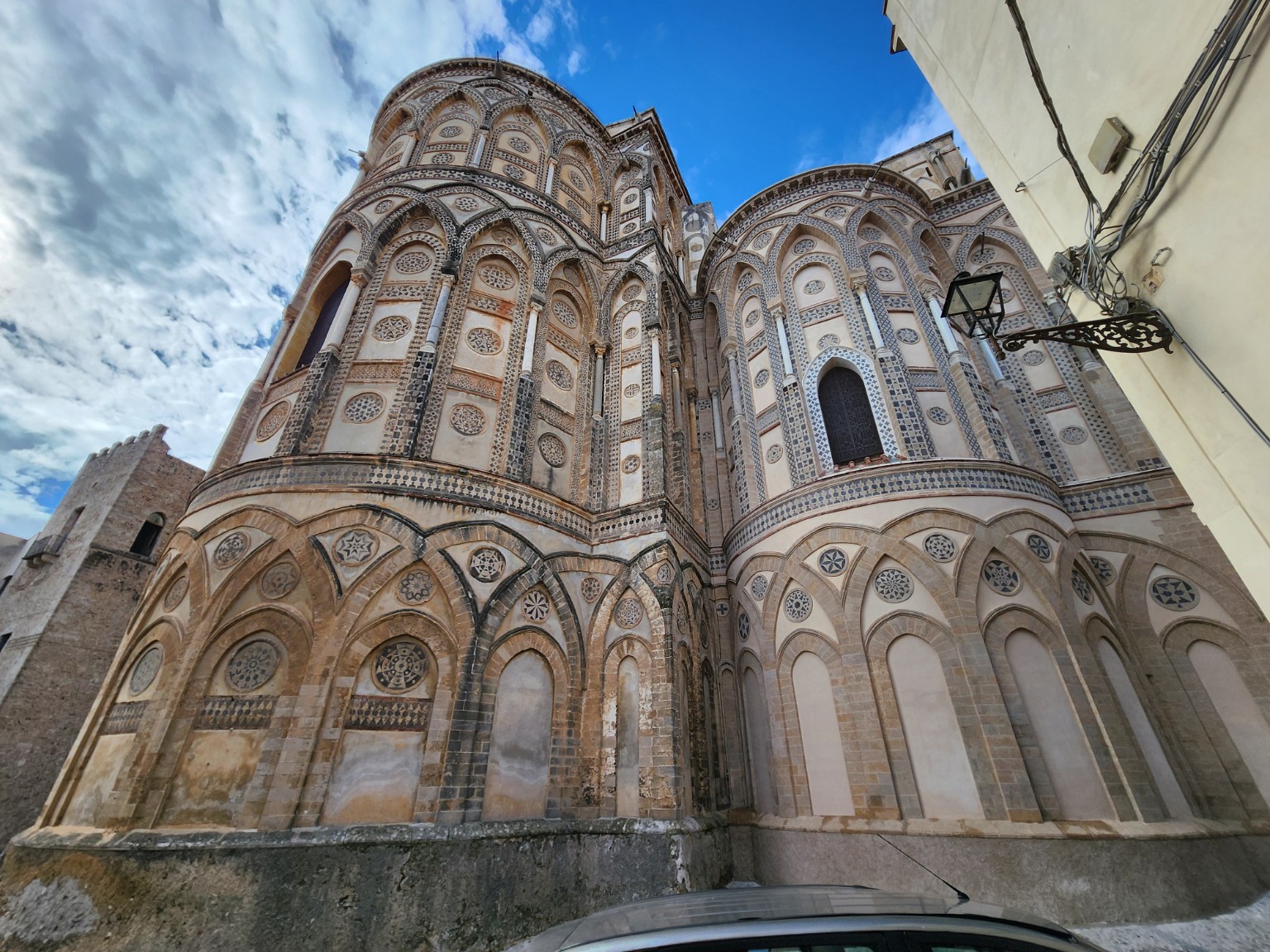
The first photograph looks along the cathedral’s nave towards the sanctuary. Tall stone columns carry ornamented arches, rows of wooden chairs emphasise the extraordinary length of the building, and a geometric marble floor guides the eye towards the apse. Above, a richly painted timber ceiling introduces patterns that recall the Islamic craftsmanship of medieval Sicily.
At the far end stands the enormous image of Christ Pantocrator, Christ as ruler of all, blessing with one hand and holding the Gospel with the other. The figure commands the entire interior, even from a great distance. Monreale’s mosaics cover approximately 6,000 square metres, among the most extensive surviving medieval mosaic cycles, illustrating Creation, the patriarchs, Christ’s life and the apostles.
These images are more than lavish decoration. They form a carefully arranged visual narrative intended to communicate biblical history and Christian theology. Their Byzantine artistic language was adapted to a distinctly Sicilian setting, where Latin, Greek and Islamic traditions had long intersected.
William II ruled a kingdom positioned between Western Europe and the eastern Mediterranean. Its craftsmen worked across religious and cultural boundaries, producing architecture that cannot be understood through a single national or stylistic label. Monreale is one of the clearest surviving expressions of that synthesis.
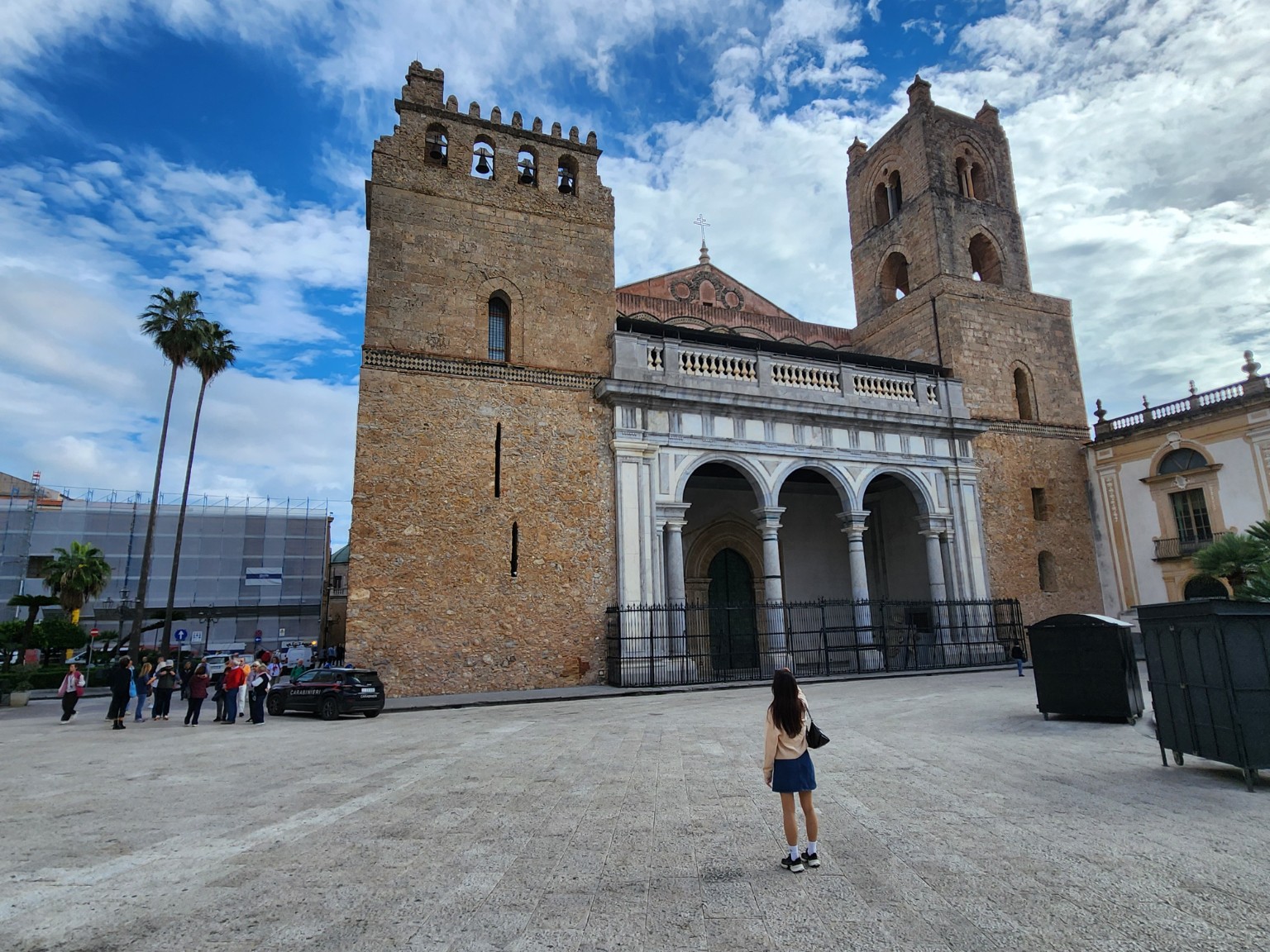
The western façade presents an altogether different personality. Its two great medieval towers resemble defensive structures, their rough stonework rising above a later classical portico. The portico, added in the eighteenth century, introduces pale arches and a balustrade that contrast with the heavier Norman masonry.
In the second photograph, the broad square and scattered visitors convey the cathedral’s scale. Palm trees, a dramatic cloud-filled sky and the surrounding town frame a building that has been altered over centuries without losing its medieval character. The façade is not perfectly symmetrical, and that is part of its interest: Monreale is a living architectural record, not a reconstruction of one moment in time.
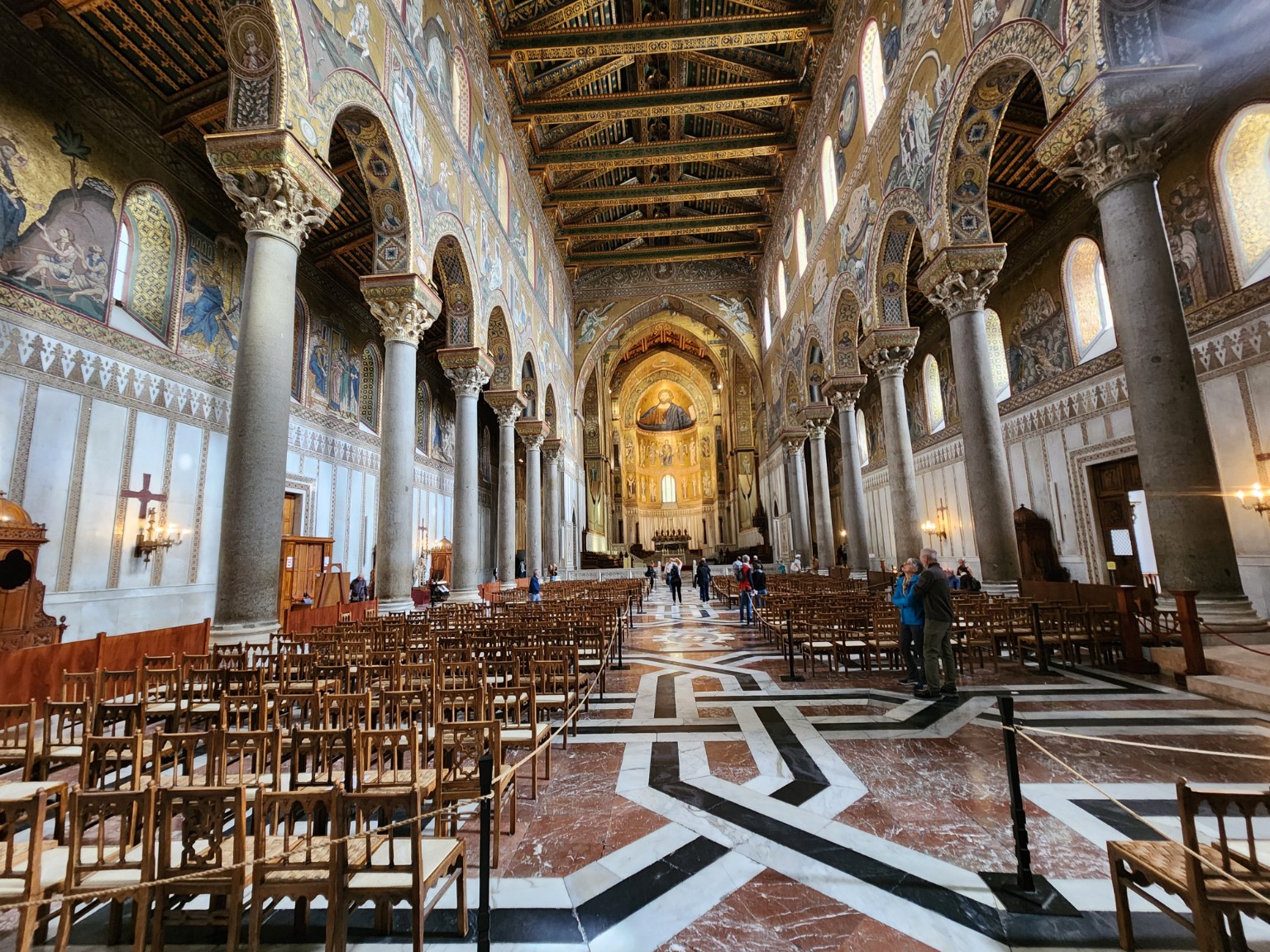
The eastern apses are perhaps the most rewarding exterior detail. Seen from the narrow street behind the cathedral, their massive curved forms are covered with interlacing pointed arches, circular medallions and intricate bands of contrasting stone. The patterns evoke the geometric ornament of the Islamic Mediterranean while remaining part of a Christian cathedral.
The third photograph captures these apses from below, emphasising their verticality and the extraordinary density of surface decoration. A traditional street lantern and the neighbouring building show how closely the medieval monument is woven into the town. The restricted viewpoint makes the apses feel even more monumental.
Monreale was conceived as both a religious foundation and a statement of royal authority. William II established an important ecclesiastical centre alongside a Benedictine monastery, strengthening the prestige of his dynasty and creating a lasting counterweight within Sicily’s political and religious landscape.
The adjoining cloister is another major reason to visit. Its arcades are supported by 228 paired columns, many decorated with mosaics and carved ornament. The capitals show biblical episodes, animals, vegetation and fantastic creatures. After the visual intensity of the cathedral, the cloister offers a quieter opportunity to examine medieval craftsmanship at close range.
For photographers, the interior presents a demanding combination of dark columns, bright windows and reflective gold mosaics. A wide-angle lens helps convey the scale, but careful exposure is needed to retain detail in both the sanctuary and the shadows. The floor patterns make strong leading lines, while the repeated columns create a powerful sense of depth.
The façade rewards a wider view from the square, especially when the sky provides texture. The apses are more difficult because the adjacent streets allow little room to step backwards. Wide-angle perspective exaggerates converging verticals, yet that distortion can also express the extraordinary height and complexity of the architecture.
Monreale lies roughly eight kilometres southwest of central Palermo, above the historic Conca d’Oro valley. Visitors can arrive by public transport, taxi or organised excursion. It is sensible to check current opening hours and admission arrangements because access to the cathedral, cloister and any rooftop areas may differ.
Allow at least two hours for the cathedral and its immediate surroundings, and longer if you want to study the mosaic narratives or photograph the exterior carefully. The town itself deserves a stroll, with elevated viewpoints across the valley and a calmer atmosphere than the busiest streets of Palermo.
What remains most memorable is the contrast between exterior and interior. Outside, Monreale speaks through stone, geometric pattern and monumental Norman mass. Inside, those same walls become a vast golden narrative. Few European monuments reveal the artistic exchange of the medieval Mediterranean with comparable force. Monreale is not merely a beautiful church near Palermo; it is one of Sicily’s essential historical experiences.