Just before one o’clock on a November weekday, Piazza San Domenico does what it has done for three centuries. People cross it. A woman walks out of the frame with a Rinascente bag on her arm and a yellow coat folded over it. Another sits on the stone step below the column, phone in hand, back to the church. Nobody looks up.
Look up anyway. The bronze Virgin on top of the Colonna dell’Immacolata wears a ring of stars, and someone has already wound strings of lights down the shaft and around the base. Behind her rises the ochre and white front of San Domenico, the second church of the city after the cathedral, with its two bell towers and its saints in their niches. To the left, a restored baroque palazzo has a department store inside it.
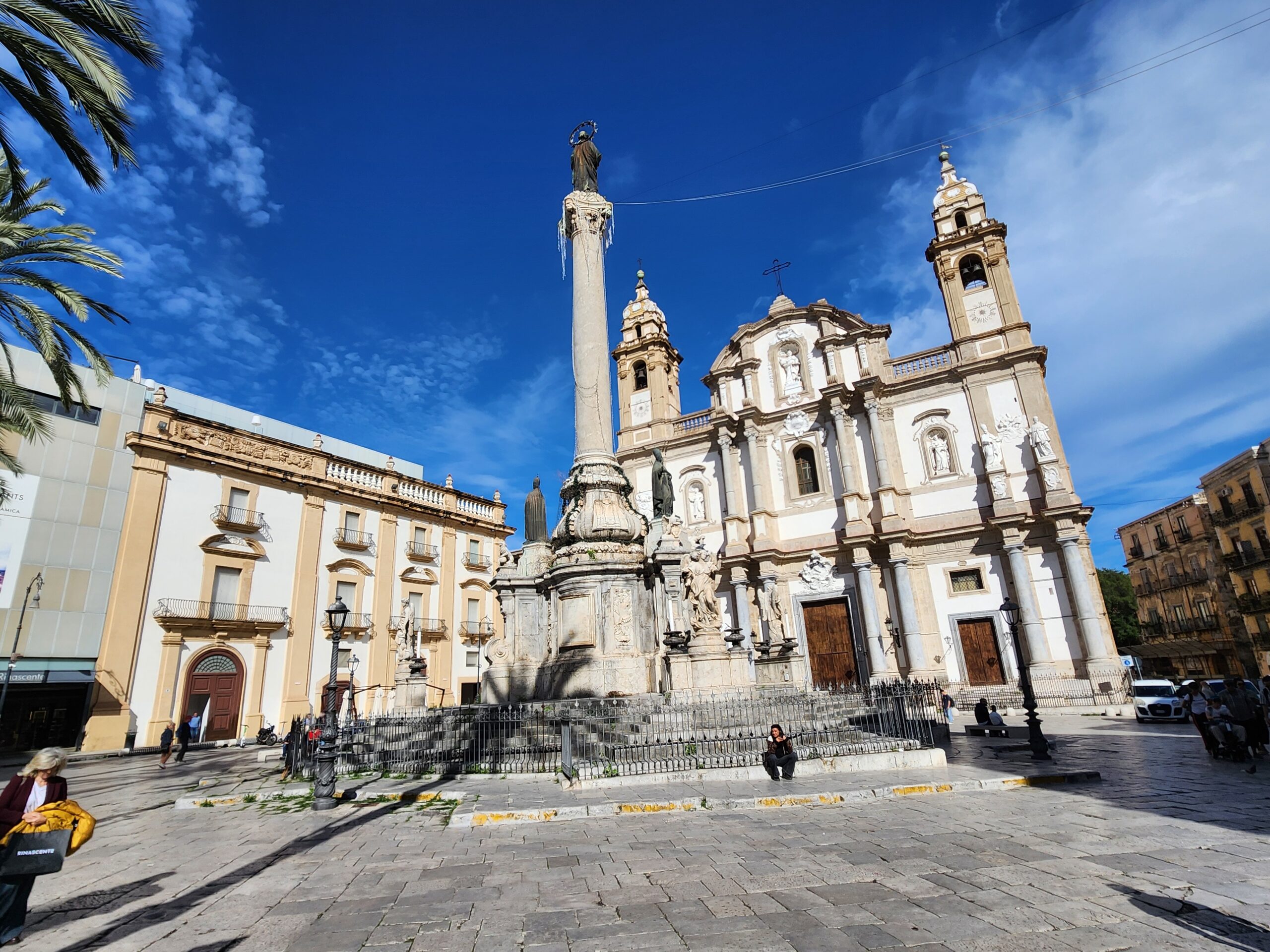
A Square Cut Out for a Column
The piazza is younger than it looks. The church went up from 1640 to a design by the Dominican architect Andrea Cirrincione, but it sat hemmed in by houses, a few of them brothels if the local histories are right. In the 1720s another Dominican friar, Tommaso Maria Napoli, drew the square and the column as one project. The houses came down. The facade was finished in 1726. The column went up between 1724 and 1727, completed by Giovanni Amico.
Vienna had a say. Sicily then answered to the Habsburg emperor Charles VI, who approved the plan, lent the place its first name (Piazza Imperiale) and wanted the Immaculate Conception on top rather than the Madonna of the Rosary the friars had in mind. One detail tells you who the square was really built for. The column was kept short enough for a priest at the high altar to see the Virgin through the big window in the facade.
Pantheon Inside, Shop Window Outside
Since 1853 San Domenico has been the Pantheon of illustrious Sicilians, the burial church for the island’s writers, painters, politicians and jurists. In 2015 the remains of Giovanni Falcone, the anti-mafia judge killed at Capaci in May 1992, were moved here. Plenty of visitors cross the square for that tomb and nothing else.
The building on the left of the photo is the other half of the story. Rinascente took over the old palazzo on the corner of Via Roma, kept the eighteenth-century baroque front that faces the piazza, and put glass and LED on the Via Roma side. The top floor has a food hall and a bar with a terrace over the square. Up there the bell towers sit at eye level and the Virgin looks close enough to touch. The Vucciria market is a few streets away. The view is the product, and the store knows it.
It nearly went away. In 2020 the store was locked in a rent dispute with the fund that owns the building and looked set to close, which would have left Via Roma with one more row of dark windows. A nine-year deal kept it open. The street around it still has its share of empty shopfronts. The square doesn’t.
Come Back on 8 December
Those lights on the column are there for a reason. On the feast of the Immaculate Conception the city gathers here, and since 1954 a firefighter has climbed a fire-engine ladder to lay a wreath at the Virgin’s feet, the same gesture Rome makes at Piazza di Spagna. Rinascente lights up its own front for the season too, so from early December to Epiphany the church and the shop glow at each other across the paving.
With an hour to spare, go into the church first for Falcone’s tomb and the marble. Then take the lift to the roof and order a coffee over the square Napoli cleared three hundred years ago.
The friars wanted the view. The shop sells it.