Walking through the Albertina is always a bit like drifting between eras—every turn of the corner pulls you into another painter’s world, and each canvas seems to breathe its own distinct air. This particular room, with its white walls and honey-colored floor, feels both stark and intimate, a quiet stage where artworks and visitors play off one another. The subdued lighting softens the edges, but also directs the gaze with a curator’s precision: you see exactly what they want you to see.
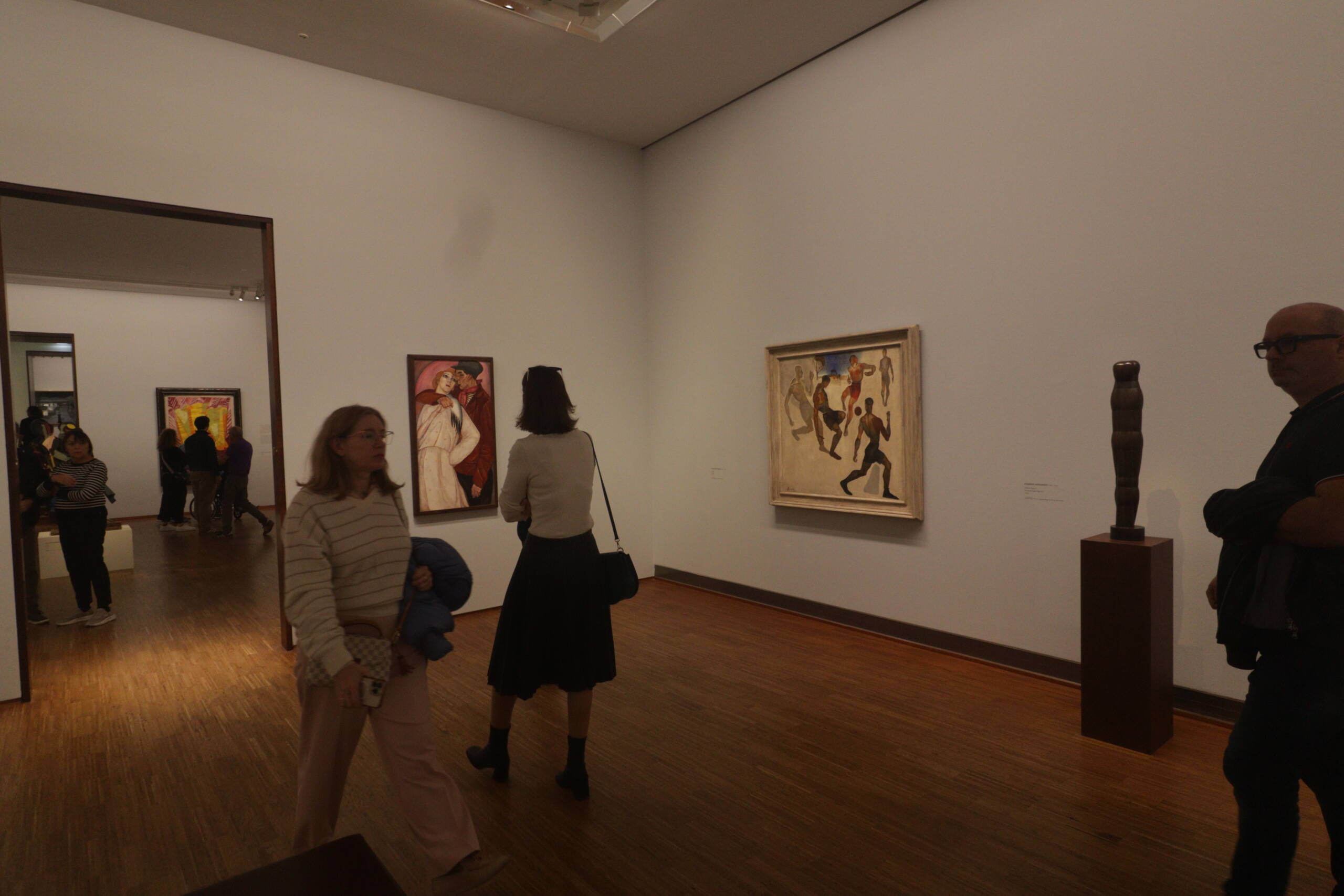
On the right wall, the painting that immediately grabs attention is the one with boxers, caught mid-stride in a choreography of fists and muscles. The angular gestures, the almost cubist anatomy, and the earthy palette with sudden splashes of color—it recalls the style of German expressionism from the interwar period, perhaps someone like Max Beckmann or Rudolf Schlichter. There’s a restlessness in it, as though the figures are less about boxing and more about struggle itself: men trapped in an endless rhythm of confrontation, fighting not just each other but also the weight of their own existence.
Next to the doorway, another painting shows two figures pressed close together, wrapped in flowing drapery tinged with warm reds and flesh tones. The intimacy, the elongated features, and the stylization make me think of works connected to the Neue Sachlichkeit (New Objectivity) or even an echo of Oskar Kokoschka, who painted with raw human emotion and often emphasized the fragile but intense bonds between people. There is something both tender and theatrical about it—the embrace feels private, yet staged for us to witness.
Looking through the doorway into the next gallery, the eye is immediately pulled by the brightness of a yellow-and-pink composition on the far wall. It’s a bold, almost shocking contrast compared to the muted tones in this room. From this angle, it looks abstract, brimming with jagged lines and raw energy, perhaps a later 20th-century piece, something tied to Austrian modernism. The crowd gathered around it seems absorbed, and in a way, that cluster of visitors forms part of the composition itself—artworks here never exist in isolation, they live in conversation with their audience.
And then there’s the sculpture: a tall, vertical form, almost totemic in its simplicity. Its smooth, elongated body, segmented slightly like vertebrae or stacked forms, could be reminiscent of Constantin Brâncuși’s influence, though Austrian and German sculptors of the 20th century also played with this kind of minimal organic abstraction. It stands there like a silent witness, a counterpoint to the motion and drama locked in the paintings.
This, I think, is what makes the Albertina so rewarding—it isn’t just the big names like Monet, Picasso, or Klimt, but these quieter rooms where lesser-known expressionists and modernists tell their stories. You move from intimacy to struggle, from tenderness to confrontation, and in the end, you leave carrying fragments of moods, colors, and unresolved questions.
The flow of the Albertina leads onward, and suddenly the mood shifts. The crisp white walls now frame canvases that no longer depict the struggles of human bodies or intimate embraces but instead plunge directly into the language of dreams. This is the Surrealist room, and it feels as though you’ve walked into someone else’s subconscious.
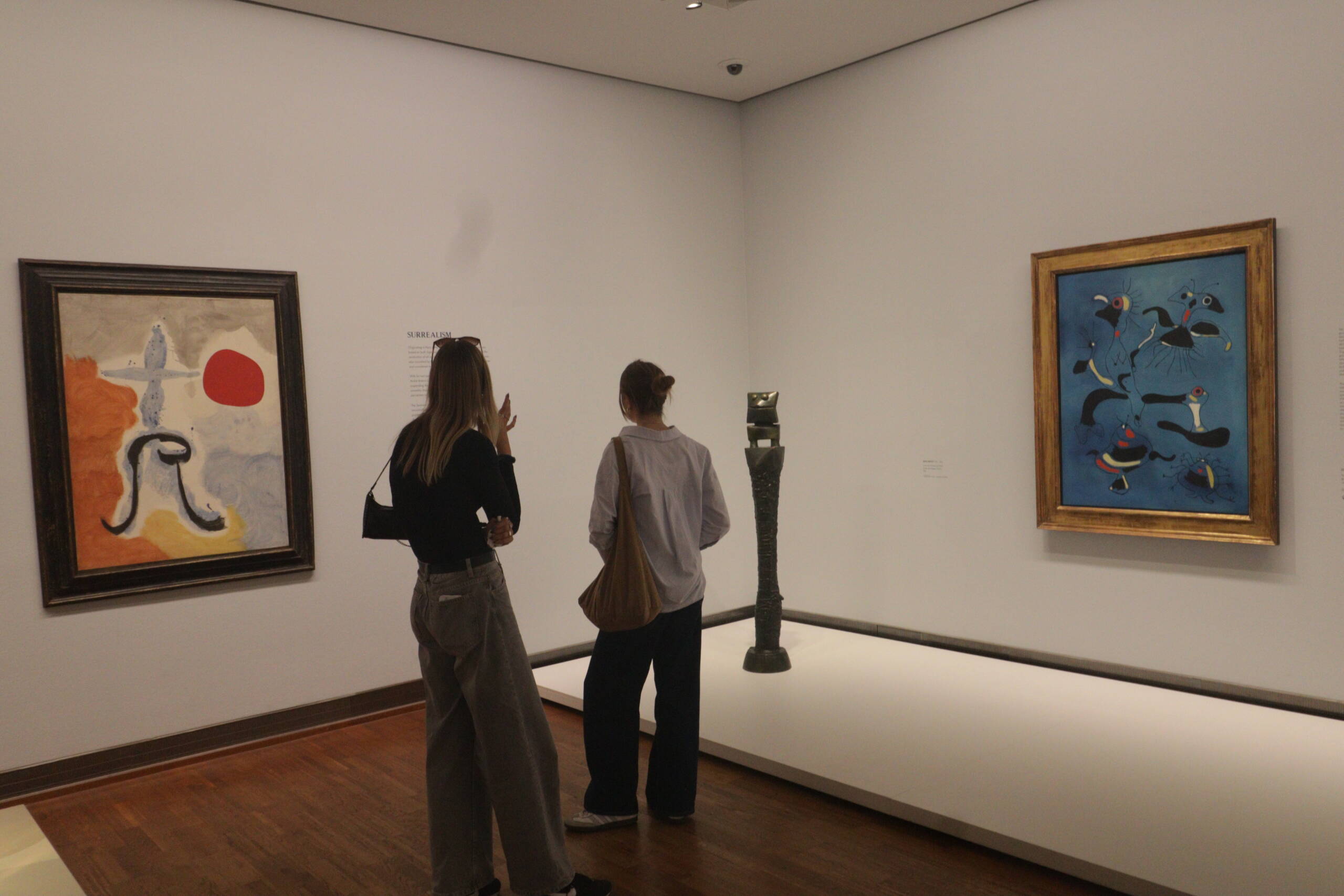
On the left, a painting dominated by a vast red form hovers above strange biomorphic shapes, hovering between abstraction and figuration. The smudges of orange and gray, the whimsical curves that might be moustache-like, the playful but unsettling ambiguity—it’s classic Joan Miró, who delighted in turning the familiar into something irreducibly strange. His works have that ability to make you smile and scratch your head at the same time, as though he’s whispering, don’t take reality too seriously.
On the right wall, framed in gold, another Miró sings out in deep cobalt blue, scattered with black forms and punctuated by bright red eyes and flashes of yellow. It looks alive, like a cosmic map of floating creatures suspended in infinite space. The rhythm of the composition feels musical, almost like sheet music for a surrealist orchestra—each figure another note, another improvisation in Miró’s language of dreams. Viewers stand still in front of it, their faces drawn closer as though to decode the private joke he left there.
Between them, standing firm and vertical, is a sculpture with a strange, totemic presence. Its dark bronze form rises from the floor, rough yet deliberate, its surface almost reptilian. It might be by Hans Arp or even Giacometti, both of whom played with surreal forms in three dimensions. Unlike the paintings, which open up infinite imaginative spaces, this piece feels more grounded, like an anchor dropped into a sea of dreams.
Two women stand absorbed in the moment, one gesturing with her hand as if decoding the enigma aloud, the other leaning in with patient curiosity. Their silhouettes become part of the installation itself, the dialogue between art and viewer now visible. Behind them, on the wall, the word Surrealism is printed in quiet block letters, like a reminder that what surrounds them is not supposed to be logical, but instead a mirror to the irrational undercurrents of thought.
Moving from the earlier rooms into this one feels like stepping out of the daylight and into twilight. The themes shift from human confrontation and tenderness to the play of the subconscious. It’s not just about art anymore—it’s about entering a dreamspace that persists even after you step back into Vienna’s streets.
Leave a Reply