Bangkok has this way of greeting you like a warm body leaning just a bit too close, a kind of humid hug that wraps around you whether you’re ready or not. The first step outside Suvarnabhumi or Don Mueang feels like walking into a dense, invisible curtain of heat — thick enough that you could almost press your hand against it. And yet people don’t love Bangkok despite this; somehow the heat becomes part of the city’s pulse. The trick isn’t to fight it. You have to learn how to move with it, like you’re sliding into the city’s bloodstream rather than trying to sprint through it. I didn’t understand that my first day — racing tuk-tuks, rushing skywalk corridors, sweating in places I didn’t even know could sweat. The city wasn’t overwhelming me; I was overwhelming myself.
The softest way into Bangkok is the early morning. The air still remembers the night and there’s this tenderness to everything. Vendors roll open shutters; someone grills pork skewers that smell faintly sweet and smoky; monks move like quiet orange lanterns collecting alms. If you wander through the sois instead of the big roads, you find the slow-life version of the city: laundry swaying like flags, a cat stretched on a motorbike seat, someone inside a doorway playing an old Thai love song on a radio that crackles like it’s made of dust and memory. This is where the city lets you breathe. Get iced coffee from a cart — the strong, condensed-milk kind that borders on dessert — and just sit somewhere. The city likes when you sit. It’s almost as if Bangkok is saying, “Good, you finally arrived.”
Then comes afternoon, and this is where people make their biggest mistake. This is not sightseeing time. This is retreat. Bangkok teaches you how to rest without apology. The malls here are not malls in the Western sense; they’re climate-controlled public oases. Central Embassy, Siam Paragon, IconSiam — half the city migrates to these places when the sun climbs high enough. You don’t have to buy anything. Just wander, drift, let your clothes dry and your body reset. Even the bathrooms in some of these places feel like small cathedrals of cool marble and chilled air. Thailand has turned resting into an art. Nobody here rushes unless they’re new or confused.
And then, almost without you noticing, the heat lifts just slightly. A degree or two, but it’s enough. This is when the city exhales. This is when Bangkok really comes alive. Find a night market. Not the loud, neon, tourist-designed ones, but the small ones where people sit on plastic stools and the smell of charcoal and sizzling chicken mingles with river breeze and scooter exhaust. Pad kra pao spicy enough to clear your sinuses actually cools your whole body. Mango sticky rice is not dessert here; it feels like medicine. A cold beer under a string of cheap lights can fix entire moods. The evenings have that gentle, slightly chaotic, deeply human rhythm that makes Bangkok feel like the world’s living room.
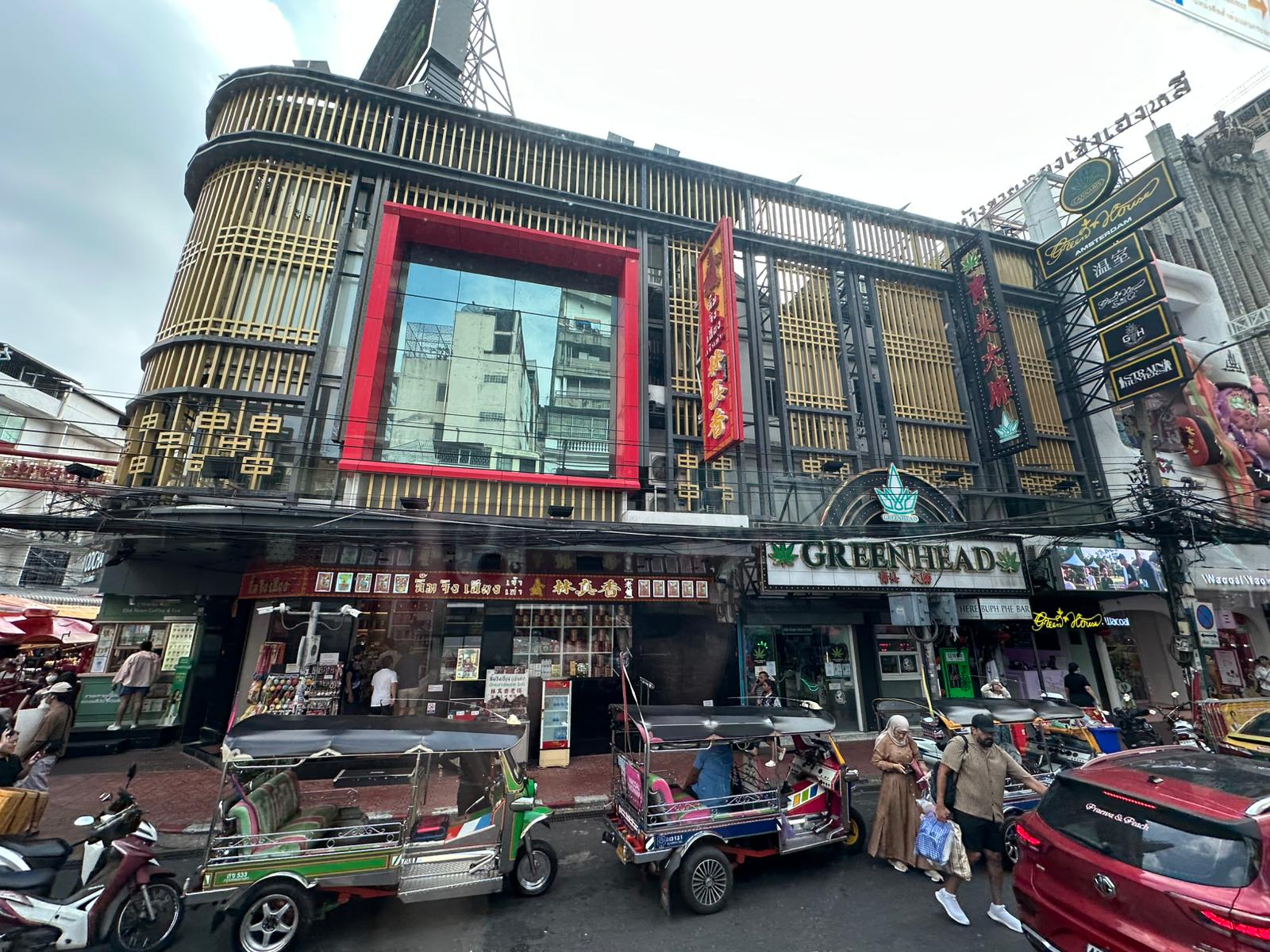
The photo (shot with Canon EOS R6 Mark III and RF45mm F1.2 STM) from Chinatown feels like catching the city in that exact exhale. The building’s gold slats stretch up like a theatrical curtain, broken by that heavy red frame reflecting older concrete buildings behind it — as if the past is always present here, layered quietly in the glass. The signs hang down in bright strips of color, speaking both Thai and Chinese at once, because in this neighborhood identity isn’t a debate; it’s just reality. At street level, a couple of tuk-tuks sit in the foreground, their paint chipped, seats worn, proud in the way something can be when it’s worked every day for years. The drivers aren’t hustling, just waiting, part of the scenery in the same way as the cables overhead — those thick black cords tangled like a messy musical score. A woman in a long dress carries shopping bags in no hurry at all, moving with that quiet confidence of someone who knows exactly where she is and has nowhere urgent to be.
And then there are the details that only reveal themselves if you stand still long enough: a storefront filled with jars and packets of things you might never identify; a glowing sign for a new cannabis shop that somehow blends effortlessly into a neighborhood older than many cities; the sky above swollen with clouds, deciding whether to rain.
Bangkok doesn’t need to impress you. It just needs you to slow down enough to notice what’s already happening. And somewhere around your third or fourth day, it happens — the heat stops feeling like something to escape. It becomes a texture. A presence. A rhythm. You stop melting. You start soaking. That’s when Bangkok opens herself fully — not all at once, but in layers, like the reflections in that red-framed glass.
Leave a Reply