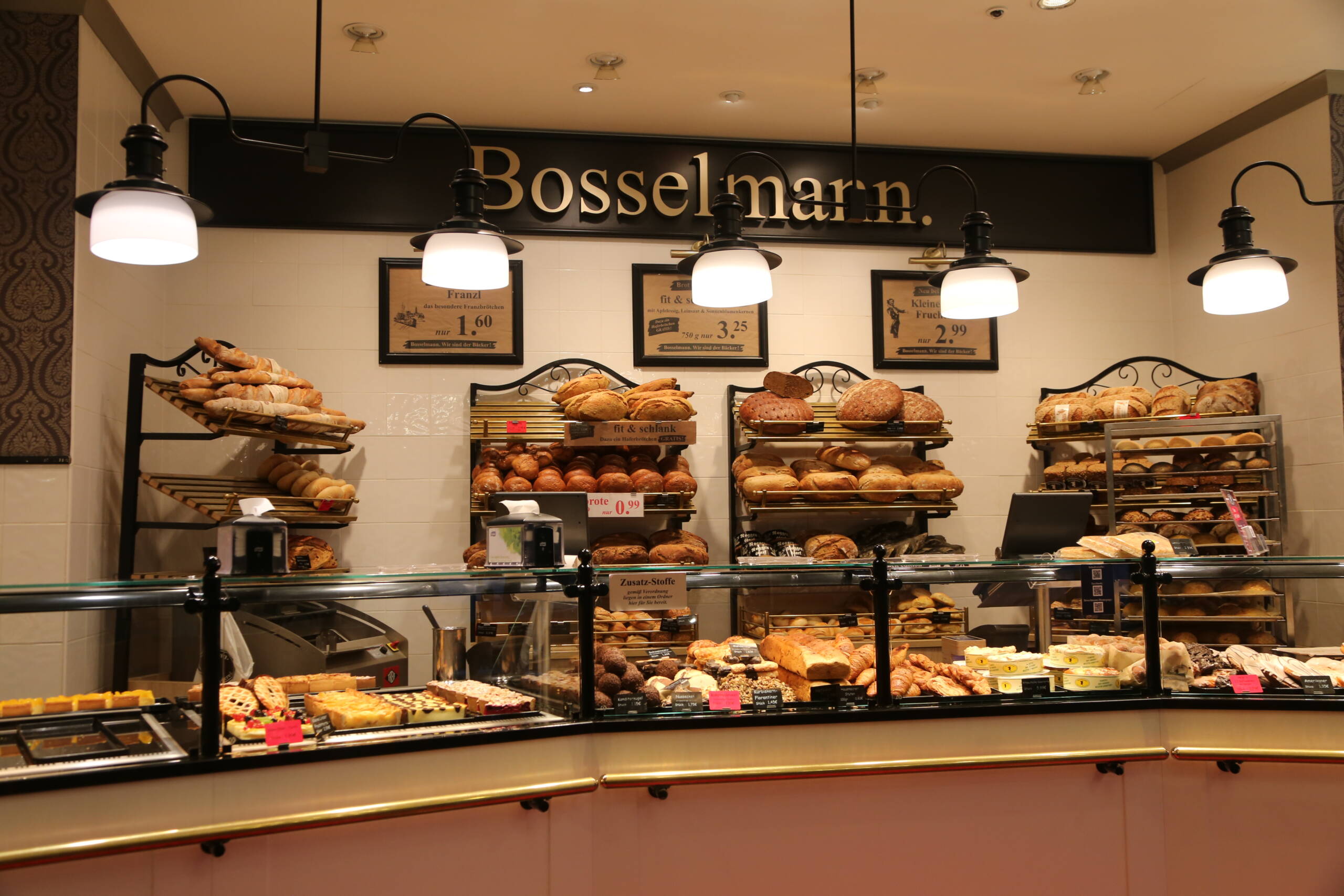
Walk into this bright Bosselmann counter and you feel the argument before you taste it: racks stacked high with domed boules and rye rounds, trays of glossy Brötchen lined up like chess pieces, pretzels lounging confidently beside seeded slabs, all under warm pendant lights that make the crusts glow. The glass cases curve in a polite half-embrace, showing off butter-rich pastries and dense, handsome loaves tagged in euros, while behind them the shelves carry the serious breads—the ones with freckles of seed and the kind of bark-like crust that whispers long fermentation, low rush. It’s not fancy; it’s focused. Flour dust, paper price placards, a slicer waiting to turn a whole loaf into tomorrow’s sandwiches—every detail says this is a place where bread isn’t a prop, it’s the point.
Germans say their bread is the best in the world, and honestly, they might be onto something. Start with the sheer range. In a single neighborhood you can find airy morning rolls and heavyweight rye bricks, nutty spelt loaves and multi-grain mosaics, sourdoughs that snap when you tear them and milk breads that sigh. That diversity isn’t a marketing trick; it’s a living tradition powered by regional styles and small bakeries that still care about starters, temperature, and time. Patience is built into the flavor. Long ferments, cultured sourdoughs, and mixed grains mean you get crusts with character and crumb with chew, not just a sweet, forgettable puff.
The ingredient story helps their case, too. Rye and spelt aren’t side characters here; they’re headliners. Seeds and kernels—sunflower, pumpkin, flax, sesame—turn loaves into edible landscapes. Bakers lean into techniques that privilege depth over speed, coaxing acidity, aroma, and that beautiful grain-toasted warmth you only get when a loaf had time to become itself. And yes, there’s a culture around daily buying: people still pop into a local Bäckerei for fresh bread, still ask for their favorite style by name, still expect the crust to talk back a little. When a country trains its palate on good bread, good bread shows up.
If you’re mapping the landscape, a few classics help you get your bearings. There’s Bauernbrot, the farmhouse rye-wheat sourdough with a dark, confident crust; Pumpernickel, inky and slow-baked with a gentle sweetness and a tight, almost cakelike crumb; Vollkornbrot, 100% whole-grain and unapologetically hearty; Schwarzbrot, the deep, malty cousin that loves butter and smoked fish. You’ll meet Roggenmischbrot and Weizenmischbrot, rye-wheat and wheat-rye blends tuned to region and mood; Dinkelbrot if spelt is your thing; Mehrkornbrot and Körnerbrot bursting with seed; Kürbiskernbrot and Sonnenblumenbrot jeweled with pumpkin or sunflower. For daily rhythm there are Brötchen in a dozen local names—Schrippen, Semmeln, Weckle—and their buttery cousin, the Laugenbrötchen dipped like a pretzel; speaking of which, the Brezel is a category of its own: glossy, elastic, salty, and perfect with beer. In the softer corner you’ll find Zopf and Hefezopf for weekends, and come winter, fruit-studded Stollen that walks the line between bread and celebration. Pick any three and you’ll still feel like you’ve barely started.
Sure, “best in the world” will always be subjective—someone’s grandmother’s ciabatta or a Parisian baguette will have a strong claim on a person’s heart—but Germany’s case rests on more than pride. It’s the ecosystem: neighborhood bakeries, rigorous craft education, a population that recognizes crumb structure the way coffee geeks talk about crema, and a willingness to let bread taste like grain, not sugar. Standing at that counter under the warm lamps, you get why the claim sticks. The loaves aren’t trying to be flashy; they’re trying to be right, and most days, that’s even better.