• Skip to main content
  • Skip to secondary menu
  • Skip to footer

Travel Marketing

Travel and Tourism Trends

  • Sponsored Post
  • Travel Event Calendar
  • Travel Market
  • Travel Magazine
  • About
  • Contact

The Good Soldier Švejk Café, Prague

October 31, 2025 By admin Leave a Comment

There’s a certain warmth to the Švejk cafés in Prague that you can’t quite fake. You walk in and immediately feel like you’ve stepped into a storybook of Czech satire—wood-paneled walls, amber lights glowing beneath arches, and cartoonish murals retelling the misadventures of the ever-smiling, ever-naïve soldier Josef Švejk. In these photos, the atmosphere is instantly recognizable: the wry humor, the nostalgia for early 20th-century Prague, and that peculiar blend of melancholy and mischief that only Hašek’s world can conjure.

On one wall, a painted scene captures Švejk and his companions slumped over beer mugs, their faces equal parts boredom and bemusement. Above them, the famous line “Tak nám zabili Ferdinanda, paní Müllerová…” (“So they’ve killed Ferdinand, Mrs. Müllerová…”) greets you like an opening sentence of a novel that changed Czech literature forever. It’s both absurd and oddly comforting—a perfect summary of how Czechs have historically met tragedy with irony. The mural’s rustic colors—muted browns, greens, and beiges—blend beautifully with the café’s soft yellow tones and the dark wood furniture, all glowing gently under the warm pendant lights.
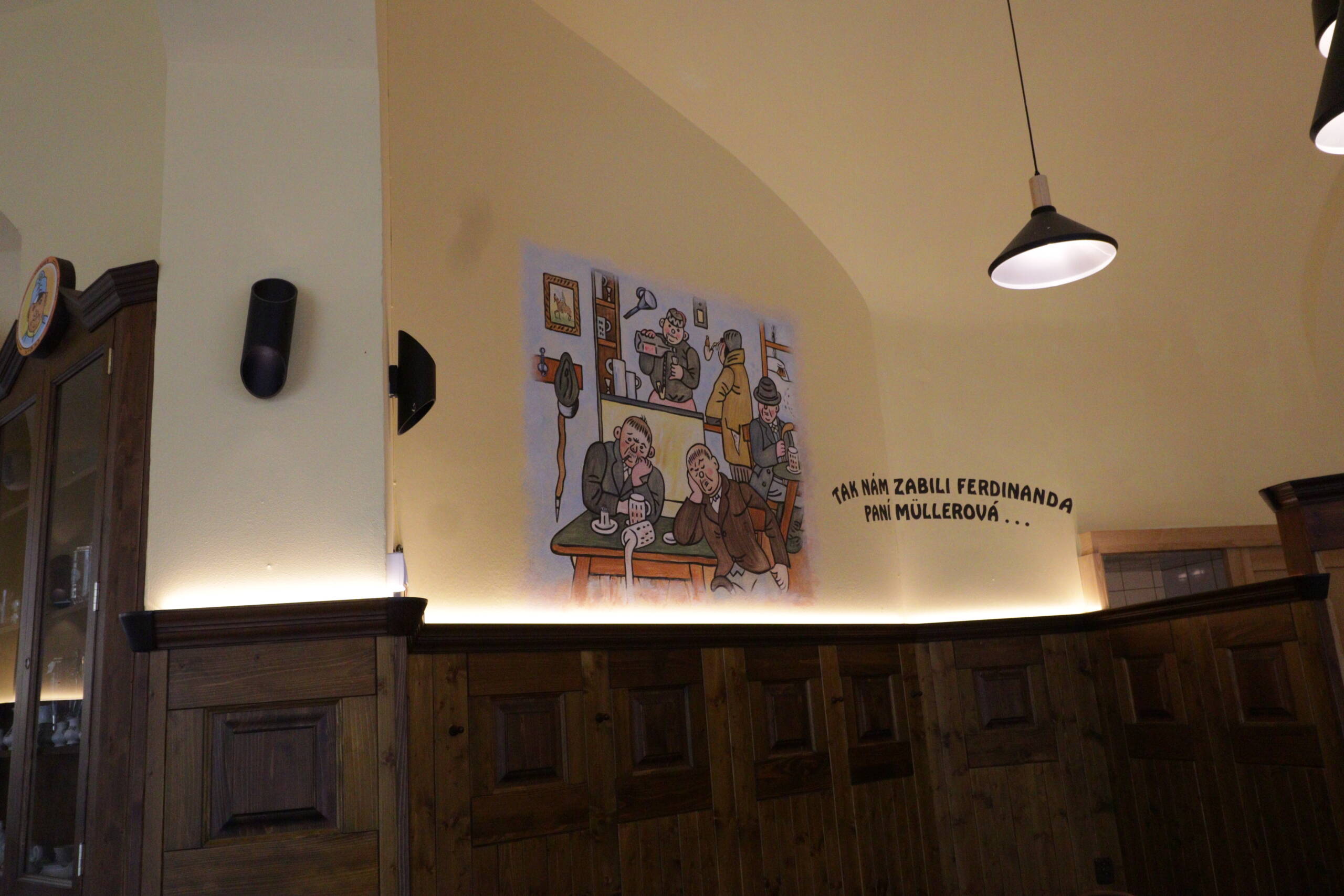
The Good Soldier Švejk Café, Prague

In the second image, you can see how the entire space carries that same mood—a long, vaulted interior where every corner feels like part of a larger comic strip. Wooden tables, bentwood chairs, and a quiet figure sitting alone in a hoodie, perhaps unaware that the scene mirrors one of Švejk’s own moments of waiting and wondering. The light coming through the windows spills across the floorboards, highlighting the balance between everyday modernity and this playful, nostalgic décor. Even the display cabinet filled with teapots, mugs, and beer steins feels like it belongs to a bygone Prague—one where stories, politics, and laughter mingled over pints of Pilsner.
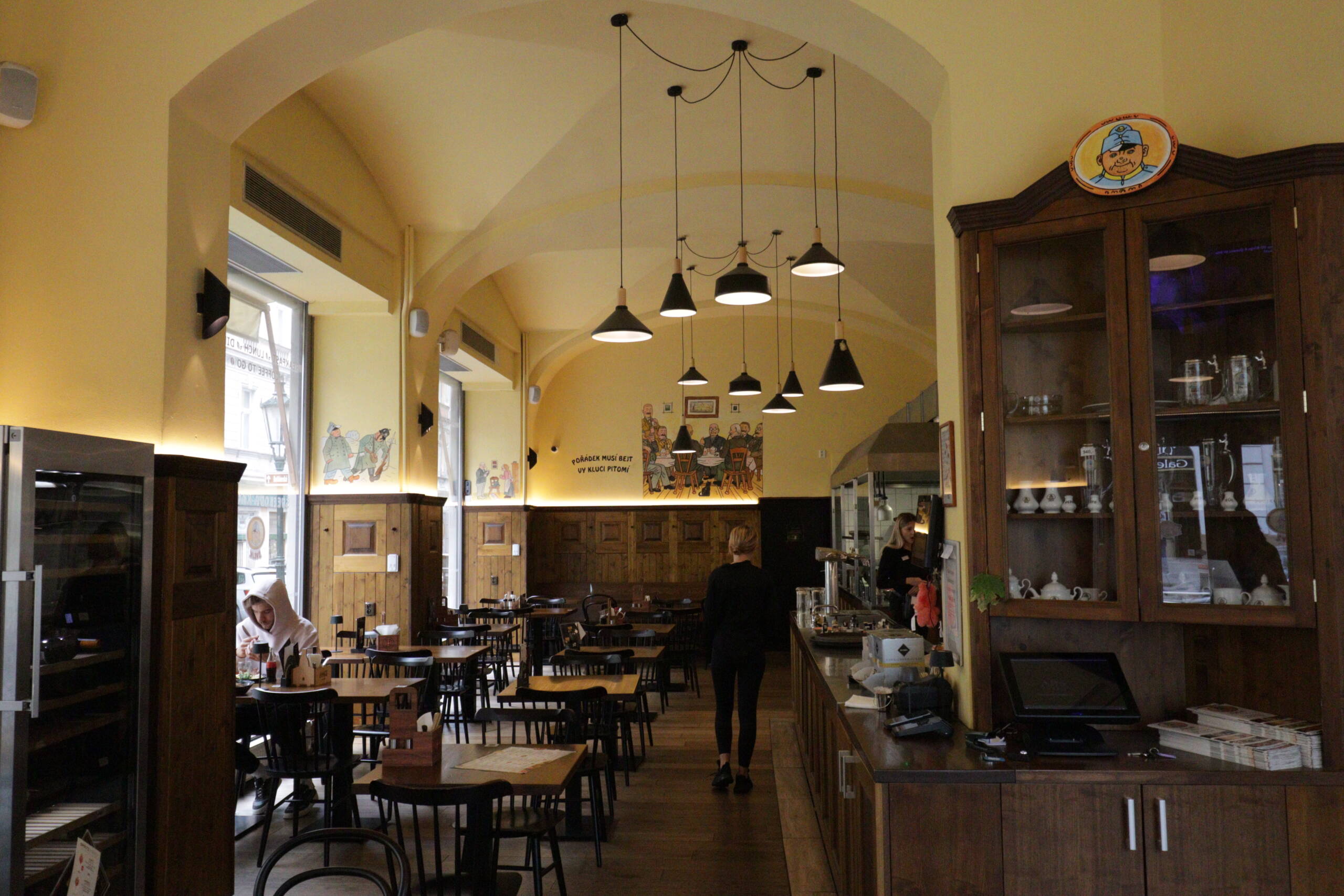
The Good Soldier Švejk Café, Prague

The Švejk-themed restaurants are more than tourist curiosities; they’re cultural shrines of irony. Named after Jaroslav Hašek’s The Good Soldier Švejk—a satirical novel published in the aftermath of World War I—they serve as both pubs and time capsules. The novel’s antihero, Švejk, embodies Czech resilience: he’s absurdly obedient, hilariously literal-minded, and yet somehow undermines every authority figure through his sheer naïveté. The cafés channel that same energy—mocking bureaucracy, celebrating beer, and finding humor in futility.

In Prague, visiting one of these places is less about the food (though the goulash and dumplings are reliably hearty) and more about immersing yourself in a mood. You’re not just dining—you’re entering the story. The laughter painted on the walls is contagious, the waiters wear expressions of practiced irony, and you can almost imagine the ghost of Hašek himself, chuckling in a corner over a half-drunk glass of lager.

Some travelers stumble upon these restaurants by accident, thinking they’re simply cozy Czech pubs. But locals know they represent something deeper—an affectionate satire of their own national temperament. The humor is self-aware, unpretentious, and timeless. Švejk’s spirit still lingers in the laughter that rises over clinking glasses, in the whimsical art on the walls, and even in the resigned shrug of the man at the next table, waiting for his soup to arrive.

It’s this blend of humor and history that makes the Švejk cafés so distinctively Prague. They invite you to sit down, take a sip, and—just for a while—join the great cosmic joke that Švejk himself never stopped telling.

Filed Under: News

Reader Interactions

Leave a Reply Cancel reply

Your email address will not be published. Required fields are marked *

Footer

Recent Posts

  • Why Lisbon Cafés Are Putting Up No Laptops Signs: Coffee, Instagram, and the Remote Work Terrace
  • Four in Ten Travelers Visit Landmarks Mainly for the Photo: How Instagram and Reels Reshaped Tourism
  • Why Comporta Still Feels Empty: The Rice Estate Behind Portugal’s Most Coveted Beaches
  • Travel in 2026: Five Photos That Explain the Year’s Real Trends
  • Tiny Tourism: Why Travellers Are Choosing Towns Nobody Photographs
  • In Defence of the Hop-On Hop-Off Bus
  • EasyJet Agrees £5.7bn Apollo Takeover: What Changes for Passengers and What Doesn’t
  • Taormina Beach Guide: Mazzarò, Isola Bella, and What Nobody Tells You About the Pebbles
  • Juliet’s Balcony in Verona Was Added in the 1930s and the Crowds Do Not Care
  • St Mark’s Basilica in Venice: The Gold Mosaics Are Dimmer Than the Photographs Suggest

Media Partners

  • Virtual Travel Guide
  • Ancient Rome
Porto’s Chestnut Season Is the Shoulder Season Worth Booking
Venice at Night Is the Version No Access Fee Covers
The 18th-Century Fountain Hidden Inside Bordeaux’s Customs Museum Courtyard
The Bilbao Effect, 500 Years Early: Jerónimos Monastery And The Guggenheim
Bilbao’s Quiet Renaissance: From Industrial Port to Design Destination
Lisbon’s Seven Hills: A Walking Guide That Tells You the Truth
New Orleans: An American City That Plays by Different Rules
Ha Long Bay Without the Cruise Brochure
Istanbul at the Threshold: A City That Has Always Been Two Things at Once
Iceland’s Ring Road: What the Drive Teaches You That No Photograph Can
Sponsored Post
About
Contact
Roman Concrete in Museum Fragments: What the Cross-Section Actually Shows
Roman Sarcophagi Spent More Time as Fountains and Church Tombs Than as Graves
Aquincum Museum Reconstructs 16 Roman Faces From Skulls Found on Budapest's Danube Frontier
Roman Public Latrines Reveal an Empire That Built Sanitation Without Achieving Hygiene
The Pont du Gard: Rome's Most Perfect Structure
Water Across the Empire: Roman Aqueducts and the Hydraulic Logic of Conquest
Who Cleaned Roman Rome: The Social Economy of Waste

Media Partners

  • Media Forum
  • Market Analysis
Micron $MU and SanDisk $SNDK Sold Off on a Weibo Post: Why I Think the Market Priced the Wrong Thing
AI Companies Are Paying Two Different Prices for the Same Books: License or Settlement
Bessent Promises an Economic D-Day for Iran While Hormuz Runs at 20% of Normal Traffic
Big Tech Will Spend About $700 Billion on AI Infrastructure in 2026. The Revenue Is Not Close.
Carney Answers With Dollar-for-Dollar Tariffs on US Steel, Dairy and Electronics From September 8
ChatGPT Referrals to Publishers Grew 200% and Still Account for Under 1% of Traffic
Congress Is Drafting Bills With AI, and AI Is Bad at the Part That Matters
Fed Minutes Show a Hiking Bias, and Traders Cut September Odds Anyway
Google Referrals Fell 60% for Small Publishers and 22% for Large Ones, and That Gap Is the Point
Indiana Enters a Second Week Without Power While the Wildfire Story Moves On
The Immersive Experience in the Museum World
Japan, China, and Taiwan: A New Triangle of Risk — and a Window of Opportunity for Japan
Ghost Kitchens as Infrastructure: The Shift from Restaurants to Intelligent Food Networks
The Zoom Divide Nobody Saw Coming
The Perfect Budget Content-Creator Kit
Reimagining Prague’s Tourism Future Through Immersive Media and VR Museums
Israel’s Urban Paradox: Tel Aviv Moves, the Rest Stand Still
American Express Global Business Travel (GBTG): Understanding the Business and the Investment Case
Why the Canon R8 Paired With the New RF 45mm f/1.2 Lens Quietly Becomes the Content Creator’s Sweet-Spot
The Future of Travel: A $15.5 Trillion Industry

Copyright © 2026 Travel Marketing

Media Partners: Timey · Publishing House · Ancient Rome · Photography · Calendarial · Transportational