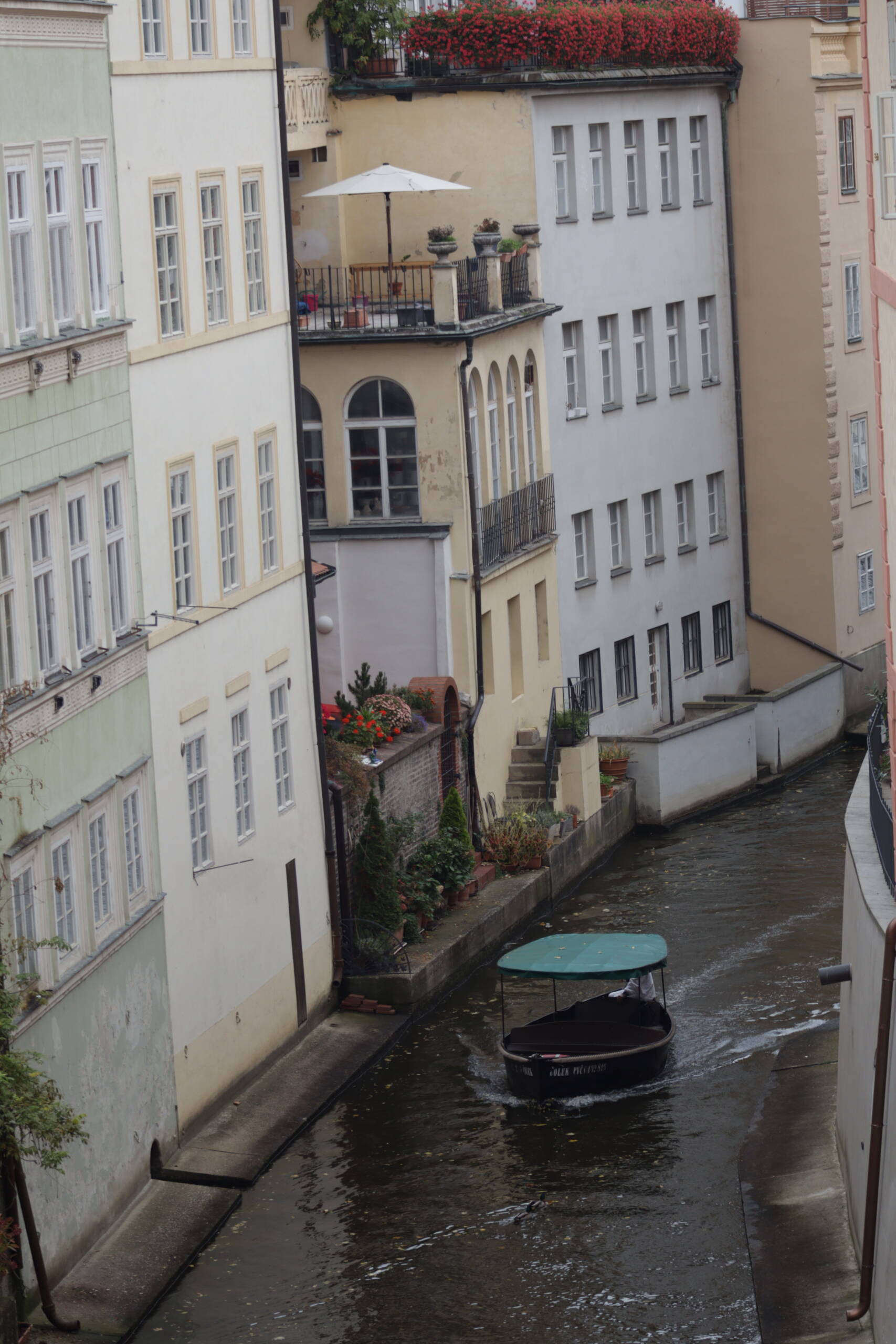
Tucked away behind the grandeur of Charles Bridge, a quieter, more secret Prague glides by on this narrow ribbon of water known as Čertovka, or “The Devil’s Stream.” The canal divides Kampa Island from the rest of the Lesser Town, a tiny artificial island that looks like it could have been pulled straight from a 19th-century novel. The photograph captures the essence of this hidden waterway: pastel façades leaning slightly toward each other as though whispering, their reflections trembling in the dark current below, and a small covered boat drifting softly between them. It’s one of those corners where the city exhales — less monumental, more human, touched by time.
Historically, Čertovka was engineered in the 12th century by the Order of the Knights of Malta to power water mills. Traces of that practical origin still remain: if you wander further down toward the Vltava, you can spot the massive mill wheel turning lazily beside the wooden house known as the Grand Priory Mill. The name “Devil’s Stream” itself likely came from a mischievous local legend — a nod to a temperamental housekeeper who lived nearby and whose spirit supposedly “haunted” the canal. Whether myth or humor, it feels appropriate; there is something uncanny about this narrow waterway, hemmed in by Baroque and Renaissance façades that seem to bend under the weight of centuries, yet still vibrantly alive with plants, terraces, and those stubborn little signs of domestic life.
In this image, the quiet geometry of the scene holds the eye — cream and pale green plaster facades layered with balconies, one adorned with a white parasol and another with a row of bright red geraniums bursting like a small act of rebellion against the grey. There’s a human intimacy to it: potted plants clustering along the narrow walkway, tiny windows reflecting morning light, and that single motorboat with its green canopy slicing through the water like a punctuation mark in a long, slow sentence. The movement of the boat ripples through the stillness, reminding you that even the most frozen corners of Prague are constantly in motion.
This stretch of canal has often been called “the Prague Venice,” and while that’s an overused phrase, here the comparison feels oddly fitting — not for scale, but for atmosphere. The closeness of architecture and water creates a strange intimacy, as though the city and the river were locked in conversation. In the soft light, the worn stucco, the delicate iron railings, and the almost secret terraces seem to whisper the stories of centuries of residents who lived, argued, loved, and watered their flowers above this same flow. There’s a palpable sense of quiet endurance — the buildings are slightly crooked, the plaster uneven, and yet the scene feels harmonious in its imperfection.
Photographically, the framing amplifies that intimacy: the downward angle compresses the scene into a visual corridor of light and texture, leading the viewer’s eye from the shadowed foreground toward the canal’s gentle curve. The composition plays on contrast — static verticals of architecture against the dynamic diagonal of the waterway. It’s not a grand view, but a deeply local one, the kind of vignette that tells more about Prague’s soul than any postcard of the castle ever could. You can almost hear the echo of footsteps above, the distant chatter of tourists from the bridge, and the slow hum of the boat’s motor dissolving into the murmuring water.
Moments like this make it clear why Prague continues to fascinate painters, photographers, and poets alike. Beneath its theatrical Gothic skyline lies a labyrinth of lived-in beauty — narrow canals, secret courtyards, and centuries of quiet domestic poetry. The Devil’s Stream is one of those places where the city shows its softer, almost tender side. Standing over it, camera in hand, one doesn’t just look at Prague — one listens to it breathing through the centuries, a sound both ancient and remarkably alive.
Leave a Reply