You can almost miss them the first time. This one, the one in the photo, sits pressed against a building’s corner like he simply chose the spot and never left. The cobblestones around him are uneven in that old-European way, patches of gray and brown stone fitting together like teeth. His hat is long, bent at the top, with a chip missing where fingers or weather have worn it down. He holds a tiny cup in one hand, his other resting on what looks like a stump that might be a seat or a makeshift table. His face has that wry, slightly mischievous patience of someone who’s been where he is for a very long time and expects to remain there long after you’ve left. The bronze has aged into that green-blue patina that cities earn slowly, the way memory stains surfaces. He looks like he knows something, but he’s in no hurry to tell you.
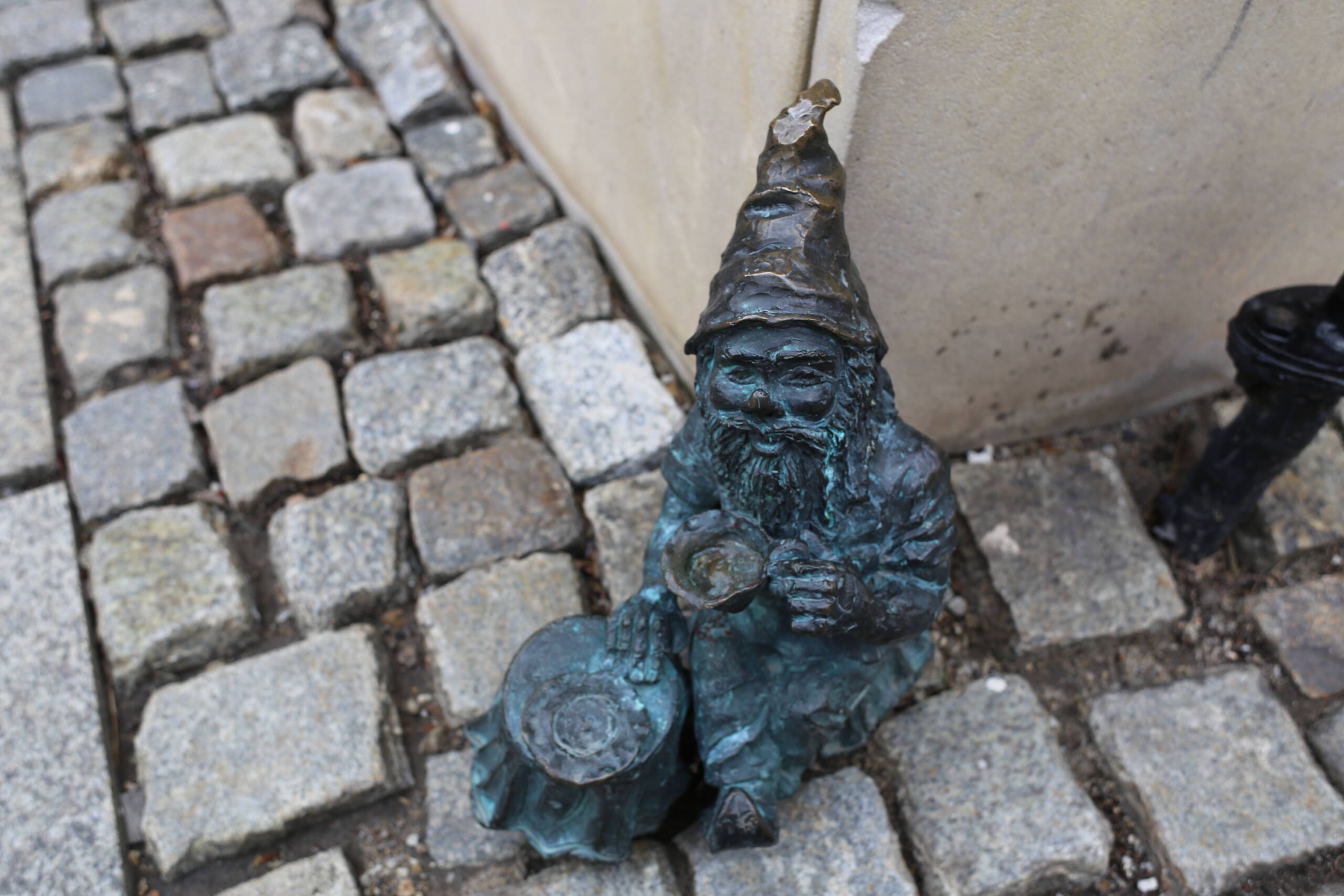
Wrocław’s dwarves (Polish: Wrocławskie krasnale) started appearing in 2005, each one about 20 to 30 centimeters tall, scattered across the city in doorways, on benches, beside bridges, under windowsills. As of 2024, there are more than 800 of them. Eight hundred tiny characters, each with its own personality, job, attitude, mood. There’s the scholar hiding near the university, the banker with a coin sack near the financial district, the sleepier ones leaning against café walls. At some point, the city made a map, which is almost funny, because part of the charm is not knowing. Tourists walk around with these maps now, checking dwarves off like they’re achievements in a game. But the real joy isn’t in collecting them all; it’s in letting them quietly appear in the corner of your eye.
This is where Wrocław quietly slides into that idea of post-tourism travel assets. The term sounds like satire, but you can see it happening across the world: people choosing destinations not for big landmarks but for how the city feels in its everyday rhythms. Think cozy laundromats in Tokyo where time slows down to the hum of dryers and quiet routine. Mall food courts in Dubai where the whole world seems to be eating under one artificial sky. Soviet-era cable cars in Tbilisi that aren’t efficient, or comfortable, or glamorous, but they carry history in their joints. These are the textures that stay with you longer than museums or towers. Wrocław’s dwarves work exactly the same way: they pull you down to street level. Literally. You walk slower. You look closer. Your attention shifts from the skyline to the details at your feet.
The dwarves don’t perform for you. They don’t announce themselves. They just exist, woven into the city’s daily life. Finding them makes you feel connected in a way guidebooks never manage. It turns walking into discovery again, not of monuments, but of moments. And it’s funny how quickly it becomes addictive. After the third or fourth one, you start scanning the bottoms of walls, the bases of fountains, the steps of storefronts. You stop rushing. You notice things you wouldn’t otherwise: the chipped paint on railings, how locals tuck umbrellas under elbows when the rain comes suddenly, the way cafes set a single chilly chair outside even in late autumn because someone always sits there.
This is a style of travel that values being present rather than triumphant. You’re not “doing” Wrocław. You’re living inside it, a little bit. Just long enough to feel like the city breathed in your direction and you breathed back. And later, when the trip turns into memory, you might forget the museum hours, or the cathedral dates, or which bridge had the best view. But you’ll remember the dwarf with the crooked hat and tiny cup, waiting on his little corner of cobblestone. You’ll remember how you found him simply by paying attention. And that’s a travel memory that stays warm for a very long time.