There’s a certain magic to walking through Vienna’s cobblestoned streets, knowing that no matter which direction you take, there will always be a café waiting for you, quietly promising warmth, comfort, and a sense of timelessness. It’s not just about coffee—though Viennese coffee has earned its own proud reputation—it’s about the culture that has grown around it. To sit in a Viennese café is to sit inside a living tradition that blends history, art, conversation, and observation into something far richer than just a drink in a porcelain cup.
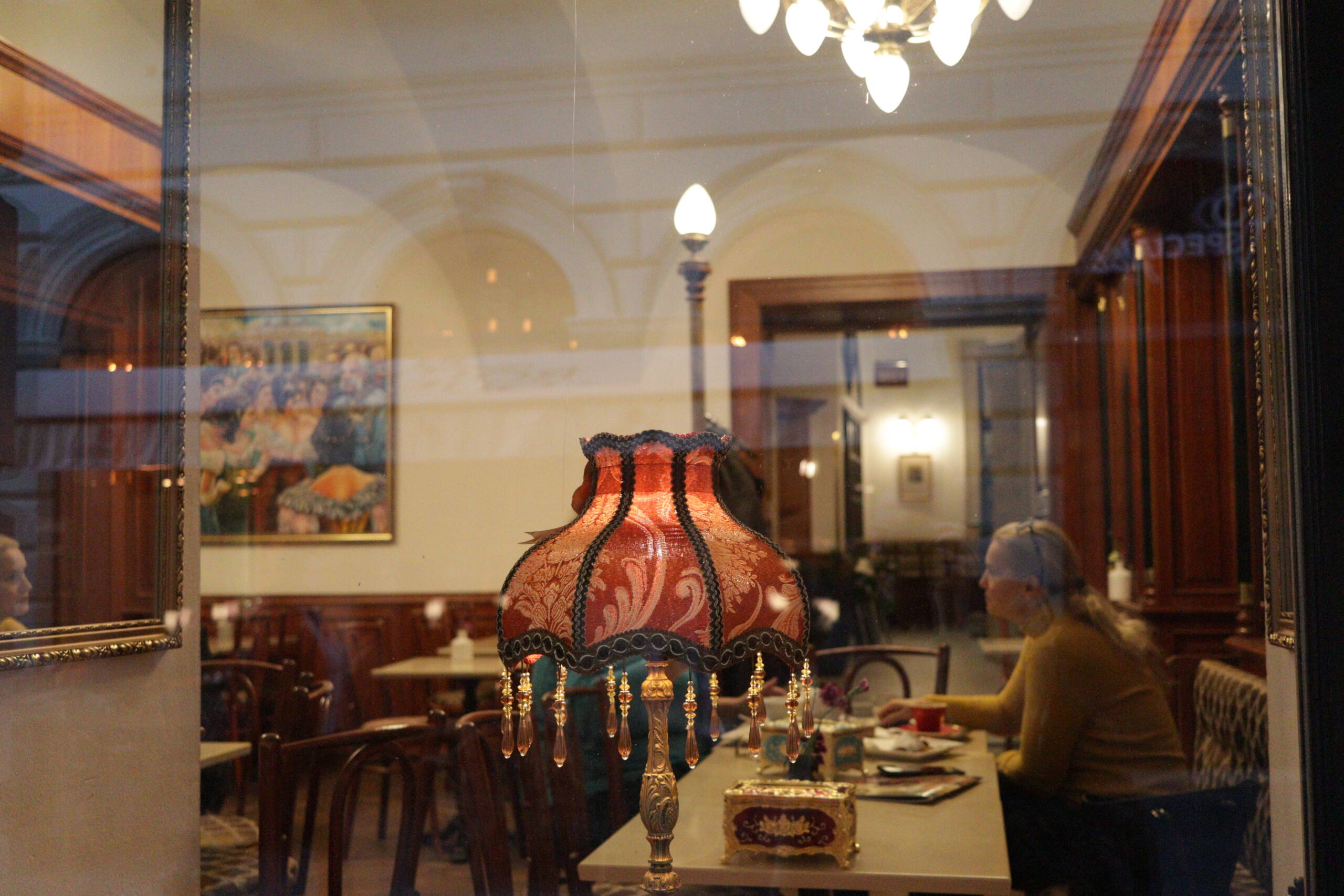
The photograph here captures this essence beautifully. At first glance, your eyes rest on the ornate, old-fashioned lampshade—deep red fabric with a floral pattern, trimmed with beads that dangle like drops of amber. The lamp, glowing softly, seems almost like a stage prop in a theater of intimacy, drawing you closer into the frame. Through the glass reflection, you glimpse the interior: polished wooden walls, classic furniture, a painting alive with color on the far wall. At one of the tables sits a woman in a mustard-yellow sweater, engaged in conversation over coffee, her gestures soft but deliberate. The reflection on the window folds the outside world into the scene, as if reminding you that café culture in Vienna is never confined, it always spills over—between inside and outside, past and present, reality and performance. This layered atmosphere is exactly what makes Viennese cafés more than just cafés. They are mirrors of the city’s spirit.
What makes Vienna’s cafés unique is their deliberate slowness. In many other parts of the world, coffee shops are designed to push you through: order fast, drink fast, leave fast. In Vienna, a coffeehouse is designed to hold you. You can sit with a single cup of Mélange for hours, and no one will chase you away. This unhurried pace was always part of their appeal, especially in the late 19th and early 20th centuries, when intellectuals, writers, and revolutionaries made cafés their second homes. Sigmund Freud famously spent hours in Café Landtmann, scribbling notes that would later transform the field of psychology. Gustav Klimt and his circle could be found debating art at Café Central, where Trotsky was also once a regular, plotting the contours of revolutions that would change history. The Viennese café became a democratic stage—open to the sharpest minds, the loudest dreamers, and the quietest observers alike.
To sit in one today is to inherit that tradition. You may not be Freud or Klimt, but as you watch the world outside the café window, you begin to sense the continuity of thought that has brewed here for centuries. The atmosphere invites you to write, to read, or simply to drift into observation. Even the objects on the tables—the sugar dispensers, the polished trays, the tiny glasses of water always served with coffee—feel ceremonial. And those lamps, like the one in the photograph, are more than décor. They are mood-setters, visual cues that time is different here, that the rest of the city may rush by, but inside this café the minutes are suspended.
There’s also a social artistry in how Vienna’s cafés function. They are paradoxical: simultaneously public and private. You are surrounded by strangers, yet wrapped in your own bubble of thought. The clink of porcelain cups, the rustle of newspapers, the quiet hum of conversations in German, English, or Italian—they all blend into a shared soundtrack. If you look closely, you notice the choreography of it: waiters in white shirts and black vests glide between tables, balancing silver trays with elegance, delivering cakes that are almost too pretty to cut into. A slice of Sachertorte or Apfelstrudel is not merely dessert—it is part of the ritual. To indulge in one is to claim your place in the long history of café culture, to taste something that countless others before you have also enjoyed.
Vienna’s cafés, at their heart, are spaces of balance between grandeur and coziness. The interiors are often majestic, with high ceilings, chandeliers, mirrored walls, and marble-topped tables. And yet, despite this elegance, they invite a kind of casual intimacy. You can be dressed formally, discussing business with colleagues, or you can arrive alone in a simple sweater, notebook in hand, and still feel completely at home. The spaces don’t discriminate; they level everyone into participants of a broader cultural performance. This democratic allure is perhaps one of the strongest reasons why Viennese cafés have been recognized by UNESCO as intangible cultural heritage.
The photograph captures another layer of this duality. The focus on the ornate lamp, glowing warmly, contrasts with the quiet everydayness of the scene behind it. A woman talking over coffee, a few empty tables, the framed art and chandeliers—it’s all understated. And yet, together, it radiates a richness you wouldn’t find in a fast-food chain or a trendy modern café. Vienna’s coffeehouses are not sterile; they are filled with character, stories, and objects that whisper of times past. Every lamp, every painting, every wooden chair holds memory. They remind you that when you sit down for coffee here, you are not just a customer, you are part of the story.
What makes this culture truly attractive is that it invites both tourists and locals to slow down. For visitors, there is novelty in stepping into such a historic setting. For locals, there is comfort in continuity. Many Viennese still maintain their favorite café as part of their routine, not as an indulgence but as a natural extension of daily life. You go there to think, to meet, to be alone among others. And in an age dominated by speed and distraction, this quality feels almost radical. To order coffee in Vienna is to reclaim your right to linger.
There is also the aesthetic appeal that cannot be ignored. Take the photograph again—the texture of the lampshade, the play of reflections on the glass, the golden tones of the chandelier lights above. The café is not simply a place to drink coffee; it is a feast for the senses. The visual richness of these interiors draws photographers, artists, and writers who find endless inspiration in the details. The atmosphere encourages creativity because it feels so carefully staged, almost like stepping into a film set where you are both audience and actor.
But the deeper attraction lies in the emotional resonance. When you sit in a Viennese café, you begin to understand the city’s rhythm. Vienna is not in a hurry. It values the art of conversation, the dignity of solitude, the pleasure of small indulgences. The cafés embody these values perfectly. They are living rooms extended into the public sphere, where strangers can coexist in comfort. They are also repositories of history, where one can sense the echo of past debates, romances, and revelations. And they are cultural bridges, where the everyday meets the extraordinary, where a simple cup of coffee can connect you to centuries of tradition.
To spend time in a Viennese café is, in the end, to experience Vienna itself. The charm is not in the coffee alone, nor in the cakes, nor even in the chandeliers and lamps—it is in the way all these elements come together to create a world that feels both timeless and alive. Whether you’re gazing at the ornate lampshade through a glass window, as in the photo, or sitting inside with a notebook and a slice of Sachertorte, you are participating in something greater than yourself. You are stepping into a tradition that has shaped art, literature, and politics, and continues to shape the everyday lives of those who call Vienna home.
And perhaps that’s the final secret: Vienna’s café culture is not about escape from the world, but about engaging with it differently. It asks you to look closer, to listen more carefully, to savor longer. It’s about presence, about allowing yourself to be woven into the tapestry of the café, where each cup of coffee is a thread connecting past, present, and future. That is its enduring charm, and that is why the attraction of Vienna’s café culture will never fade.