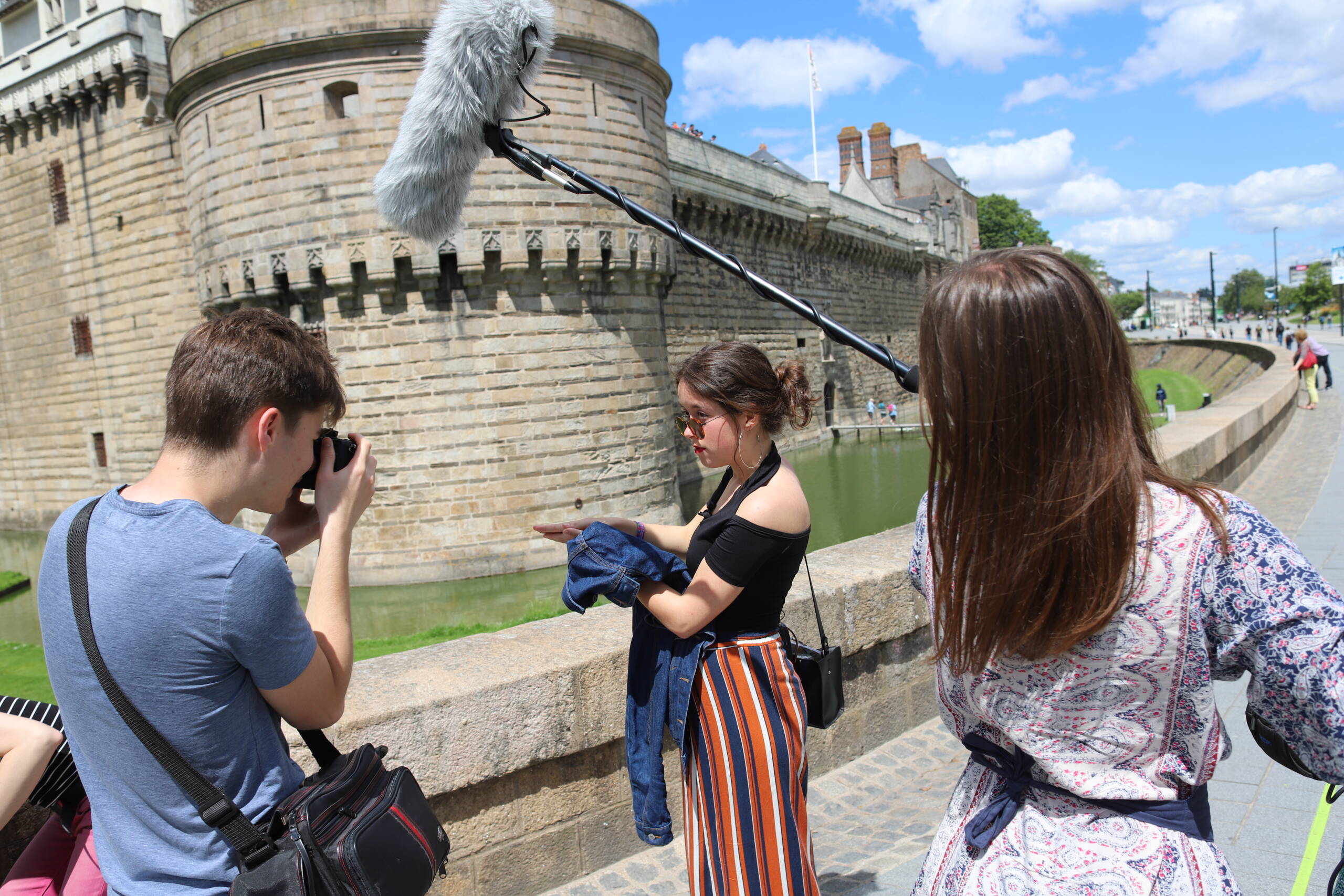
There’s something oddly poetic about stumbling onto a scene like this: a young woman standing in front of medieval stone walls and a green moat, sunlight catching her sunglasses just right, while another person holds a boom mic wrapped in a ridiculous furry windscreen hovering over her like a curious animal, and a camera operator leans in with focus and intensity. The setting looks like the Château des Ducs de Bretagne in Nantes—built for dukes, wars, and royal intrigue—yet here it becomes a live backdrop for a modern kind of storytelling: a travel podcast or vlog or documentary hybrid, the kind that fills YouTube, Spotify, and TikTok feeds with wanderlust and curiosity.
If there’s ever been a moment that captures the new generation of travel media, it’s this one. Three people, portable gear, natural light, public space, and one idea: share the experience. No TV network, no supervisors, no trucks full of equipment. Just gear, creativity, and maybe a shared Google Doc somewhere holding the script. That freedom is the real shift—travel content isn’t broadcast anymore, it’s cast. Thrown out into the world to find an audience who either loves it, scrolls past it, or saves it for a flight they’ll never take.
Travel podcasting—or travel casting, if we broaden it—sits somewhere between audio documentary, casual storytelling, visual blogging, and culture journalism. If you strip it down, the craft has a few essential pillars: sound, visual narrative, voice, and workflow.
First, sound. The furry thing in the photo—the boom mic windscreen—exists because wind is the sworn enemy of every outdoor recording. Your voice may sound confident, poetic, deeply insightful in your head, but a 12 km/h breeze doesn’t care. So rule one: record controlled sound, even in uncontrolled places. Lavalier mics, boom mics, “deadcat” windscreens, and a quick mental note about passing motorbikes, fountains, and screaming families matter more than fancy editing later.
Second, visual narrative, even if you’re making a pure audio podcast. You need reference imagery—stills, short clips, people reacting to spaces, textures, light. Something to post, something to tease the episode, something to anchor memory. In the photo, the striped pants, the old stone fortification, and the reflected sky in the moat all do part of that job. The listener or viewer subconsciously absorbs the setting. It becomes real.
Then comes the most fragile part: voice, story, and tone. Travel podcasting isn’t Wikipedia with footsteps. It’s perspective, and perspective requires vulnerability. A good travel caster doesn’t simply say, “This castle was built in the fifteenth century.” They say something closer to: “I’m standing next to this fortress and imagining what it felt like to walk here during the reign of Anne de Bretagne—because there’s a kind of heavy silence in these walls that even tourists can’t erase.” The difference is subtle, but everything. Travel content isn’t about raw information—it’s about translation. You’re not just showing a place, you’re showing how you encounter it.
Finally—and this is something people often underestimate—workflow is the quiet architecture behind the magic. Recording while traveling means juggling memory cards, batteries, backups, quick edits, script reshaping, spontaneous retakes, local interruptions (“What are you filming?”), and weather that usually laughs at your optimism. The best creators build habits: label files immediately, carry extra audio backups, hold onto short notes in a physical notebook or an app, and always capture more ambient sound than you think you’ll need. The world doesn’t sound like silence; it sounds like texture.
Looking at this scene, you can almost feel the energy. Someone will soon say, “Okay, ready? Rolling—in 3, 2…” and then the voice becomes intentional. The moment becomes content. The place becomes part of a narrative that someone, somewhere, will listen to while commuting, cooking, packing, or dreaming.
Maybe that’s why this image works so well. It shows that travel podcasting isn’t glamorous equipment and perfect lighting—it’s improvisation, curiosity, and the willingness to tell a story before you fully know where it ends. Travel isn’t planned perfectly. It unfolds. The story unfolds with it.
If you ever decide to try travel podcasting yourself—start like this photo suggests: just go somewhere interesting, press record, stay curious, and let the place speak through you. The rest gets figured out one episode, one castle wall, one wind-protected microphone at a time.