• Skip to main content
  • Skip to secondary menu
  • Skip to footer

Travel Marketing

Travel and Tourism Trends

  • Sponsored Post
  • Travel Event Calendar
  • Travel Market
  • Travel Magazine
  • About
  • Contact

Rudolf Wacker’s Psychological Realism, Leopold Museum, Vienna

October 31, 2025 By admin Leave a Comment

The photograph captures a section of the Leopold Museum where Rudolf Wacker’s uncompromising realism meets the soft quiet of contemporary observation. On the wall before the visitors hangs “Frauenakt mit Figurengruppe” (Group of Women, c. 1926–1928), one of Wacker’s most disquieting works. Three figures occupy the canvas: a pale, heavyset woman in patterned undergarments, a darker, more slender woman in lilac stockings, and between them, a robed male figure, possibly a priest or authority. The composition feels tense, almost frozen in moral interrogation. Wacker, a leading voice of Austria’s Neue Sachlichkeit (New Objectivity), had a gift for unveiling the emotional geometry behind appearances—how posture, light, and flesh reveal the psychology of an age trying to recover from war and illusion.
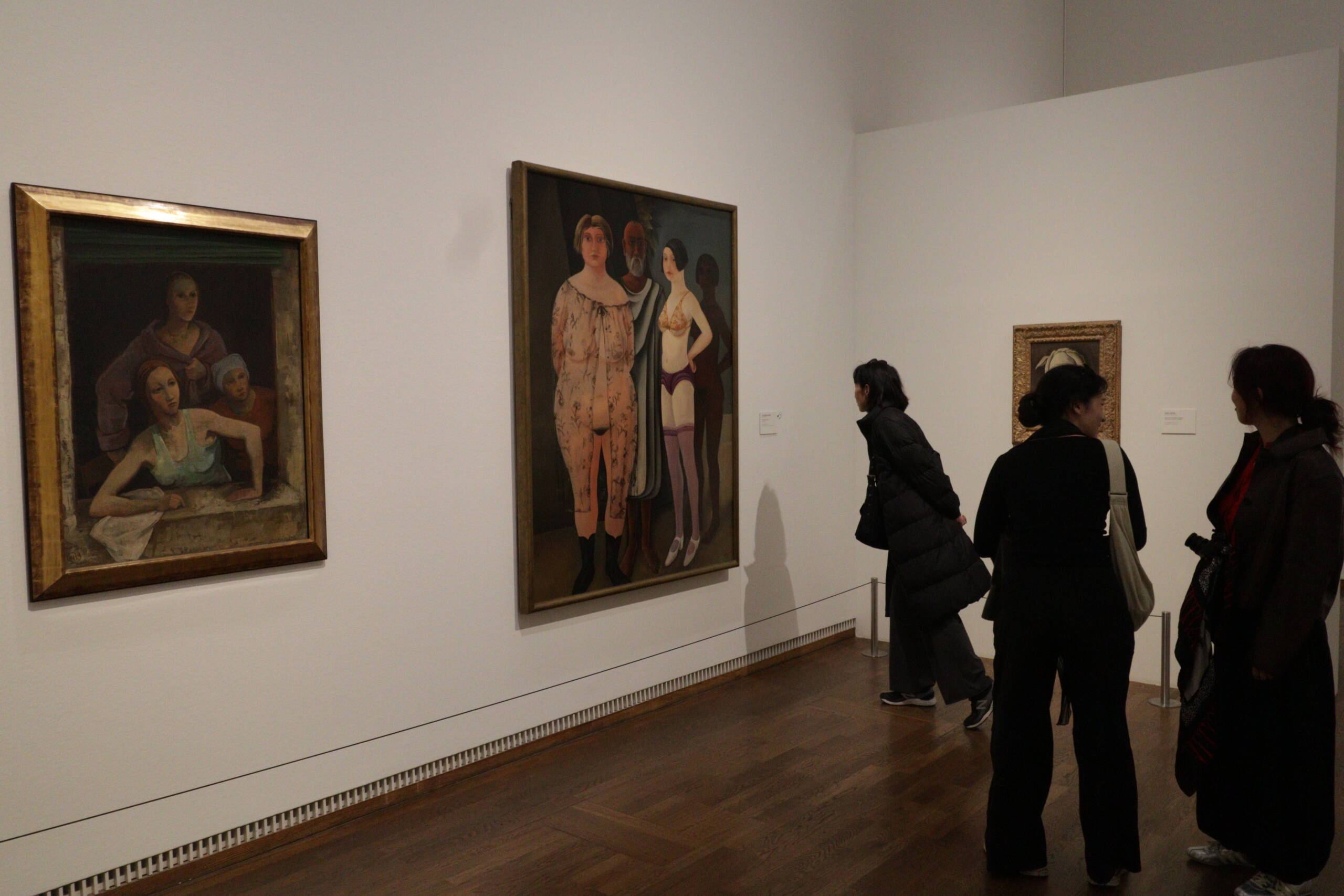
Rudolf Wacker’s Psychological Realism, Leopold Museum, Vienna

To the left of this centerpiece hangs “Am Fenster” (At the Window, 1929), a smaller painting yet equally introspective. Three figures—perhaps a mother and children—stand near a window, their expressions muted and distant. The composition balances domestic intimacy with quiet melancholy, a recurring motif in Wacker’s work. Here, the light entering from outside becomes symbolic: the world beyond the glass is unreachable, and the stillness inside becomes a mirror for postwar Austrian life, suspended between reflection and resignation.

The small framed portrait on the right belongs to Anton Faistauer, most likely “Weiblicher Kopf” (Female Head, 1919). Faistauer’s delicate brushwork and softer chromatic transitions contrast with Wacker’s structural precision. It represents an earlier stage in Austrian modernism—still tinged with Expressionism, but already shifting toward the analytical clarity that defined the 1920s. Together, Wacker and Faistauer illustrate the turning of the artistic tide in Vienna: from the emotional storms of Expressionism to the still, almost surgical realism of the interwar period.

The image itself, showing three women standing quietly before these works, mirrors the very tension Wacker painted. Each visitor takes on the same contemplative posture as his subjects—observing, judging, empathizing. Their silhouettes against the soft gallery light create an uncanny continuity: modern viewers reflected in modern art, each bearing the same subtle unease of existence under observation. The Leopold Museum, by placing these works side by side, transforms a quiet gallery into a dialogue about humanity—how we look at others, how we are seen, and how the act of looking itself becomes art.

Filed Under: News

Reader Interactions

Leave a Reply Cancel reply

Your email address will not be published. Required fields are marked *

Footer

Recent Posts

  • Château de Monbazillac, Dordogne: A difficult childhood. One château too many.
  • Fora Hits $1 Billion Valuation as AI Transforms the Future of Travel Planning
  • The Open Kitchen Experience: Dining Where You Can Watch the Cooking
  • Holland America Line Adds Flåm and Hellesylt to Five 2027 Norway Fjord Cruises
  • La Cité du Vin, Bordeaux: The Building That Looks Like Wine in a Glass
  • EU Border Delays: ETIAS Pre-Travel Authorization Pushed to Late 2026 as EES Chaos Continues
  • Toledo’s Old Town: A Mudéjar Watchtower Hiding an Antiques Shop
  • Piazza del Duomo, Catania: Where a Black Lava Elephant Guards Sicily’s Baroque Heart
  • Château de Fougères: Inside Europe’s Largest Medieval Fortress
  • Château de Vitré: The Medieval Fortress Guarding Brittany’s Eastern Gate

Media Partners

  • Virtual Travel Guide
  • Ancient Rome
Bilbao’s Quiet Renaissance: From Industrial Port to Design Destination
Lisbon’s Seven Hills: A Walking Guide That Tells You the Truth
New Orleans: An American City That Plays by Different Rules
Ha Long Bay Without the Cruise Brochure
Istanbul at the Threshold: A City That Has Always Been Two Things at Once
Iceland’s Ring Road: What the Drive Teaches You That No Photograph Can
Marrakech’s Medina: How to Read a City That Was Not Designed for You
Torres del Paine: What You Are Actually Getting Into
Kyoto in Autumn: What the City Looks Like When the Maples Turn
Disneyland Paris Rewrites Its Script With World of Frozen and Disney Adventure World
Water Across the Empire: Roman Aqueducts and the Hydraulic Logic of Conquest
The Oath of the Horatii: David's Roman Republic in Paint
Jean-Léon Gérôme: The Victorian Gaze on Rome
Ostia: The Port That Fed Rome
Roman Naval Warfare: The Sea They Called Their Own
The Roman Grain Ship: How Rome Fed Itself Across the Sea
Trajan's Column: Rome's Greatest Comic Strip
Caesarea Maritima: A Roman City Built from Nothing
Damnatio Memoriae: Rome's War on Memory
Faustina the Younger: The Woman Behind the Philosopher Emperor

Media Partners

The Immersive Experience in the Museum World
Japan, China, and Taiwan: A New Triangle of Risk — and a Window of Opportunity for Japan
Ghost Kitchens as Infrastructure: The Shift from Restaurants to Intelligent Food Networks
The Zoom Divide Nobody Saw Coming
The Perfect Budget Content-Creator Kit
Reimagining Prague’s Tourism Future Through Immersive Media and VR Museums
Israel’s Urban Paradox: Tel Aviv Moves, the Rest Stand Still
American Express Global Business Travel (GBTG): Understanding the Business and the Investment Case
Why the Canon R8 Paired With the New RF 45mm f/1.2 Lens Quietly Becomes the Content Creator’s Sweet-Spot
The Future of Travel: A $15.5 Trillion Industry

Copyright © 2026 Travel Marketing

Media Partners: Timey · Publishing House · Ancient Rome · Photography · Calendarial · Transportational