There is something hypnotic about the Charles Bridge when the clouds hang low and the light turns that muted silver-grey that only autumn in Prague can produce. The photograph captures this exact in-between moment — when the day hasn’t quite decided whether it wants to drizzle or hold still. The ancient stone arches stretch across the Vltava River like the spine of the city itself, each arch a small triumph of medieval engineering, each block stained with centuries of footsteps, wars, and prayers. You can almost hear the shuffle of pilgrims and merchants who once crossed here under the watchful eyes of saints carved in weather-darkened sandstone.
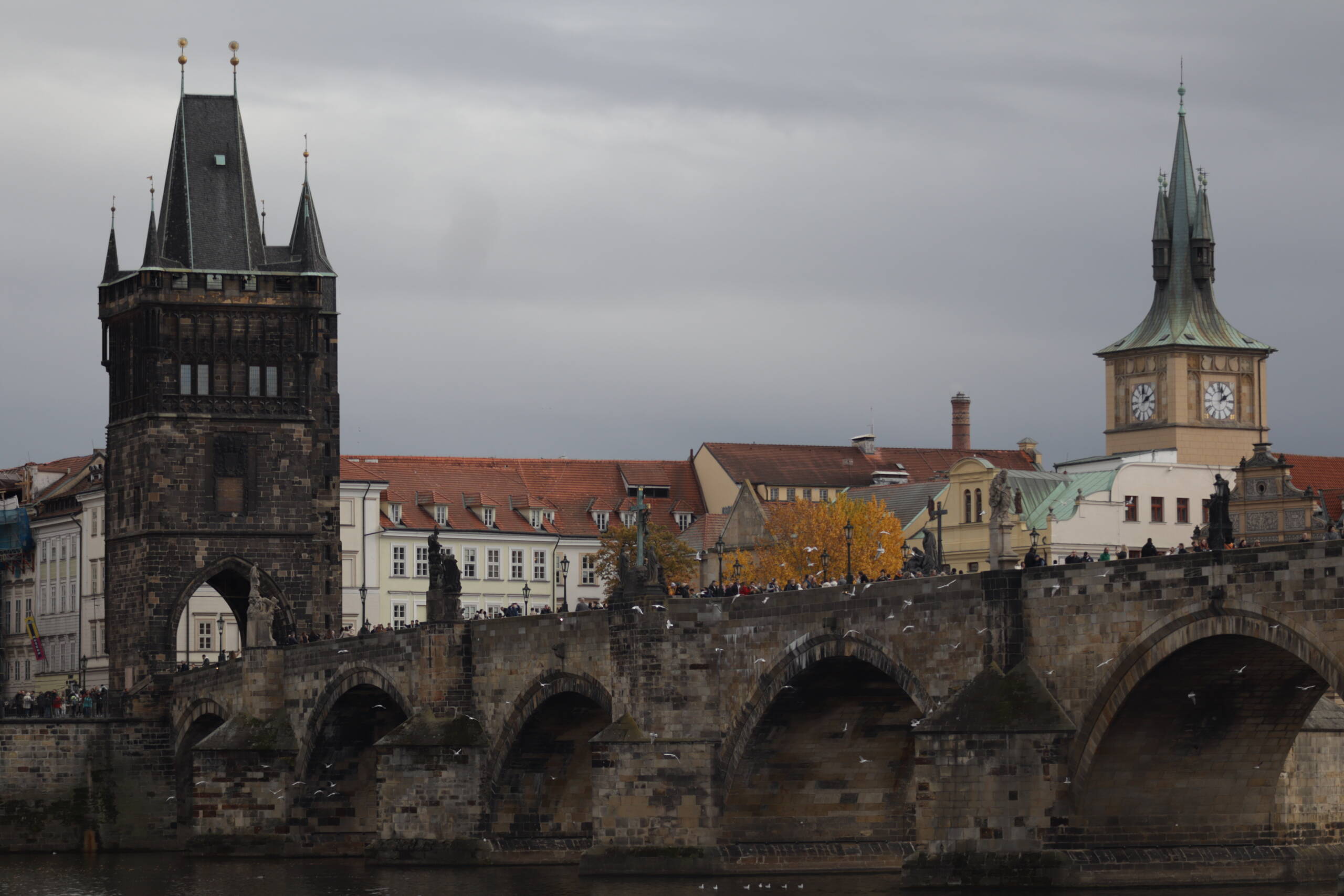
On the left rises the Old Town Bridge Tower, a magnificent piece of Gothic architecture that once served both as a defensive gate and a ceremonial archway. Commissioned by Emperor Charles IV in the 14th century and designed by Peter Parler, the same architect behind St. Vitus Cathedral, it still radiates the authority of the Holy Roman Empire. The tower’s blackened stones, the result of age and centuries of coal smoke, seem to absorb light rather than reflect it. It stands as a kind of visual counterpoint to the paler facades behind it — a reminder that Prague’s beauty comes as much from its shadows as from its baroque elegance.
Just beyond, the clock tower of St. Francis of Assisi Church and the Clementinum complex peek above the rooftops, while the copper-green spire with its clock faces (the Old Town Water Tower) marks time over the river. The rooftops in the background — terracotta and cream — recall the city’s quieter centuries, when it was a center of trade and scholarship. They soften the Gothic severity of the bridge, suggesting that life goes on in ordinary rhythms even amid history’s grandeur. The faint golden glow of a single autumn tree — just visible near the bridge’s midpoint — punctuates the otherwise subdued palette, like a small rebellion of color in a city that knows the art of melancholy.
What makes this scene so irresistibly iconic is not just the bridge itself but the layering of epochs. The Charles Bridge has survived everything from floods to occupations; it has been a stage for royal processions, a canvas for baroque statuary, and, more recently, a backdrop for street artists and lovers carving initials into the railing. Each figure on the bridge — St. John of Nepomuk, St. Luthgard, St. Vitus — tells a piece of Bohemia’s story, and together they form an open-air gallery of faith, power, and artistic ambition. Even the flocks of white birds circling the arches seem to echo the restless movement of the centuries — the eternal flow of memory that Prague carries with such nonchalant grace.
There’s also something cinematic about this light. The low clouds filter out harshness, leaving a gentle luminosity that feels like an old film still, the kind you’d find in a 1950s European travelogue. The reflections of the arches ripple faintly in the Vltava below, blurring the line between the material and the poetic. It’s easy to imagine Kafka, whose Prague was not far from here, pausing on this bridge in thought, seeing the world reflected back in the same uneasy waters.
The photograph doesn’t shout; it murmurs. It holds still long enough for history to breathe. The details — the crows perched on the parapet, the faint figures of tourists absorbed in the rhythm of the walk, the flicker of light on damp stone — are all part of the city’s living texture. Prague’s charm lies in this delicate balance between grandeur and human scale, between the monumental and the intimate. And in this frame, that balance is perfect — the Charles Bridge as both symbol and scene, ancient yet perpetually awake to the footsteps of the present.
Leave a Reply