Prague Essentials: Museums, the Jewish Quarter, and What’s Open on SundaysPrague can feel like a living museum in itself, with every street corner carrying centuries of history, but deciding what to visit — and when — makes a big difference in how the city unfolds for you. The must-see institutions, the layered Jewish Quarter, and even something as simple as knowing when supermarkets or galleries open all come together to shape your experience.
If you start with the National Museum (Národní muzeum), you’ll get the broad sweep: natural history, cultural treasures, and a neo-Renaissance palace of a building at the top of Wenceslas Square. It’s a good anchor, but for art lovers, the real crown jewel is the National Gallery Prague (NGP). Unlike many cities, this isn’t one monolithic building — it’s a network of palaces and convents. The Trade Fair Palace in Holešovice is where you’ll find modern and contemporary collections, including Czech modernists and international giants like Picasso and Klimt. For medieval art, the Convent of St. Agnes of Bohemia is a quiet, atmospheric favorite. Sternberg Palace brings old masters and European classics, while the Schwarzenberg Palace leans into Baroque works. Scattered across these sites are treasures like Dürer’s Feast of Rose Garlands, Mucha’s Slav Epic, and hundreds of illuminated manuscripts and graphic works. With limited time, it’s best to choose one “old” site (St. Agnes or Sternberg) and one “modern” site (Trade Fair Palace), so you don’t drown in beauty overload.
Then there’s the Jewish Museum in Prague, which is really a constellation of sites inside Josefov, the Jewish Quarter. Each stop tells part of the story. The Maisel Synagogue covers medieval history, the Pinkas Synagogue stands as a Holocaust memorial with nearly 80,000 names inscribed on its walls, and the Old Jewish Cemetery packs centuries of memory into one haunting plot of land with leaning tombstones stacked layer upon layer. The Klausen Synagogue explains traditions and rituals, while the Ceremonial Hall explores burial customs. Finally, the Spanish Synagogue dazzles with its Moorish Revival interior, a burst of gilded color and geometry. Taken together, they form one of Europe’s most powerful museum experiences — at once a cultural lesson and an emotional journey. And right nearby sits the Old-New Synagogue, Europe’s oldest working synagogue, still active, tied to the legend of the Golem of Prague.
The Jewish Quarter (Josefov) itself is worth more than a checklist of museums. It’s a district where the ghetto’s remnants meet grand 19th-century Art Nouveau buildings and today’s luxury boutiques. Pařížská Street is lined with designer names like Cartier and Prada, while tucked away side streets hold Judaica shops, cafés, and quiet corners where Kafka once walked. The juxtaposition of a high-end shopping street running alongside a centuries-old cemetery is pure Josefov — layered, paradoxical, unforgettable.
And what about Sunday in Prague? The good news is: the city doesn’t close down. Museums and galleries generally stick to their usual 10:00 to 18:00 rhythm (with the Jewish Museum open on Sundays but closed Saturdays). Shops and malls stay lively, especially in the center. Pařížská’s boutiques, the Palladium mall, and smaller stores all keep their doors open. Supermarkets are reliable too: most big chains run from 8:00 in the morning until 22:00 at night, sometimes even longer, while little corner shops and minimarkets can be 24-hour operations. The only times you’ll run into closures are on certain national holidays, when a law forces large stores to close, but even then the smaller grocers usually keep going.
So, whether it’s a half-day museum circuit, a slow walk through Josefov’s synagogues and cobbled streets, or simply grabbing snacks from Billa after an evening stroll, Prague on a Sunday doesn’t stop for you — it waits, quietly, for you to step in.
Franz Kafka Head, Prague
There’s something mesmerizing about standing in front of David Černý’s kinetic sculpture of Franz Kafka in Prague. At night, under the city’s lights, the massive mirrored head feels almost otherworldly. Made of forty-two rotating layers of stainless steel, the sculpture is in constant motion, reshaping and rearranging itself like fragments of thought. It’s a strange dance of reflection—one moment the face comes into sharp focus, and in the next it dissolves into shifting lines of glassy surfaces, scattering the reflections of street lamps, buildings, and the occasional passerby.
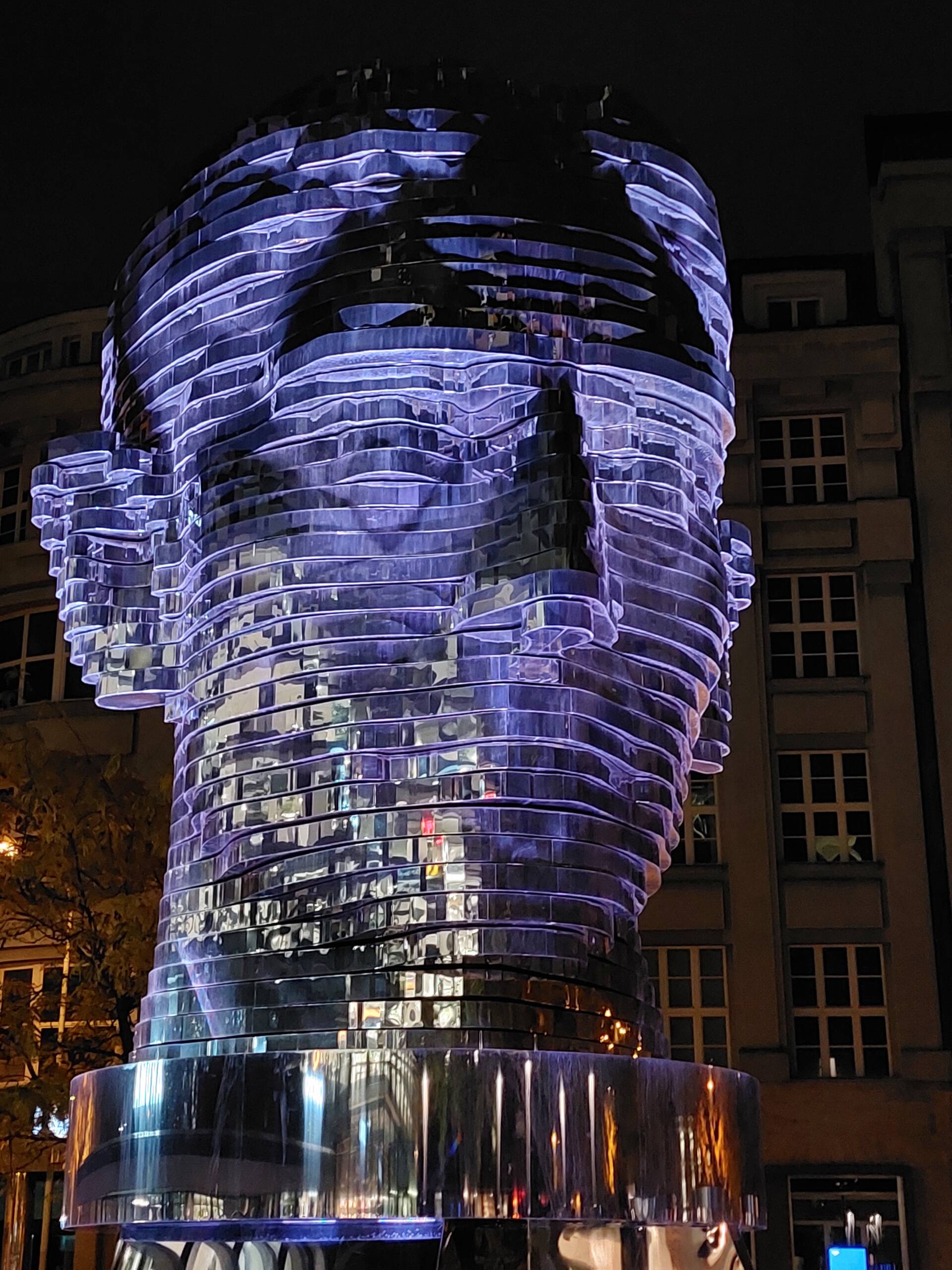
What makes it even more fitting is that it’s Kafka himself—the writer of transformations, paradoxes, and impossible bureaucracies—immortalized in a form that never stays still. You can almost imagine him smirking at the irony: his likeness, endlessly fragmented and reconstructed in the heart of his own city. Standing there, you feel like you’re not just watching a piece of public art but stepping into one of his stories, where reality is never entirely what it seems.
It’s both eerie and beautiful, a mirror not only of Prague but of the strangeness of human identity itself. And if you linger long enough, you realize it’s impossible to see it the same way twice—an artwork that, like Kafka’s writing, refuses to let you settle.
Leave a Reply