There’s a moment in travel that almost always goes unnoticed: the instant when people stop walking and begin gathering — as if pulled by gravity rather than curiosity. In Porto, that moment happens again and again in the square in front of the Sé Cathedral, where a strange, twisted stone column rises like a fossilized corkscrew against the soft Portuguese sky. Before anyone looks it up, before anyone knows its name, they simply sense that this is where people stop — and so they do.
The photo makes this instinct visible. A large group crowds the staircase surrounding the column, the sunlight catching glasses, jackets, hair, expressions — a whole spectrum of travel moods. Some are smiling, some waiting, some half-posing, some visibly unsure if the photo is being taken at that exact second or in five more. The steps beneath them are uneven, smooth from centuries of feet. Behind them stands the solid Romanesque wall of the cathedral, fortress-like with narrow windows and stone crenellations, as if the building still remembers when cities weren’t visited — they were defended. Around it, ochre rooftops add warmth, and just beyond the frame, Porto tumbles toward the Douro River in a glorious mismatch of levels, alleyways, archways, and tiled facades.
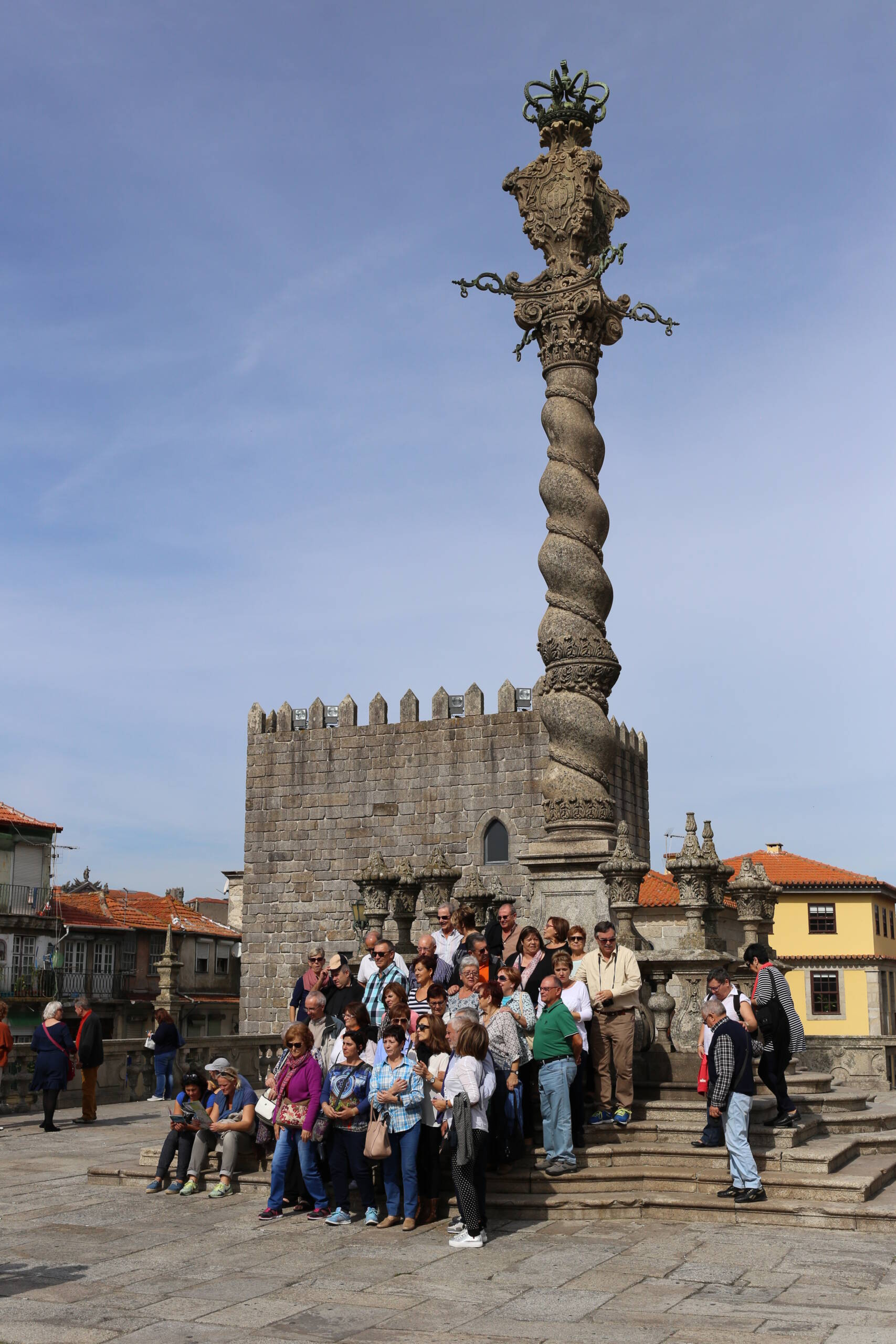
That twisted column — the pelourinho — isn’t just decoration. Historically, it was a symbol of authority and punishment. People were once tied here as the city watched, judged, reacted. Now, centuries later, the spectacle remains — but gently reversed. The public gathers not to witness others, but to document themselves.
And this is where tourism marketing fails — and where it could easily win.
Destinations still market themselves with empty-perfect imagery: the cathedral without people, the staircase without footsteps, the square without noise. They edit away the very thing that proves relevance: other humans.
Real travel isn’t clean, silent, and perfectly framed. It’s layered. It’s crowded. It’s slightly chaotic. It’s someone fixing their sunglasses while someone else checks the map, while another person shrugs and follows the group because the group must know where they’re going.
It’s the woman in the front row of this photo holding her jacket with one hand and her phone in the other. It’s the person on the left sitting slightly apart, scrolling while waiting. It’s the man in a green shirt who looks like he’s in charge, even if he isn’t. These tiny realities say more about tourism than any press release ever could.
And yet Porto succeeded anyway — without needing to pretend.
Two decades ago, Porto wasn’t a major tourism magnet. Lisbon took the global shine, and Porto remained stubbornly authentic: quieter, more industrial, more granite, more old-world than marketing-friendly. Then budget airlines arrived, Instagram arrived, remote work arrived, and suddenly the world realized Porto had everything travelers secretly want:
A cityscape that photographs effortlessly, even crooked.
History that feels older than context.
Wine with mythology built in.
Streets that look even better when imperfect.
Prices that feel like winning.
And something intangible — a sense of soul.
People began arriving not because advertising convinced them, but because someone like them had already been there — and shared it.
That is the new structure of tourism influence: not messaging → traveler, but traveler → traveler.
The algorithm doesn’t reward budgets anymore. It rewards proof. Presence. Humanity.
Travel photos that feel like documentary fragments have more power than any cinematic drone shot. A group photo like this — slightly messy, uncurated, unfiltered — tells the truth: People come here. People care. This place matters.
This is what most tourism marketers don’t understand. You can’t brand authenticity; you can only show evidence of it. Travelers aren’t searching for destinations — they’re searching for feelings. Recognition. Connection. The quiet reassurance that they won’t be the only ones there, wandering cluelessly with a camera and a half-remembered historical fact.
Maybe this is the new tourism narrative: not perfection, but participation.
Not the empty square — but the one full of strangers sharing space and time without speaking the same language.
Not the ideal shot — but the real one.
The future of travel marketing belongs to those who embrace honesty: the crowds, the pauses, the puzzled looks, the ordinary magic of humans gathering around something they don’t fully understand — but instinctively feel is worth stopping for.
Porto already gets it.
Now tourism marketing needs to catch up.