If Vienna is often imagined through the lens of imperial palaces and baroque splendor, Otto Wagner’s work along the Linke Wienzeile rewrites that script. Here, at the threshold of the Naschmarkt, Wagner built not just one but three adjacent apartment blocks between 1898 and 1899—together forming a trilogy that speaks of a new urban language. Each one is distinct, and yet together they tell the story of Vienna standing on the edge of modernism, shedding the heavy costumes of the past while still refusing to strip away beauty.
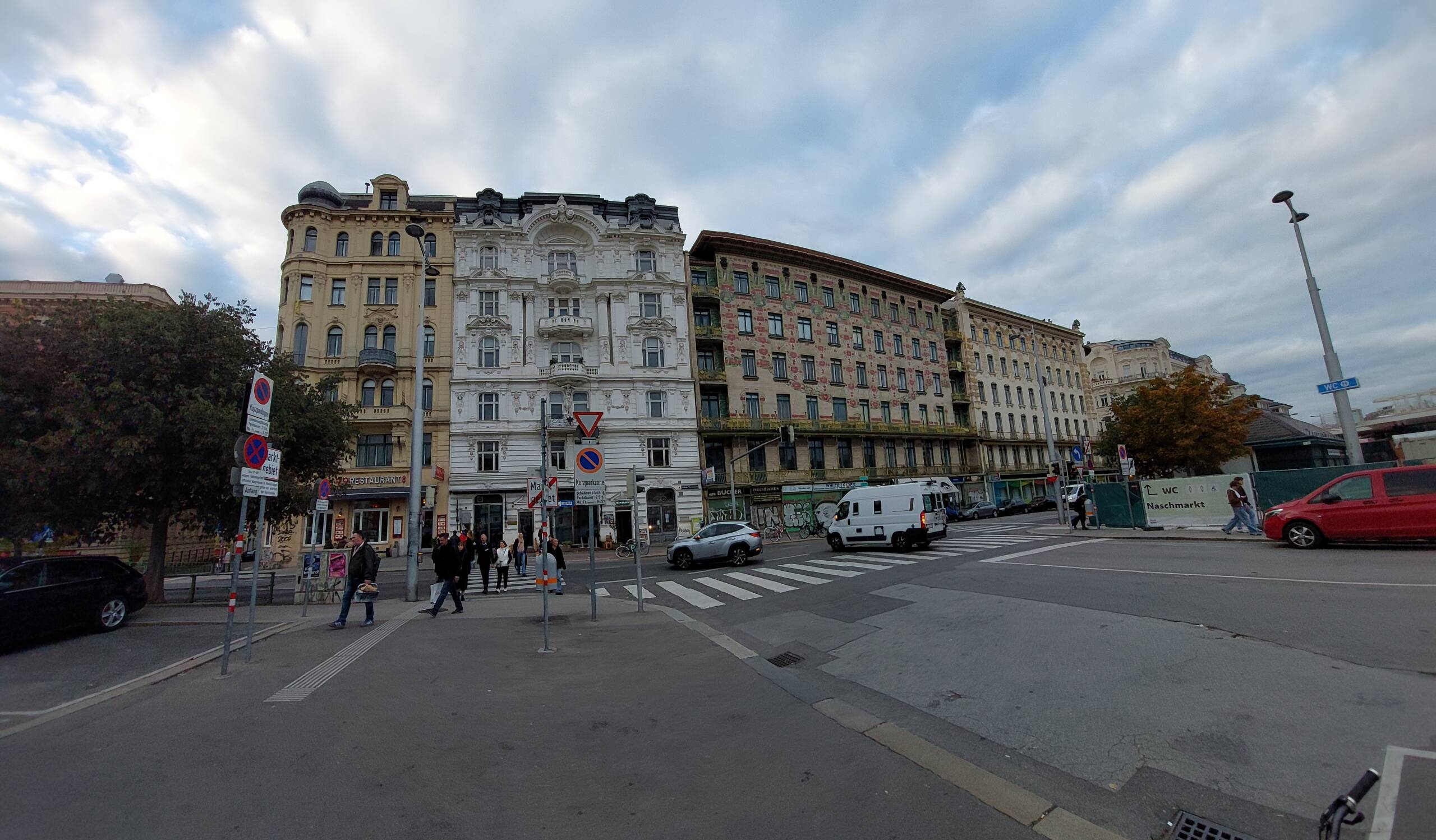
The most famous of the three, the Majolica House at Linke Wienzeile 40, wears its façade like a second skin of blossoms. The majolica tiles—designed by Alois Ludwig—carry their floral pattern with a stubborn permanence, the pinks and greens resisting the dullness of time. The choice of material was revolutionary in its practicality: washable, durable, hygienic, and yet Wagner transformed it into an enduring mural. Here, functionality did not erase ornament; instead, it carried it forward into the modern world. The building feels alive, a vertical garden of clay and glaze, blooming endlessly above the heads of market-goers.
Next door, at Linke Wienzeile 38, stands the so-called Medallion House. Where its sister façade is wrapped in flowers, this one offers restraint—yet not without subtle lyricism. The surface is marked by rows of golden medallions designed by the painter Koloman Moser, set against a light plaster background. They shimmer gently, catching daylight like coins scattered across a wall. This building feels less lush than its neighbor, but more contemplative, balancing between geometric order and decorative grace. It is Wagner testing the limits of how much surface can carry before tipping into excess. The medallions are both ornament and punctuation, breathing rhythm into what could otherwise be a flat expanse of wall.
The third building, often overlooked, is at Köstlergasse 3 on the corner. This one is Wagner in a quieter mood: more restrained, more focused on proportion and modern form. While it does not announce itself with roses or gold, it remains radical for its time—flat surfaces, rational lines, and large windows that rejected the fussy historicism of earlier decades. It completes the trilogy not by competing for attention, but by grounding it, reminding us that Wagner’s modernism was not only about decoration, but about a total rethinking of how an apartment house could look and function.
What makes these three buildings so compelling is how they exist together. They line the edge of the Naschmarkt, facing the churn of daily life: vegetable stalls, butchers, tourists, graffiti, and the constant movement of traffic. Yet above it all, their façades carry a permanent vision. They are not monuments in the traditional sense, but living architecture—places where people still live, shop, and walk past without always noticing. In that way, they embody Wagner’s philosophy: the modern city should not merely house its citizens, but uplift them, weaving beauty into the routines of ordinary life.
When you stand at that corner today, the scene is layered. At street level, a white van idles at the lights, graffiti scrawls across shutters, and a sign points the way to a public toilet. It could be any city, any moment. But lift your gaze, and suddenly Vienna reveals its secret garden of tile and gold, its quiet manifesto of modernism. Wagner’s trilogy is not about the cessation of ornament, as some later modernists demanded, but about its transformation—ornament that endures, that resists weather and time, that insists even the most ordinary street can bloom.
Leave a Reply